A private condo foyer may feel like part of the residence without legally belonging to it. For Miami buyers and owners, the right to furnish, enclose or alter that space depends on recorded boundaries, association rules and the scope of the proposed work.
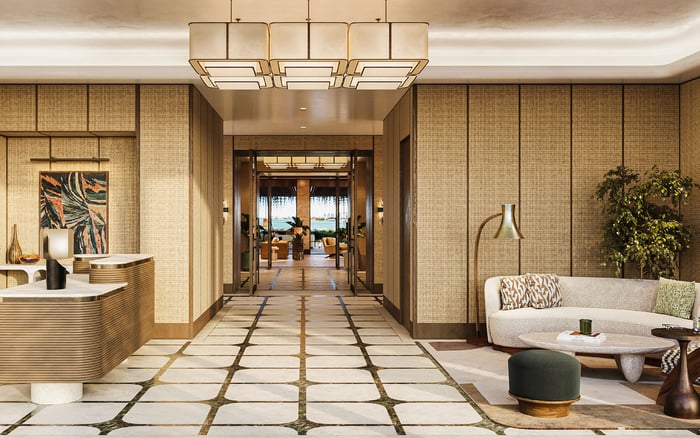
A quiet foyer offers an appealing transition between the building and the residence: a place for art, a sculptural console or a more intimate arrival. Yet the legal question precedes the design question. In a Miami condominium, “private” does not necessarily mean the owner owns the space or may change it freely.
Whether an owner can enclose, furnish or alter a foyer depends on two things: its legal classification and the proposed work. A movable console, built-in cabinetry and a new enclosure are not interchangeable requests. Each warrants its own review before the owner purchases furniture or commissions drawings.
For buyers considering The Residences at 1428 Brickell, or another Brickell address, the question is not simply whether an arrival area feels exclusive. It is what the recorded documents allow for the residence under consideration.
Begin with the recorded declaration and condominium plat. These establish unit boundaries and identify common elements, limited common elements and applicable use rights. The apparent threshold of an apartment is no substitute for that legal description.
Florida’s common-element framework includes condominium property outside the units. A foyer may therefore remain common property even when it sits immediately outside one residence. It may also be designated a limited common element, reserved for the exclusive use of one unit or specified units without becoming part of the unit itself.
That distinction matters: exclusive use does not confer unrestricted authority to alter the space. Nor does responsibility for cleaning or maintenance establish ownership. The association generally maintains common elements, but the declaration may assign maintenance of limited common elements to the owners entitled to use them.
Ask for a written explanation of the classification, supported by the recorded documents. The objective is to distinguish what belongs to the unit, what the owner may use and what remains subject to shared control.
A freestanding console may seem less consequential than construction, but movable furniture is not automatically permitted in an exclusive-use foyer. Before placing rugs, artwork, seating or other objects, review the declaration and association rules for that space.
In Miami Beach, a buyer considering The Perigon Miami Beach should apply the same document-first discipline to any proposed foyer arrangement. This is a due-diligence principle, not a statement about that project’s layouts or policies.
Present the actual proposal rather than asking whether “decorating” is allowed. Identify whether an object is freestanding or attached, and where it would sit. A general conversation about furnishings should not be treated as permission for anchored millwork later.
The practical distinction is between using a space within its rules and physically changing it. Both require attention, but they need not follow the same approval path.
Built-in cabinetry, partitions, gates and other permanent installations raise a different set of questions. Their treatment depends on the declaration’s alteration provisions and, where common elements are involved, the applicable common-element approval requirements.
Legal ownership of the surrounding interior does not settle every issue. Structural-support easements can fall within the common-element framework, while installations serving multiple units or common elements remain common elements even when located within or beside a foyer.
Owners also may not do anything within their units or the common elements that adversely affects the safety or soundness of common elements or association property. An attractive finish scheme does not override those protections.
For a Sunny Isles Beach search that includes Jade Signature Sunny Isles Beach, the same distinction should guide any future design brief: confirm the boundaries and shared systems before treating an arrival area as a blank canvas. Project-specific permissions must be established separately.
Enclosing a common-element foyer can constitute a material alteration or substantial addition. Subject to statutory exceptions, those changes generally must follow the approval procedure specified in the declaration.
If the declaration does not specify an approval procedure, the statutory fallback generally requires approval from 75% of the total voting interests before work begins. That is not simply 75% of those attending a meeting, nor is it equivalent to an architectural committee’s acceptance of a design.
Board permission alone may therefore be insufficient. Where an owner vote is required, a favorable board response does not replace it. Before authorizing work, have condominium counsel identify the applicable approval path and confirm that the written record satisfies it.
Enclosure and ownership are separate questions. Permission to install a partition does not, by itself, establish that the enclosed area has become part of the unit.
If a proposal would materially change the unit’s size, configuration or appurtenances through a declaration amendment, a separate legal analysis applies. Unless the declaration as originally recorded provides otherwise, such amendments generally require the affected owner and lienholders to join in execution, together with approval from all other unit owners.
This is distinct from the material-alteration analysis. An enclosure should not be assumed to transfer common space into private ownership merely because it makes the area function like another room.
In Coconut Grove, buyers considering Park Grove Coconut Grove should likewise distinguish physical presentation from recorded boundaries when assessing a residence. Neither a furnished appearance nor an existing enclosure answers the ownership question on its own.
For an existing enclosure or permanent improvement, request the recorded boundary documents and written evidence of approval. Check that the approval covers the work actually present, not simply an earlier or less extensive proposal. Confirm maintenance obligations as well.
Unauthorized work can create enforcement exposure, including actions seeking damages or injunctive relief. Fines depend on statutory authorization and procedures. An existing installation is therefore something to investigate, not proof that the work was permissible.
The disciplined sequence is simple: classify the space, define the proposal, establish the required approvals and document the result. Have counsel and the relevant professionals separately confirm applicable permitting and safety requirements; no universal clearance dimension or Miami permit rule can be assumed here. This is a decision framework, not unit-specific legal advice.
For a considered approach to your next South Florida residence, explore MILLION.
If branded residences are on your mind — as a home or as an allocation — we would be glad to share what we are seeing, privately.
Begin a quiet conversationNo. Its legal status depends on the recorded unit boundaries and declaration, not whether it serves only one residence.
It is common property reserved by the declaration for the exclusive use of one unit or specified units. Exclusive use does not make it part of the unit.
Possibly, but movable furniture is not automatically permitted. Review the declaration and association rules for the particular space before placing it.
No. Fixed installations require review under the declaration’s alteration provisions and any applicable common-element approval requirements.
Yes, enclosing a common-element foyer can constitute a material alteration or substantial addition. The applicable approval procedure must generally be completed before work begins, subject to statutory exceptions.
The statutory fallback generally requires approval from 75% of total voting interests when the declaration does not specify an approval procedure for material alterations or substantial additions.
Not necessarily. If the declaration or applicable statutory fallback requires an owner vote, board or architectural approval alone should not be treated as sufficient.
Not automatically. A boundary-changing amendment involves a separate legal analysis and generally carries additional consent requirements unless the declaration as originally recorded provides otherwise.
The association generally maintains common elements, but the declaration may assign maintenance of limited common elements to the owners entitled to use them.
Request the recorded declaration and plat, along with written evidence approving the existing enclosure. Have counsel check whether the approvals match the work and whether any boundary amendment was necessary.