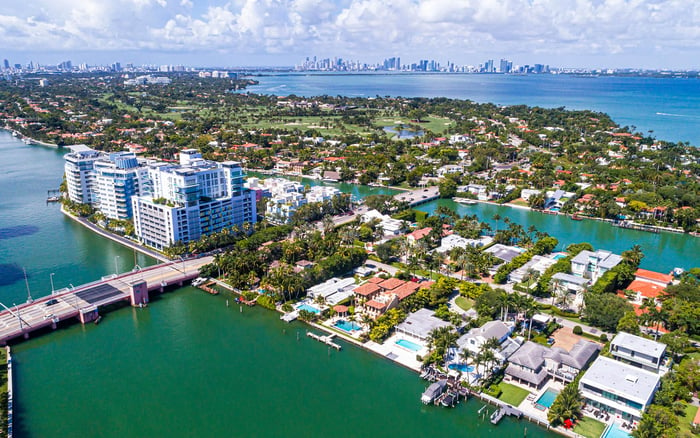
For Los Angeles buyers, a Miami Beach residence can be evaluated through a disciplined lens that joins flight logistics, domicile counsel, privacy, and property fit. The strongest shortlist begins with use patterns rather than assumptions about tax outcomes or prestige.

For a Los Angeles buyer considering Miami Beach, the most productive question is not whether one city replaces the other, but how a South Florida residence would function within an established pattern of business, family, travel, and leisure. Private aviation may shape that pattern, while domicile planning introduces a separate legal and financial dimension. Neither should serve as shorthand for a purchase decision.
A disciplined search begins by defining intended use. Will the property serve as a second home, a future primary residence, or a flexible base for recurring stays? How important are privacy, immediate service, guest accommodation, and low-friction arrivals? These questions turn a broad lifestyle aspiration into a residential brief that advisers can test.
Private aviation becomes most useful to the property search when considered as itinerary design. Buyers should map where trips begin, who travels, how frequently plans change, and what ground transfers feel acceptable after landing. The relevant comparison is door to door, not simply time in the air.
That exercise should account for luggage, pets, security preferences, household staff, and the possibility of separate family schedules. It should also consider how the residence will operate before arrival and after departure. A home that is effortless to open, secure, maintain, and provision may offer more practical value than one selected primarily for a dramatic first impression.
Aviation advisers can evaluate aircraft suitability, operating constraints, and contingency planning. Real estate advisers can then translate those findings into a more precise geographic and building shortlist without making unsupported promises about travel time.
Domicile is not merely a mailing address or the act of purchasing property. It is a legal concept that warrants review with qualified tax and legal counsel, particularly when a buyer retains homes, business interests, and personal ties in more than one state.
The prudent sequence is to establish the buyer's objectives, obtain individualized advice, and create an implementation plan grounded in actual conduct. Ownership structure, time spent in each location, documentation, family arrangements, and business activity may all warrant professional review. The residence should support the plan; it should not be expected to create the plan by itself.
This separation also protects the quality of the real estate decision. A buyer can assess architecture, privacy, service, and long-term suitability on their own merits, while counsel addresses domicile, tax exposure, estate planning, and recordkeeping. Coordination matters, but each adviser should remain within the appropriate discipline.
Miami Beach is not a single residential proposition. A buyer should compare setting, building scale, service model, arrival sequence, exposure, and the relationship between private and shared spaces. Waterfront and oceanfront preferences should be defined carefully: a view, a direct relationship to the water, and day-to-day access are distinct considerations.
For a South Beach-oriented comparison, Apogee South Beach and Shore Club Private Collections Miami Beach can enter the conversation as distinct candidates for investigation. The objective is not to assume equivalence, but to examine how each aligns with the buyer's desired rhythm, privacy threshold, and service expectations.
Farther along the beach, The Perigon Miami Beach, The Ritz-Carlton Residences® Miami Beach, and 57 Ocean Miami Beach broaden the field. Each should be assessed through current availability, governing documents, residence configuration, fees, use policies, completion status where relevant, and the buyer's own inspection.
Ultra-premium buyers often benefit from treating the residence as an operating asset, even when investment return is not the primary motivation. The operating question is straightforward: What must happen every week for this home to feel effortless?
Review staffing permissions, access controls, package handling, vehicle procedures, guest protocols, maintenance responsibilities, and emergency planning. If the home will remain vacant for extended periods, determine how inspections, climate management, storm preparation, and post-event checks are handled. These are diligence questions, not assumptions about any named property.
Interiors merit the same practical scrutiny. Storage, owner closets, work areas, acoustic separation, kitchen function, and circulation can matter more over repeated stays than a singular decorative gesture. The best residence is the one that remains composed when family, guests, and professional obligations overlap.
The most effective process is coordinated but buyer-led. Begin with a written use case, then align legal, tax, aviation, insurance, property, and estate advisers around it. Tour only after the essential criteria are clear, and revisit the brief when a compelling residence creates an emotional exception.
As with the strongest buyer's guides, the shortlist should record trade-offs rather than conceal them. Compare privacy, location, service, carrying obligations, use restrictions, and exit considerations on a consistent basis. Before signing, confirm all material details through current documents and appropriate professional review.
Does buying a Miami Beach residence establish domicile? A property purchase alone should not be assumed to establish domicile. Buyers should obtain individualized legal and tax advice.
Should private aviation access determine the neighborhood choice? It can inform the search, but door-to-door logistics, privacy, and daily use should be considered together.
Is Miami Beach best viewed as a replacement for Los Angeles? Not necessarily. Buyers can evaluate it as a complementary base before deciding whether their broader residential pattern should change.
What should an aviation review include? It should address traveler profiles, schedule variability, aircraft needs, ground transfers, security preferences, and contingency plans.
When should domicile counsel become involved? Counsel should be consulted before ownership structure or residency-related decisions are finalized.
How many properties belong on the first shortlist? A focused group is generally easier to compare, provided it represents genuinely different location, service, and privacy propositions.
What documents deserve close review? Buyers should review current governing, financial, insurance, disclosure, use, and transaction documents with qualified advisers.
How should branded service be evaluated? Test the actual service model, costs, responsibilities, and consistency rather than relying on the brand name alone.
What matters for an intermittently occupied home? Security, maintenance, climate management, arrival preparation, emergency protocols, and trusted local oversight deserve attention.
What is the final decision test? The residence should support the buyer's real schedule, household needs, advisory plan, and preferred standard of privacy.
If you'd like a private walkthrough and a curated shortlist, connect with MILLION.
If branded residences are on your mind — as a home or as an allocation — we would be glad to share what we are seeing, privately.
Begin a quiet conversation