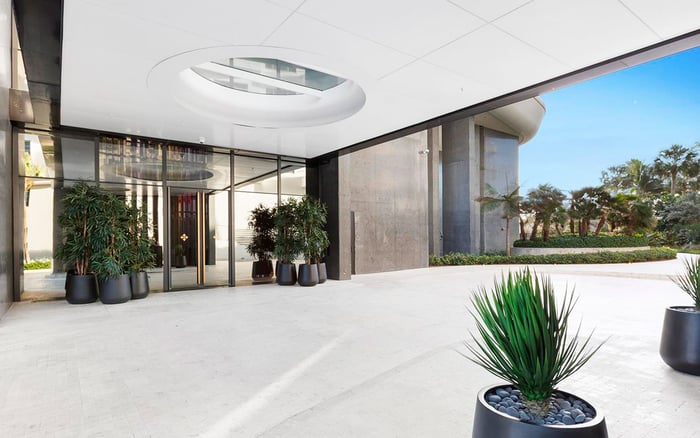
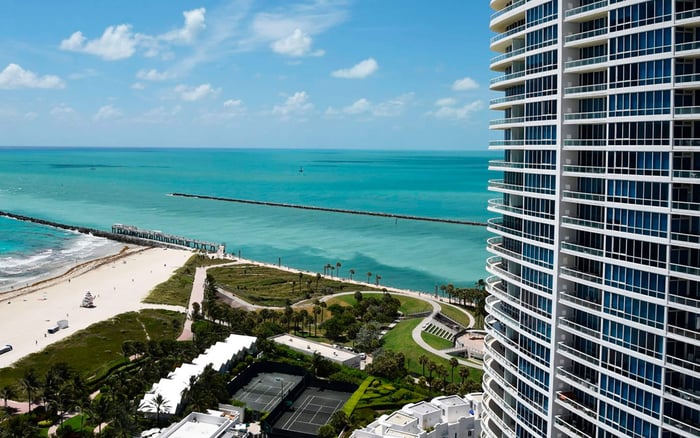
A discreet arrival depends on more than a private elevator. Compare Miami Beach residences through the complete journey from curb, garage, or dock to the front door, then examine service circulation and the costs that sustain it.
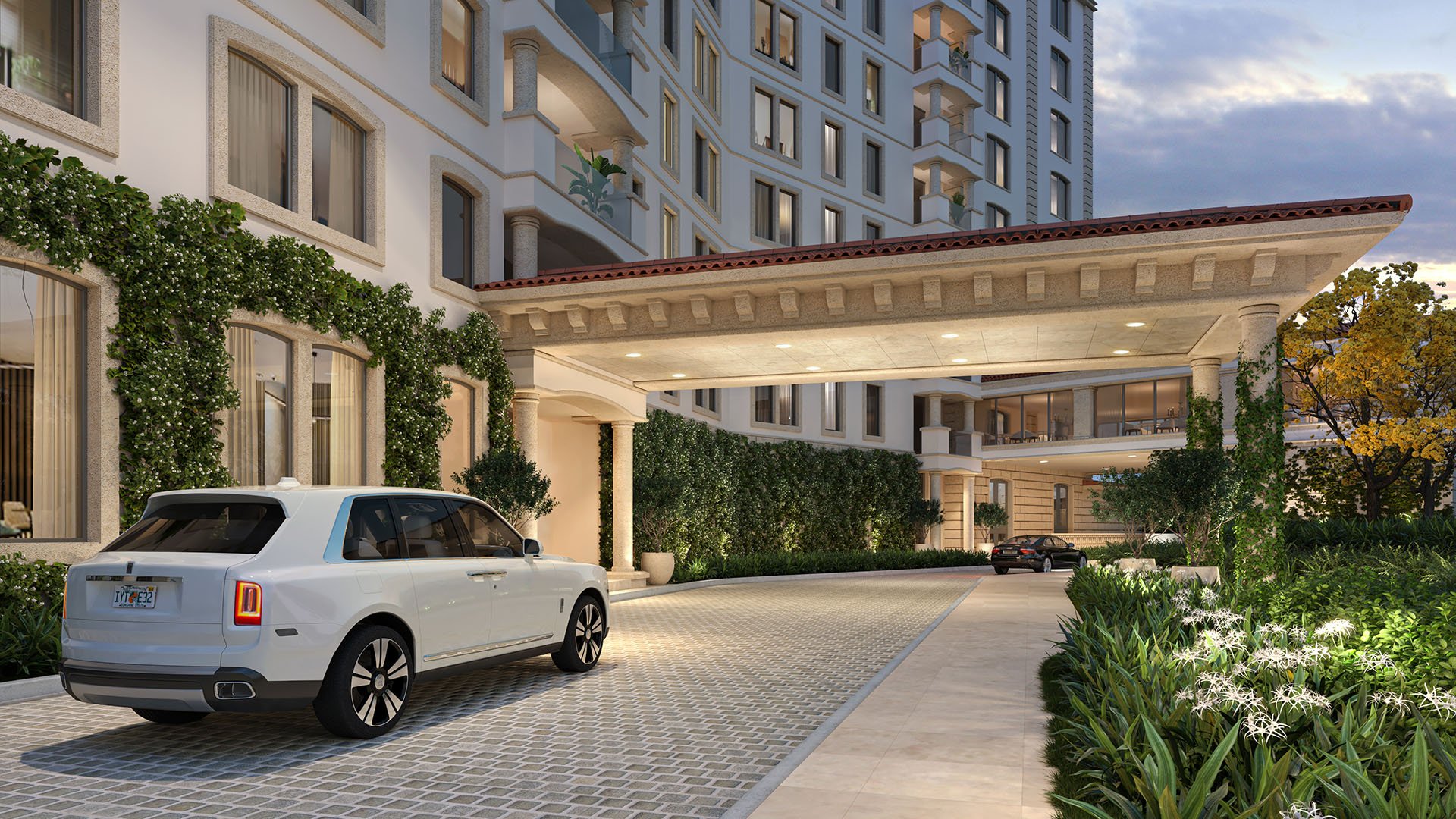
In Miami Beach, the most meaningful arrival luxury is control: choosing when to be seen, how to reach home, and where household activity intersects with neighbors and guests. A private elevator can be valuable, but it answers only part of that brief. Reaching it may still require a shared lobby, a valet handoff, or a passage used by other residents.
Evaluate privacy as a complete route, not a single amenity. Trace the journey from curb, garage, or dock through every threshold to the residence. Then trace the parallel route taken by deliveries, maintenance personnel, and household staff. Where those paths meet deserves as much attention as the residential foyer.
This is a comparison of arrival designs, not a ranking of buildings. The right choice depends on whether a buyer prioritizes a discreet drop-off, independent vehicle access, waterfront arrival, or separation from service activity.
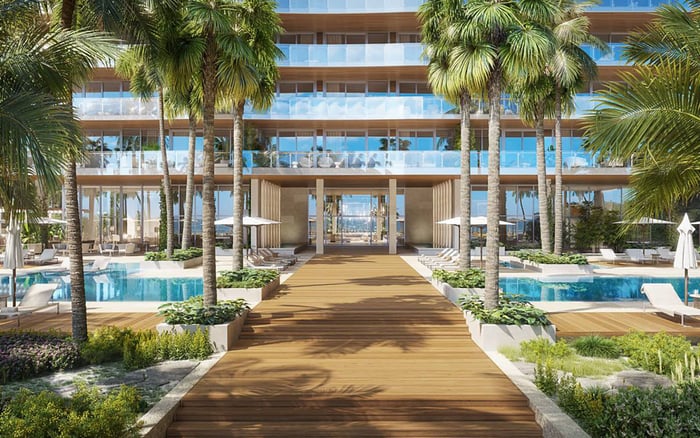
At Five Park Miami Beach, advertised features include a private resident porte-cochère drop-off and lobby, alongside valet service, electric-vehicle car ports, and private elevators. These are distinct components of arrival. On their own, they do not describe every transition between the vehicle door and the residence.
During a viewing, follow that route at an ordinary pace. Ask where visitors wait, where residents approach the elevators, and whether the preferred entrance remains available under the building’s current operating rules. A resident lobby is not the same as an individually private arrival.
EDITION Residences Miami Beach offers a dedicated private entrance and an “anonymous” celebrity entrance, together with 24-hour doormen, security, and valet service. Confirm how those entrances function for the particular residence; do not treat the language as a guarantee of invisibility.
One Ocean presents another useful distinction: its grand porte-cochère and private high-speed elevators are separate advertised features. Covered parking and 24-hour valet round out the arrival amenities, but neither guarantees a retrieval time.
For buyers who prefer to drive themselves, the decisive question is not simply whether parking is private. It is what happens after the car is parked.
Apogee South Beach combines private enclosed double-car garages with private elevators. It also has four residences per floor, secured entry, a residents-and-guests-only lobby, and valet parking. These distinctions matter, but the garage and elevator descriptions do not establish direct garage-to-residence access.
Walk the actual route assigned to the residence under consideration. Determine whether it crosses a shared parking aisle, elevator vestibule, or lobby, and ask whether resident self-parking is permitted. Confirm who can access the garage enclosure and which access rights accompany the purchase.
Treat valet as a service choice, not proof of privacy. For a household seeking both convenience and autonomy, ask management to demonstrate the valet route and the self-parking route, if available. The handoffs along each matter more than their inclusion on a feature sheet.
The South Tower at Continuum on South Beach offers private and semi-private elevator foyers. Its advertised oversized service elevator is accessed through a separate service corridor, an explicit distinction between service circulation and residential arrival. Private garage parking and 24-hour valet are also advertised, but do not establish a lobby-free route to every residence.
The service corridor warrants close scrutiny: physical separation and operating discipline are different questions. Ask how deliveries are screened, which floors staff can access, and when contractors may use the service elevator. Confirm whether moves or maintenance activity can affect the route residents ordinarily use.
For a household with regular deliveries or visiting staff, request a walkthrough of those arrivals as well. The objective is not simply to avoid encounters. It is to understand whether service can reach the home efficiently without making the principal arrival feel like a working corridor.
At The Ritz-Carlton Residences® Miami Beach, the waterfront offering includes 36 private boat dockages and a private waterway. Garage parking and 24-hour valet are also listed, while private elevator foyers apply to most residences-not necessarily every residence.
For an owner arriving by boat, the essential inspection begins where the vessel is secured. Follow the path from dock to building entrance, then to elevator and residence. The dockage offering does not establish a route that bypasses the principal lobby.
Review applicable dock documents alongside the residence documents. Confirm the access rights and charges relevant to the proposed purchase, rather than assuming that a waterfront address includes a particular dockage arrangement. Water access and arrival discretion remain separate benefits until the complete route and its permissions are established.
Building-level descriptions can obscure residence-level distinctions. The Bath Club combines private and semi-private elevators with concierge service, valet parking, 24-hour security, and direct beach access. Establish which elevator arrangement serves the specific home and inspect the space outside its door.
Flamingo Point illustrates a different boundary: its private entrance and VIP lobby are advertised for penthouse residents. Do not assume that benefit extends to every apartment. Its apartment service model should not be used as evidence of condominium ownership costs, either.
Apply the same discipline throughout a shortlist. Distinguish a private foyer from a semi-private one, a resident-only lobby from an exclusive entrance, and an advertised service from a documented access right. Verify each relevant feature against current building documents before allowing it to influence the purchase decision.
A credible cost comparison requires more than knowing that valet, garages, or dockages exist. Do not assign a price advantage without current, residence-specific figures for assessments, valet charges, garage arrangements, dock fees, and capital reserves.
Request the last two association budgets, the current assessment schedule, parking and valet agreements, applicable dock documents, and loading and service-elevator rules. Separate what regular assessments include from services charged separately, and distinguish recurring obligations from capital funding questions.
Pair that document review with practical operating questions. Ask about peak valet retrieval times, delivery screening, resident self-parking, and lobby bypass. A 24-hour service description establishes availability-not speed or an uninterrupted private route.
The strongest purchase decision aligns three things: the path you actually use, the access rights attached to the home, and the documented cost of maintaining that experience. A polished entrance is an introduction, not the full answer.
Explore Miami Beach residences with a more discerning arrival brief at MILLION.
If branded residences are on your mind — as a home or as an allocation — we would be glad to share what we are seeing, privately.
Begin a quiet conversationNo. The curb, garage, lobby, and elevator approach may still involve shared spaces, so inspect the complete route to the residence.
Five Park advertises a private resident porte-cochère drop-off and lobby, private elevators, valet service, and electric-vehicle car ports. Confirm how those features connect for the specific residence.
Apogee has private enclosed double-car garages and private elevators, but those features do not establish a direct connection. Verify the route during a viewing.
Its advertised oversized service elevator is accessed through a separate service corridor. Buyers should also confirm delivery screening, staff access, and service-elevator operating rules.
The property lists 36 private boat dockages and a private waterway, but a lobby-bypassing dock-to-residence route is not established. Walk the route and review applicable access rights.
Private elevator foyers are listed for most residences, not all. Confirm the arrangement for the home under consideration.
A dedicated private entrance and an anonymous celebrity entrance are advertised. Confirm their availability and operating rules for the specific residence.
No retrieval-time guarantee is established by a 24-hour valet description. Ask management about peak retrieval times and review the applicable valet agreement.
Request the last two association budgets, current assessment schedule, parking and valet agreements, applicable dock documents, and loading and service-elevator rules. Confirm which services carry separate charges.
Its private entrance and VIP lobby are advertised specifically for penthouse residents. Its apartment service model should not be treated as evidence of condominium ownership costs.