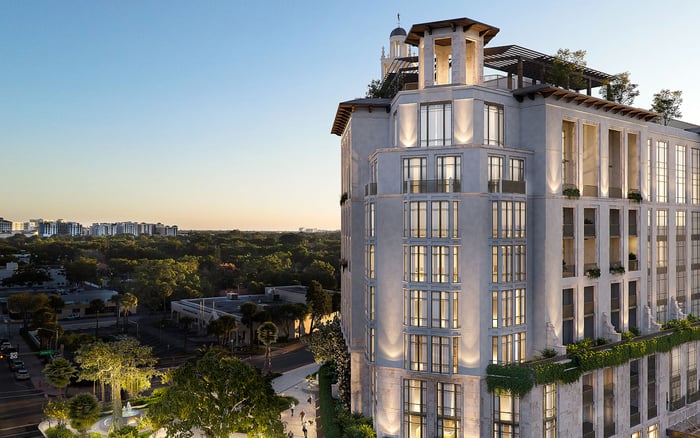
A privacy-focused review of Ponce Park Coral Gables should examine the full arrival sequence, including lobby visibility, elevator permissions, guest screening, service circulation, staff procedures, and terrace sightlines. Buyers should verify each operational detail directly rather than infer privacy from design language alone.

At Ponce Park Coral Gables, a buyer’s privacy review should begin with the complete path from the street to the residence. The important questions concern who can enter each area, where visitors wait, what staff can see, and how residential movement is separated from other activity.
A polished entrance does not establish discretion by itself. Buyers should ask for current plans and operating explanations that show how residents, guests, deliveries, vendors, and staff move through the property. Any access or staffing detail that is not documented should remain an open due-diligence item.
Buyers comparing Coral Gables options may also review Cora Merrick Park and The Village at Coral Gables. The comparison should focus on documented circulation, access control, and operating procedures rather than assumptions based on presentation materials.
The lobby should be evaluated as both an interior and a controlled threshold. During a visit, observe views from the exterior, the position of reception, the visibility of elevator doors, and whether anyone can approach residential circulation without acknowledgment.
Acoustics also influence discretion. Ask how reception conversations, visitor announcements, and delivery discussions are kept from carrying into seating or elevator waiting areas. A well-resolved plan should allow staff to supervise access without making residents feel publicly processed.
Sightlines matter at every point. Buyers should consider whether a person waiting in the lobby can observe resident arrivals, identify elevator destinations, or see into areas intended for private circulation.
Any representation concerning private or controlled elevator access should prompt specific questions. Buyers should confirm how credentials work, who assigns permissions, whether access is limited by destination, and how authorization differs for residents, family members, guests, vendors, and staff.
Ask where visitors wait after screening and whether that location exposes another household’s arrival. Buyers should also clarify what happens when credentials are lost, replaced, temporarily shared, or disabled.
Technology inside a residence should not be assumed to control building access. Any connection among in-home systems, lobby entry, elevator credentials, visitor management, and security procedures should be confirmed through current project documentation.
A credible privacy review addresses routine operations as closely as owner arrivals. Request an explanation of delivery intake, valet activity, loading, refuse movement, service elevators, and back-of-house routes. The goal is to understand where circulation overlaps and how those intersections are supervised.
Trace a grocery delivery from arrival to handoff. Repeat the exercise for household employees, maintenance personnel, move-in crews, and larger vendors. Confirm where each person is authenticated, where items are held, which route is used, and who authorizes access beyond the receiving point.
Staff flow deserves the same attention. Buyers should ask where personnel enter, change shifts, store equipment, and move between public and service areas. These operating details can determine whether the privacy suggested by the architecture is maintained after occupancy.
Privacy does not end at the residence entrance. Review outdoor exposure from the interior glazing, seating areas, terrace edge, and any cooking or dining zone shown in the applicable plan. Each position may create a different relationship with neighboring residences, streets, or shared areas.
Study direct and diagonal sightlines rather than relying only on the primary view. Ask how exposure may change after dark, when illuminated interiors can become more visible, and whether any screening element shown in a rendering is included in the delivered design.
Floor level alone does not determine privacy. Orientation, nearby buildings, adjacent outdoor areas, glazing, screening, and the resident’s habits should all be considered together.
Before making a decision, request the latest available plans and access narrative. Trace separate paths for an owner, an expected guest, an unannounced visitor, a household employee, a delivery, and a service appointment.
For each path, confirm who grants authorization, where the person waits, which entrance and elevator are used, and what occurs outside normal staffing conditions. Also ask about emergency access, credential replacement, move-in procedures, incident response, and changes to access permissions.
Written materials should take precedence over inference. If a privacy feature, staffing practice, or access restriction matters to the purchase decision, buyers should seek direct confirmation in the appropriate project and transaction documents.
What is the first step in evaluating privacy at Ponce Park Coral Gables? Trace the complete route from the exterior entrance to the residence and identify every point where access is checked or circulation overlaps.
What should buyers inspect in the lobby? Review exterior sightlines, reception placement, elevator visibility, waiting areas, and the acoustic separation of conversations.
How should elevator access be verified? Ask for current documentation explaining credentials, destination permissions, visitor authorization, and access for staff or vendors.
Does controlled elevator access eliminate shared circulation concerns? Not necessarily. Buyers should still examine waiting areas, service routes, emergency procedures, and points where different users may intersect.
What should buyers ask about guest entry? Confirm how guests are identified, approved, directed, and restricted from unauthorized areas.
How should delivery handling be reviewed? Follow the delivery path from arrival and authentication through holding, transfer, elevator use, and final handoff.
Why does staff flow matter? Staff entrances, shift changes, equipment movement, and back-of-house routes can affect how often service activity overlaps with residents.
What outdoor privacy issues deserve attention? Review direct and diagonal sightlines from interior and outdoor positions, including how visibility may change after dark.
Should buyers assume in-home technology controls building access? No. Any integration among residential systems, visitor management, elevators, and building security should be verified directly.
Which privacy details should be documented before a decision? Confirm the access sequence, credential rules, guest and service procedures, staffing practices, emergency access, and any feature material to the purchase.
For a discreet conversation and a curated building-by-building shortlist, connect with MILLION.
If branded residences are on your mind — as a home or as an allocation — we would be glad to share what we are seeing, privately.
Begin a quiet conversation