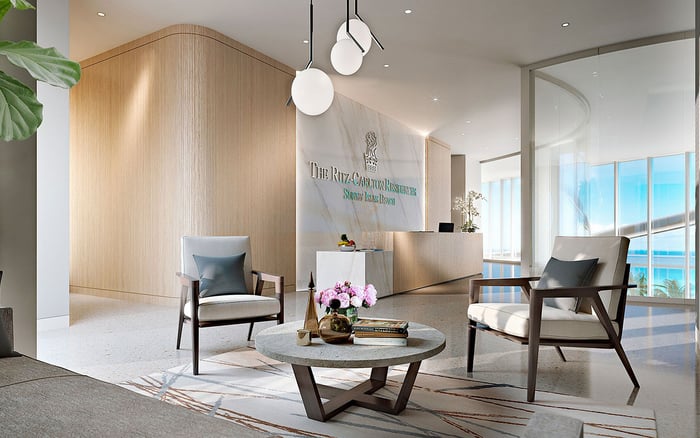
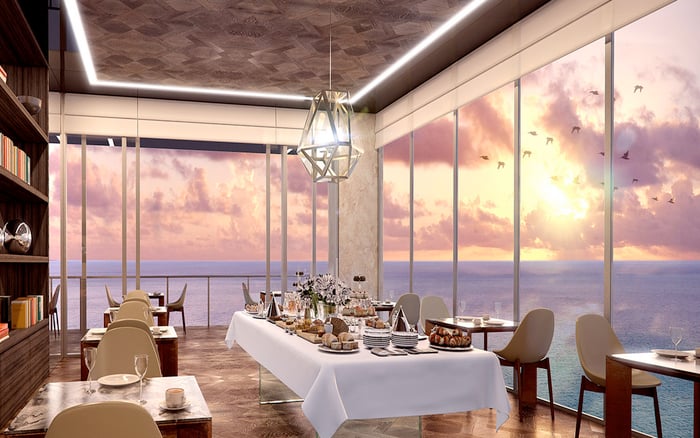
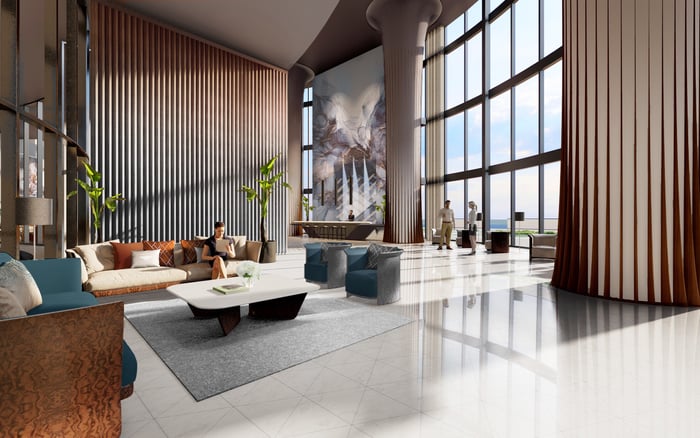
At St. Regis® Residences Sunny Isles, acoustic privacy deserves its own purchase review. Refined finishes, private elevator access and residential-only use should be evaluated separately from documented sound isolation and residence-specific testing.

A residence can satisfy the eye before it answers the ear. For a buyer considering St. Regis® Residences Sunny Isles, that distinction deserves attention early in the purchase process. Views, interior detailing and a private arrival experience are meaningful qualities. None, on its own, establishes how the finished home will perform acoustically.
At 18801 Collins Avenue in Sunny Isles Beach, the development comprises two residential towers on approximately 4.7 acres of oceanfront land. Fortune International Group and Château Group are the developers, with architecture by Arquitectonica. The setting and design pedigree frame the purchase, but acoustic privacy remains a separate due-diligence question.
The material available for this discussion contains no verified project-specific acoustic test results. That is not evidence of a noise problem, nor does it establish that technical documentation is unavailable elsewhere. The appropriate response is a focused request for information, followed by independent testing when feasible.
Views, kitchens, interior features and approximately 10-foot ceilings in standard homes-with higher ceilings in selected premium residences-define the visual and spatial offering. They are not substitutes for evidence of sound isolation.
A finish inspection and an acoustic assessment should likewise have distinct briefs. Ask the finish inspector to address the visible scope of that inspection. Ask an acoustic consultant to define the documentation, access and measurements needed to evaluate your privacy priorities. Do not assume one appointment covers both.
Begin with your intended use of the home. Identify the bedroom where uninterrupted rest matters most, the room intended for confidential calls and the spaces used for entertaining. Give the consultant that brief before defining the testing scope. The goal is not an abstract promise of silence, but a considered assessment of the rooms where quiet matters to you.
The project is described as a private residential development without a hotel component or transient use, with private elevator access and entry foyers. These distinctions concern occupancy and access privacy; they do not constitute a documented acoustic-performance rating.
For the buyer, this calls for two parallel inquiries. One should establish who uses the building and how residents reach their homes. The other should examine the evidence relevant to sound within the selected residence. Keeping those questions separate allows each feature to be valued on its own merits.
If your shortlist also includes Bentley Residences Sunny Isles, apply the same distinction there. Compare the acoustic documentation offered for each candidate rather than inferring quiet from branding, presentation or an appealing arrival sequence. This is a purchasing discipline, not a performance ranking between developments.
The advertised amenity program exceeds 70,000 square feet and includes club-members, tower and lap pools, cabanas and private beach facilities. The beach bar and grill offering includes indoor and covered outdoor seating, beach service and in-residence dining.
These are lifestyle offerings, not evidence of disturbance. They do, however, provide a useful starting point for reviewing a residence’s position within the broader plan. Ask to see its relationship to shared spaces, circulation and service areas rather than evaluating the floor plan in isolation.
Request plans identifying the spaces above, below and beside the rooms that matter most to you. Ask where elevators, building equipment and service routes are located, and which nearby amenities are intended to operate during your preferred quiet hours. Treat these as questions to resolve, not assumptions about the building.
Bring that location review to the acoustic consultant, who can determine which relationships warrant closer examination. A buyer should not need to predict noise from a diagram, and the available information does not support such a prediction.
Panoramic windows are described as incorporating “noise-reducing technology,” but the available material provides no accompanying numerical STC or OITC rating. It also does not identify detailed acoustic assembly specifications or a post-construction testing program.
Request the supporting specifications, any relevant test documentation and clarification of what each document covers. Ask whether the information applies to the proposed window assembly, another building element or the completed residence. Have an acoustic consultant explain its relevance rather than interpreting an isolated rating yourself.
Extend the request to other assemblies and building systems the consultant considers relevant. Ask which details apply specifically to your selected home and whether any design or installation changes remain unresolved. Keep technical answers in writing so they can be revisited against the eventual testing scope.
The same approach can guide a comparison with Jade Signature Sunny Isles Beach: distinguish descriptive language from documented performance without presuming either residence will perform better. The information here does not warrant a numerical acoustic target or a project-specific noise prediction.
If you are purchasing before the residence can be assessed in its finished condition, discuss a staged acoustic review. Begin with available plans and specifications, then ask when access for an on-site assessment might be possible. Do not assume a sales visit, finish walkthrough or closing schedule provides suitable testing conditions.
Before commissioning testing, ask the consultant to propose a written scope. It should identify the spaces to be assessed, the conditions needed, any neighboring-area access required and the limitations that would remain. Ask how the assessment would address your priorities without promising to reproduce every future living condition.
Coordinate permissions and timing with the relevant project representatives. Ask your attorney to review any proposed arrangements for access, evaluation and follow-up before relying on them. A recommendation to test does not mean a purchase agreement already grants testing rights or a particular remedy.
If the assessment raises a concern, request a written explanation and discuss the appropriate next step with your advisers. If something cannot be assessed, keep that uncertainty explicit rather than treating it as either reassurance or a presumed defect.
The purchase review should answer two distinct questions: does the residence deliver the design experience you want, and what evidence supports the acoustic privacy you expect? A favorable answer to one should not fill a gap in the other.
For a home selected as a retreat, quiet deserves deliberate attention alongside finishes and views. Separate testing makes that expectation explicit; it is not an allegation about St. Regis or any other development.
For discreet guidance on your South Florida residence search, connect with MILLION.
If branded residences are on your mind — as a home or as an allocation — we would be glad to share what we are seeing, privately.
Begin a quiet conversationNo. It recommends separate acoustic due diligence and does not present verified project-specific acoustic test results.
St. Regis Residences Sunny Isles Beach is located at 18801 Collins Avenue, Sunny Isles Beach, FL 33160.
No. The absence of a hotel component or transient use describes occupancy, not measured sound isolation.
No. Private elevator access and entry foyers are access-privacy features, not documented evidence of acoustic performance.
Visible finish quality does not establish sound isolation. Give the acoustic assessment its own scope, with attention to the rooms and activities that matter most to you.
Request supporting specifications and relevant test documentation for the advertised noise-reducing technology. Ask an acoustic consultant to explain what those documents cover and how they apply to the selected residence.
No. The extensive amenity program is a reason to review the residence's location and nearby uses, not evidence of a noise problem.
Identify your most important sleeping, working and entertaining spaces. Ask the consultant to use those priorities when defining the assessment.
Raise the question early, beginning with available plans and specifications. Coordinate later testing around feasible access and suitable conditions, with legal review of any proposed arrangements.
Use consistent documentation requests and residence-specific assessment questions. Do not rank acoustic performance by brand, finish presentation or private access alone.