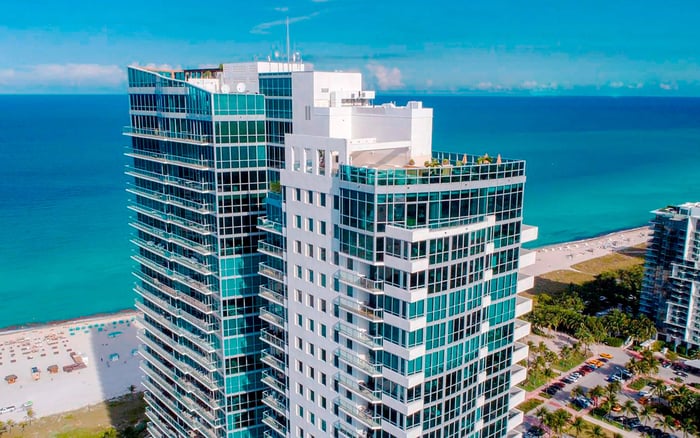
A Five Park purchase calls for two distinct reviews: the unit’s association obligations at closing and the building’s future capital needs. An estoppel certificate addresses the first, not the second.

A considered purchase at Five Park Miami Beach requires more than confirming the amount due at closing. The condominium tower at 500 Alton Road, developed by Terra and GFO Investments, had obtained a temporary certificate of occupancy and begun recording condominium closings by November 2024. That milestone provides context; it does not establish the outlook for future association spending.
For a buyer, the distinction is straightforward: an estoppel certificate addresses the unit’s association account, while a capital-project review examines the building’s potential spending needs and how they would be funded. These are complementary inquiries, not interchangeable assurances.
This is not an assertion that Five Park has a pending capital project or a building defect. It is a framework for evaluating a purchase without mistaking a clean closing statement for a complete financial picture. The objective is to understand both the residence being acquired and the shared obligations of ownership.
An association estoppel certificate states what a particular unit owes as of a specified date. The closing agent uses it to settle the unit’s association account, and the association is generally bound by the figures it provides.
Florida condominium estoppel requirements under Section 718.116(8) include regular assessment amounts and payment frequency. The certificate also identifies delinquencies, applicable special-assessment charges within its defined effective period, and applicable transfer or capital-contribution fees. These disclosures distinguish recurring ownership expenses from amounts payable in connection with the transfer.
The certificate’s value lies in its precision within a defined scope. It is not a structural inspection, a reserve study or an evaluation of the association’s long-term funding adequacy. The absence of a delinquent unit balance does not answer whether a future project will require additional owner contributions.
For buyers also considering Apogee South Beach, the same distinction applies: compare unit-level closing obligations separately from the association-level financial picture, without assuming that either property has a particular capital issue.
A capital contribution, a capital project and a special assessment are not three versions of the same expense.
A capital contribution is a closing charge. Its appearance on an estoppel does not, by itself, explain the association’s future spending needs or establish that those needs are fully funded. Ask what the charge represents rather than treating its name as evidence of reserve adequacy.
A capital project concerns building-level work or expenditure. Evaluating any project identified during diligence requires an understanding of its scope, timing, anticipated cost and proposed funding. Those questions extend beyond the unit’s account statement.
A special assessment is a one-time or time-limited charge for costs not covered by regular condominium fees or existing reserves. It can fund capital work, but also major repairs, large insurance deductibles, legal settlements or replenishment of depleted reserves.
Thus, “no special assessment listed” does not mean “no future capital spending.” Nor does a special assessment automatically establish a structural problem. Its purpose and supporting documents matter.
A separate association review should examine financial statements, budgets, reserve schedules, insurance, board minutes, and engineering or reserve studies. Each addresses a different aspect of ownership. A thorough review connects these records rather than treating receipt of a document package as the end of diligence.
Begin with the budget and financial statements. Ask how current operating costs compare with the association’s income and what the records show about funds available for future needs. Then examine reserve schedules and relevant studies to understand the assumptions behind planned funding.
Read board minutes for discussions of contemplated work, funding decisions and unresolved questions. If a project appears, request its supporting scope, cost information and anticipated schedule, where available. Distinguish early discussion from an approved commitment, and a preliminary estimate from an established budget.
Insurance deserves separate attention because special assessments can cover large deductibles as well as physical work. Ask qualified advisers to explain the coverage and financial implications rather than inferring protection from the existence of a policy.
For a Miami Beach search that also includes Faena House Miami Beach, use these same document categories to organize the comparison. The aim is consistency of review, not an assumption that different associations share the same obligations.
If the records identify contemplated or approved capital work, organize the follow-up around four questions: what is proposed, what stage has it reached, how would it be paid for, and what could it mean for the unit being purchased?
Request written clarification of whether the work remains under discussion or has been approved. Ask whether funding is expected from existing reserves, regular assessments or a separate special assessment. Where costs remain preliminary, retain that uncertainty rather than treating an estimate as a fixed ownership expense.
Next, have counsel and the closing team review how the purchase agreement addresses any identified assessment and its payment schedule. Do not assume the estoppel alone resolves the contractual allocation of every expense between buyer and seller.
This exercise should clearly separate documented charges from potential future costs. An unanswered funding question calls for further inquiry; it is not proof of a defect or an inevitable assessment.
The development-agreement materials associated with the Five Park site contain a separate municipal estoppel provision. It concerns the agreement’s status, payments and developer compliance.
That is distinct from the residential unit’s association account. A municipal estoppel concerning development obligations does not establish condominium reserve adequacy, just as a unit association estoppel does not substitute for a review of the development agreement.
If both appear in a transaction file, ask counsel to identify the issuer, the obligations covered and the purpose of each document. The shared word “estoppel” should not obscure their different functions.
Whether the shortlist includes Five Park or Continuum on South Beach, a disciplined purchase separates three matters: the sums needed to close, the recurring cost of ownership and the possibility of future capital demands. No single document answers all three.
Before proceeding, ask the advisory team to summarize what is documented, what remains contingent and which questions require written clarification. Keep the estoppel review alongside-not in place of-the association financial and capital review. Building-specific legal and technical conclusions belong with qualified professionals reviewing the actual records.
For a discreet perspective on your next South Florida residence, connect with MILLION.
If branded residences are on your mind — as a home or as an allocation — we would be glad to share what we are seeing, privately.
Begin a quiet conversationIt states a specific unit’s association obligations as of a particular date. The closing agent uses it to settle the association account.
No. It is a point-in-time account statement, not an assessment of building condition, reserve adequacy or future spending needs.
No. It explains purchase due diligence and does not assert that Five Park has a pending capital project or building defect.
No. The absence of a listed special assessment does not establish that the association will have no future capital spending or additional funding needs.
No. A capital contribution is a closing charge, while a capital project concerns building-level work or expenditure.
Special assessments can fund major repairs, capital projects, large insurance deductibles, legal settlements or replenishment of depleted reserves.
Review financial statements, budgets, reserve schedules, insurance, board minutes, and engineering or reserve studies. Read them together to understand spending needs and funding assumptions.
Ask about the scope, approval status, anticipated cost, timing and proposed funding. Distinguish preliminary discussions and estimates from approved commitments.
No. The municipal provision associated with the Five Park site concerns development-agreement obligations, not the unit’s association account or condominium reserve adequacy.
No. Obtaining a temporary certificate of occupancy and beginning condominium closings does not establish current reserves, capital needs or assessment obligations.