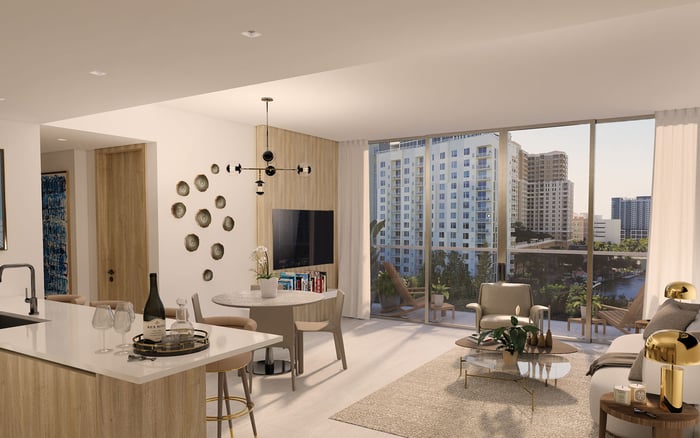
A Chicago-to-Las Olas move calls for three distinct capital decisions: the wealth committed to the residence, the funds available to close, and the liquidity preserved afterward. Property-level diligence should shape all three.

A move from Chicago to Las Olas is more than a change of address. It is an opportunity to reconsider how much wealth to commit to a residence, how to fund the transaction, and how much flexibility to preserve afterward. Those distinctions matter when the desired home combines waterfront access with a substantial capital commitment.
The purchase allocation, cash needed to close, and liquidity retained afterward are three separate decisions. A buyer can comfortably own a property on paper yet face a difficult closing calendar or an unnecessarily constrained first year.
Start with three schedules: a post-purchase balance sheet, a dated transaction-funding plan, and a reserve budget. Each should stand on its own before the offer is finalized. The objective is not simply to secure the residence, but to preserve the freedom that made the move attractive.
Distinguish a waterfront house in Las Olas Isles from other residences near Las Olas Boulevard. Do not apply one property's ownership economics indiscriminately to other property types or nearby addresses.
Use property-level comparable sales and condition assessments to evaluate the asking price, rather than relying on a broad neighborhood price range.
Before setting the allocation, separate essential features from attractive extras. Is private dockage central to the move? Is the priority a particular waterfront setting, construction profile, or different residential format? A broader search that includes Sixth & Rio Fort Lauderdale calls for its own ownership-budget review, rather than assumptions carried over from an Isles house.
The financial question becomes clearer once the lifestyle brief is specific: which features justify the capital commitment, and which would absorb funds without materially improving daily life?
Rather than impose a universal home-equity allocation, test the proposed commitment against the household's wider assets, obligations, spending needs, and tolerance for reduced liquidity.
Ask your wealth adviser to compare the balance sheet before and after purchase. Show the Florida residence, any retained Chicago property, associated debt, liquid investments, and other commitments separately. Do not treat gross Chicago property value as cash available for the Florida closing.
Then compare an all-cash purchase with financing on actual terms. Evaluate each against the liquidity remaining after purchase. If financing is planned, pursue the appropriate loan preapproval early rather than leave borrowing capacity unresolved during negotiations.
If portfolio sales are contemplated, ask qualified advisers to assess the tax and allocation consequences. If securities-backed borrowing is proposed, have them evaluate suitability and collateral risks rather than assume it is interchangeable with cash.
Also consider whether a different residence would preserve more of the desired flexibility. When considering Four Seasons Hotel & Private Residences Fort Lauderdale, request property-specific ownership figures before comparing costs with a waterfront house.
Closing liquidity is as much a timing exercise as a net-worth exercise. Map when deposits are due, when investment funds would become available, when any Chicago sale proceeds could be used, and when the final closing balance must be funded.
Prepare a transaction-specific estimate covering the purchase funds still due, title fees, applicable transfer taxes, lender charges, prepaid insurance and taxes, and any lender-required reserves. Confirm which obligations belong to the buyer under the contract and financing terms. A blanket closing-cost percentage cannot replace that estimate.
Keep the ledger explicit. Credit deposits already paid against the purchase balance, and distinguish money spent at closing from funds that must remain available afterward. Ask the lender whether its reserve requirements overlap with the household's planned liquidity, so the same dollars are not inadvertently committed twice.
For the Chicago exit, test at least two scenarios: sale proceeds available before the Florida closing, and proceeds arriving later. In the latter case, identify the funding solution and budget for overlapping ownership before committing. Questions about Illinois-Florida residency and capital-gains timing belong with qualified legal and tax advisers, not in assumptions embedded in the offer.
When evaluating waterfront value, look beyond frontage. Investigate canal width, turning space, water depth, and the navigation route rather than treating apparently similar properties as interchangeable.
Do not assume a Las Olas Isles address guarantees the marine access you need. Verify the specific canal, water depth, dock dimensions, bridge restrictions, and navigation route against the intended vessel before paying for marine utility.
Apply the same discipline to the physical asset. Obtain property-specific assessments of construction age, seawall and dock condition, anticipated repairs, insurance quotes, and deductibles. Build those findings into the budget rather than assume newer construction or an appealing presentation eliminates reserve needs.
If the search also includes St. Regis® Residences Bahia Mar Fort Lauderdale, verify any marine arrangements independently. A waterfront setting is no substitute for confirmation of the access and obligations relevant to your purchase.
Build the post-closing reserve from the actual ownership budget and diligence findings rather than adopting a fixed percentage of the purchase price. Review recurring housing expenses, insurance deductibles, potential repairs, and the possibility of carrying two residences during the transition.
With your adviser, test how long the remaining liquid funds would cover those obligations under both the expected timeline and a delayed sale. Keep lender-required reserves visible in that review rather than assuming they represent additional spending capacity.
Separate known spending from contingency capital. If furnishing, relocation, or an identified repair is planned, record it as a committed expense rather than quietly drawing it from the emergency reserve. A reserve figure is meaningful only if those funds remain available after the commitments are met.
Before proceeding, confirm three outcomes: the residence fits the wider portfolio, every transaction obligation has a dated funding source, and the remaining liquidity supports the first year without relying on an optimistic Chicago sale timeline.
The strongest purchase is not necessarily the largest one available. It is the home whose lifestyle value remains compelling after its capital requirements are fully understood.
For a discreet exploration of Las Olas and Fort Lauderdale residences, connect with MILLION.
If branded residences are on your mind — as a home or as an allocation — we would be glad to share what we are seeing, privately.
Begin a quiet conversationSeparate the wealth committed to the residence, the cash needed for the transaction, and the liquid reserves retained afterward. Each answers a different planning question.
No; review each residence's property type, condition, and ownership budget separately. Do not carry assumptions from a waterfront house into a different residential format.
Review property-level comparable sales and condition assessments. Verify that features such as dockage meet your needs before assigning them value.
Rather than impose a universal percentage, review the proposed commitment with a wealth adviser. Consider liquidity needs, obligations, other assets, and any retained Chicago residence.
Compare both approaches using actual financing terms and the post-purchase balance sheet. If financing is planned, pursue the appropriate loan preapproval early.
Review remaining purchase funds, title fees, applicable transfer taxes, lender charges, prepaid insurance and taxes, and possible lender-required reserves. Confirm buyer obligations under the contract and financing terms.
Model both an early sale and a sale that closes after the Florida purchase. Identify funding and overlapping ownership needs without assuming the proceeds will arrive in time.
Check the specific canal, water depth, dock dimensions, bridge restrictions, and navigation route against the intended vessel. Do not assume the address alone guarantees suitable access.
Build it around actual ownership expenses, insurance deductibles, potential repairs, and possible overlapping ownership. Review the amount with an adviser rather than relying on a fixed purchase-price percentage.
Record planned furnishing, relocation, and identified repairs as committed expenses. Assess contingency reserves after those commitments are accounted for.