At Mr. C Residences Boca Raton, reserve diligence begins by replacing headline pricing with the buyer’s executed contract price, then testing component costs, useful lives, allocation methods, inflation, and potential financing over long ownership periods.

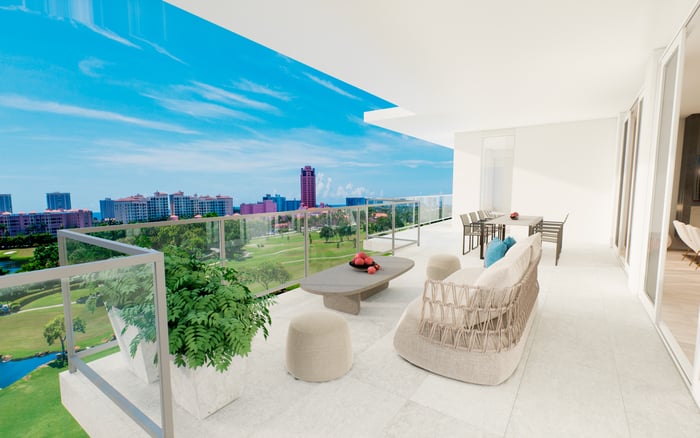
For a buyer considering Mr. C Residences Boca Raton, the acquisition price is only the first capital decision. Planned for 41 SE 4th Street in central Boca Raton, the 133-residence condominium combines residential common elements with an on-site Bellini Restaurant, indoor and outdoor amenity areas, and hospitality-style services. That breadth makes the reserve schedule more than a compliance document; it is an early model of how the property intends to preserve its physical quality.
Published configurations range from two-bedroom residences of approximately 1,520 to 1,800 square feet to three-bedroom-plus-den homes spanning 2,500 to 2,869 square feet. Marketing prices begin around $1.7 million for two bedrooms, $2.2 million for two bedrooms plus den, $2.8 million for three bedrooms, and $3.5 million for three bedrooms plus den. The top penthouse has been marketed at an expected price of approximately $8.5 million.
Those figures orient the market, but they do not define an individual owner’s economics. Options, premiums, negotiations, and the final contract amount can create a meaningful gap between published “from” pricing and the price actually paid. Any reserve ratio based on a marketing number should therefore be recalculated using the executed contract price.
A reserve schedule becomes useful only when translated into the buyer’s own economics.
Project-wide totals can appear substantial while revealing little about a single residence. A buyer should isolate the unit’s proposed annual reserve contribution and express it in three ways: dollars per unit, dollars per interior square foot, and as a percentage of the actual contract price.
Each measure answers a different question. The per-unit figure clarifies annual cash exposure. The per-square-foot figure enables a more disciplined comparison across layouts of different sizes. The percentage-of-price figure shows how reserve funding relates to invested capital, particularly when comparing a lower-floor two-bedroom home with a larger residence or penthouse.
This framework is equally useful when assessing nearby luxury choices such as Alina Residences Boca Raton. It does not suggest that unlike buildings carry identical obligations. Rather, it prevents a low monthly fee or large aggregate reserve balance from substituting for unit-level analysis.
The relevant lenses overlap: the discipline of buyer’s guides, investment analysis, pre-construction document review, pricing and trends context, and the operating complexity often associated with branded residences. Each should return to the same question: what is this owner expected to fund, when, and under what assumptions?
Florida’s post-Surfside framework applies milestone-inspection and structural-reserve requirements to qualifying condominium buildings of at least three stories. Structural Integrity Reserve Studies, commonly called SIRS, address major common elements that can include roofs, foundations, load-bearing walls, fireproofing, plumbing, electrical systems, waterproofing, windows, doors, and other structural components.
Beginning in 2025, qualifying associations cannot waive or intentionally underfund required structural reserves covered by the SIRS regime. Budgets adopted from January 1, 2025, forward are subject to the strengthened funding requirements. Required contributions may be collected through regular assessments, special assessments, loans, or lines of credit, but the funding obligation cannot simply be waived.
For Mr. C, structural reserves should be evaluated separately from the future renewal of its restaurant, hospitality, and indoor-outdoor amenity environments. These categories may have different useful lives, replacement cycles, and cost pressures. Folding them into a single blended inflation assumption can obscure where exposure is concentrated.
The same distinction matters across design-led Boca Raton offerings, including Glass House Boca Raton and The Residences at Mandarin Oriental Boca Raton. Buyers should compare documents, not branding, and assess each property’s component inventory and allocation formula on its own terms.
A reserve estimate stated in today’s dollars is not a complete long-term funding plan. Buyers should model cumulative reserve payments over 10 and 20 years while escalating projected repair and replacement costs. Rather than treating one inflation percentage as definitive, the analysis should apply multiple scenarios to structural systems and separate scenarios to luxury amenity spaces.
A practical sensitivity table can test a base case, a higher replacement-cost case, and a scenario in which selected component lives shorten. It should then show whether annual contributions remain sufficient, whether a funding gap emerges, and how that gap could affect the unit.
The analysis should also account for timing. If work must occur before reserves are fully accumulated, an association could rely on a special assessment, loan, or credit line. Debt may extend the collection period, but it introduces interest expense. A comparatively low initial association fee therefore does not eliminate capital exposure; it may simply defer how that exposure is collected.
This is particularly important for a newly delivered luxury property, where early budgets can appear orderly because many systems are new. The meaningful test is whether contributions accumulated during those low-maintenance years are calibrated to later replacement obligations at future prices.
Structural reserve studies recur every 10 years. A new building’s initial schedule should therefore be treated as an informed estimate, not a permanent forecast. Later engineering reviews can revise useful lives, replacement costs, scope, and required annual contributions. As the building develops an operating history, owner-controlled budgets should be compared with the developer’s initial schedule.
The general milestone-inspection trigger is the year a qualifying building reaches 30 years of age, with subsequent inspections generally required every 10 years. Earlier guidance used a 25-year trigger for buildings within three miles of the shoreline. Because the framework has been amended, counsel and qualified advisers should confirm the governing statute and Boca Raton’s local enforcement rules when projecting the property’s eventual inspection date.
That distant horizon should not invite complacency. Reserve adequacy is shaped long before the first milestone inspection by annual funding decisions, component performance, maintenance standards, inflation, and the association’s response to updated engineering information.
A serious review begins with the proposed association budget, component-level reserve schedule, allocation formula, engineering assumptions, and any completed SIRS or equivalent reserve study. The buyer’s advisers should reconcile these materials rather than read each in isolation.
The component schedule should identify expected cost, useful life, remaining useful life, and annual funding logic. The allocation method should show how expenses are divided among residences. The budget should indicate whether reserve contributions are distinct from operating costs and whether amenity renewal is addressed outside the statutory structural categories.
Next, substitute the executed contract price for every marketing benchmark. Calculate the unit’s annual and cumulative contributions, then test higher costs, shorter lives, special assessments, and borrowing with interest. Finally, establish a process for reviewing owner-controlled budgets and later studies after turnover. Reserve diligence is not a prediction of one exact bill; it is a structured assessment of the range, timing, and funding mechanisms of future obligations.
For private guidance on Boca Raton condominium opportunities and ownership documents, connect with MILLION.
If branded residences are on your mind — as a home or as an allocation — we would be glad to share what we are seeing, privately.
Begin a quiet conversationThe executed price reflects the buyer’s actual capital commitment. Published “from” pricing is a marketing reference and may produce a misleading reserve-to-price ratio.
Convert the unit’s proposed annual reserve contribution into dollars per unit, dollars per interior square foot, and a percentage of the executed contract price.
A SIRS addresses major common elements such as roofs, foundations, load-bearing walls, fireproofing, plumbing, electrical systems, waterproofing, windows, and doors.
Beginning in 2025, qualifying associations cannot waive or intentionally underfund reserves covered by the SIRS regime.
Structural reserve studies recur every 10 years, allowing engineering assumptions, useful lives, replacement costs, and contributions to be updated.
Restaurant, hospitality, and indoor-outdoor amenity spaces may have different replacement cycles and cost pressures from structural systems.
No. Capital needs may later be collected through higher regular assessments, special assessments, loans, or credit lines carrying interest.
Buyers should model cumulative payments and escalated replacement costs over at least 10- and 20-year periods.
Request the proposed budget, component-level reserve schedule, allocation formula, engineering assumptions, and any completed SIRS or equivalent study.
The general trigger is when a qualifying building reaches 30 years, with later inspections generally every 10 years. The governing statute and local rules should be confirmed at the time of review.