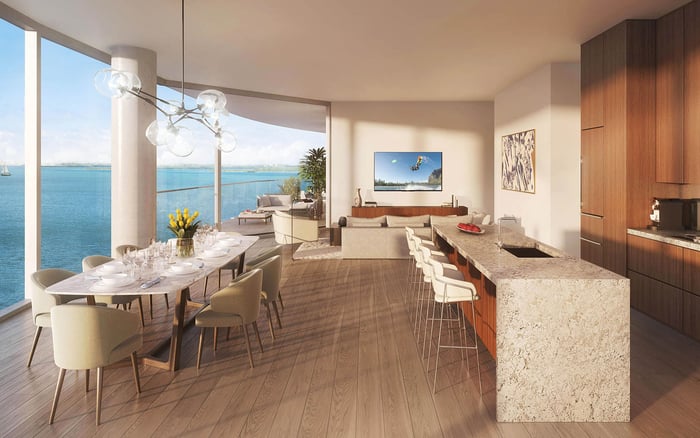
At House of Wellness Brickell, ownership diligence turns on rental permissions, operating costs and project-level financing review. A condominium questionnaire could clarify those issues, but lender appetite and future resale liquidity remain unproven.

At House of Wellness Brickell, the ownership proposition extends beyond a wellness-centered address. The consequential questions are how the condominium will operate, what owners must fund and whether a future purchaser can obtain suitable financing. For a buyer intent on preserving flexibility, those details deserve the same attention as the residence itself.
Read the condominium questionnaire alongside the declaration, financial documents, insurance terms and management agreements. It organizes project-level questions; it does not replace the documents supporting the answers. Until a completed questionnaire and supporting materials are evaluated, neither financing eligibility nor resale liquidity should be treated as established.
The essential distinction is between what is marketed and what can be underwritten. Wellness branding alone does not establish condo-hotel status, and an attractive payment schedule does not establish mortgage availability.
House of Wellness is marketed as a pre-construction condominium at 152 SW 9th Street, Miami, with 656 residences across 34 stories. The developer is North Development, a partnership between Oak Capital and Edifica. Planned residences include studios, one-bedroom and two-bedroom layouts, with marketed sizes of approximately 337 to 676 square feet.
Advertised entry prices vary: around $400,000, $420,000 and $445,900. These figures are guidance, not interchangeable offers for the same residence. Establish the unit-specific price and contractual obligations before evaluating financing or a future exit.
For a buyer also considering 2200 Brickell, the disciplined comparison is document against document. A neighborhood shortlist does not establish equivalent rental rights, operating expenses or lender acceptance. Each property requires its own ownership review.
Rental language is a central verification issue. Platform-based rental permission is marketed alongside an advertised 30-day minimum term. A platform reference does not establish permission for nightly occupancy. The declaration, leasing rules and any management agreement should reconcile these descriptions.
Ask for the minimum lease duration, limits on leasing frequency and applicable approval procedures. Then distinguish permission to rent from participation in a rental operation. Is participation optional or mandatory? Are there centralized reservations, rental pooling, leasebacks or income guarantees? These are questions to resolve, not established features of House of Wellness.
If ORA by Casa Tua Brickell is also on a buyer’s shortlist, apply the same inquiry independently rather than carrying assumptions between projects. What matters is the agreement governing each residence, not whether two properties appear in the same search.
Ask the lender for an explicit assessment of the documented operating structure. Neither wellness programming nor permissive-sounding rental language, standing alone, settles project classification.
The planned wellness concept includes an Integrated Wellness Method beginning with a full-body assessment, as well as a lifestyle director overseeing wellness and social programming. These elements may attract a buyer, but they also raise questions about how they will be funded.
Request the current proposed budget and identify how wellness services are funded. Which expenses belong to the association, which are paid individually, and which depend on a separate service agreement? Ask whether an introductory funding arrangement exists and, if so, what owners would assume when it ends. Do not presume such an arrangement is offered.
Reserve assumptions and master insurance terms warrant equally careful review. Ask the lender to specify the financial and insurance information needed for its assessment, and ask counsel to reconcile those answers with the governing documents. Pre-construction status is no reason to presume that budgets are unavailable or litigation is absent. Explicitly request available financial information and litigation disclosures.
A buyer’s ability to qualify for a loan does not establish whether a lender will accept the condominium. Request a project-specific assessment that identifies the documents reviewed, unresolved conditions and circumstances under which financing could proceed.
The questionnaire inquiry should cover the sales and occupancy breakdown, delinquency information and litigation disclosures, with a clear status date. Where an answer is provisional, ask what will replace it as the project advances. Foreign ownership should not be used as a proxy for investor occupancy.
Nothing established here confirms agency eligibility, condo-hotel classification, a particular mortgage product, lender pricing or approved leverage. Nor does a marketing mortgage calculator establish non-QM availability. Distinguish an indicative financing conversation from a documented decision, and understand what remains subject to later review.
The advertised schedule calls for 10% at contract, followed by 5% after two months, 5% after four months and 5% after six months, then 15% at groundbreaking and 60% at closing. That totals 40% before delivery.
The remaining 60% is a purchaser obligation, not evidence of an approved 60% loan-to-value ratio. A buyer intending to finance that balance should ask what happens if the eventual loan is smaller than anticipated or unavailable. The purchase agreement controls definitive deposit terms; review it for the obligations that apply to the transaction.
Delivery guidance also varies, with projections of 2029 and Q1 2030. Treat timing as a contractual diligence matter, not a fixed marketing promise. The ownership plan should remain workable if closing timing or financing assumptions change.
The project’s location beside The Underline and the Metromover is a concrete access attribute. It does not establish rental performance, appreciation or the speed of a future sale. Likewise, the planned 656-residence scale raises a question about competing inventory, not a prediction that owners will face a liquidity discount.
Consider distinct exit scenarios: a purchaser requiring financing, a cash buyer prioritizing personal use and a buyer whose interest depends on rental rights. For each, ask whether the documented rules, carrying costs and available financing support the purchase. This is scenario analysis, not evidence of future demand or a measured resale outcome.
The strongest ownership decision remains attractive once the rental language, operating budget and lender conditions are explicit. Ask for answers that identify the relevant document and its date. Refresh the review as the project advances rather than treating early guidance as permanent assurance.
For a discreet conversation about Brickell ownership and purchase priorities, connect with MILLION.
If branded residences are on your mind — as a home or as an allocation — we would be glad to share what we are seeing, privately.
Begin a quiet conversationIt could clarify rental operations, financial assumptions, insurance and other project-level issues relevant to a lender’s review. It does not replace the supporting documents or establish approval by itself.
No project-specific lender approval is established here. Agency eligibility, mortgage products, pricing and approved leverage remain unconfirmed.
The project is marketed at 152 SW 9th Street, Miami, with 656 residences across 34 stories.
The marketed mix includes studios, one-bedroom and two-bedroom residences, with approximate sizes of 337 to 676 square feet.
No. Separate marketing advertises a 30-day minimum, so the declaration, leasing rules and management agreements should establish the actual permissions.
That is not established. Buyers should ask whether participation is optional or mandatory and whether pooling, centralized reservations or other rental arrangements exist.
Request the proposed budget and identify which wellness costs are association obligations, individual charges or governed by separate service agreements.
No. The published schedule allocates 40% before delivery and 60% at closing, but it describes purchaser payments rather than approved financing.
Published projections differ between 2029 and Q1 2030. Buyers should confirm contractual timing rather than relying on marketing guidance.
No measured resale outcome or future liquidity discount is established. Financing access, operating costs, rental restrictions and competing inventory should be evaluated as scenarios.