A buyer-oriented review of Apogee South Beach’s medical-equipment power, caregiver parking, and emergency access, separating established amenities from operational details that warrant written confirmation before closing.

At Apogee South Beach, ownership offers privacy, service, and a position beside South Pointe Park overlooking Government Cut. For a household using powered medical equipment or ongoing caregiver support, however, the most consequential questions arise when ordinary routines are interrupted. Waterfront living deserves evaluation not only for its views and finishes, but also for the practical continuity of care.
Located at 800 South Pointe Drive in Miami Beach’s South of Fifth neighborhood, Apogee was completed in 2008 and contains 67 residences across 22 stories. Its private garages, private elevator access, and 24-hour services provide a useful starting point. They do not, by themselves, establish medical-equipment backup power, caregiver-specific parking rights, or a verified emergency responder-access protocol.
A sound review separates three matters: what the residence offers, what the association authorizes, and what the building can support during an interruption. Each deserves a written answer tied to the particular residence and the household’s actual needs.
Apogee’s residences have privately enclosed two-car garages on the parking levels, with air conditioning and storage. Additional vehicles may be accommodated through valet. Building services include 24-hour valet, concierge, and security, while an AMX interactive smart panel provides access to security, valet, spa, and other services.
These features can support an orderly daily routine. A caregiver may nevertheless need permissions different from those of an occasional visitor, and a medical transport vehicle may require more space than an ordinary passenger car. Likewise, a private elevator is an access feature-not confirmation that it will remain available during an outage or alarm.
An undocumented capability is not necessarily absent. The appropriate response is neither reassurance nor alarm, but a request for current, residence-specific documentation. Evaluate service promises separately from electrical capacity, access rules, and emergency procedures.
The available amenity information does not confirm generator capacity, residence-level backup circuits, or emergency receptacles for home medical equipment. Buyers should not treat a general reference to building services as assurance that a particular device can operate through a utility interruption. Nor should they assume a garage outlet has backup power.
Begin with the household’s equipment requirements, coordinated with the treating clinician or equipment provider. Then ask management to confirm in writing which residence circuits, if any, receive backup power. The response should identify the relevant receptacles and any approved dedicated medical-equipment connection, rather than simply state that emergency power exists somewhere in the building.
Request the applicable electrical diagrams, transfer-switch arrangements, generator runtime information, and refueling plan. Ask who can explain the system’s operating limits and whether the proposed equipment connection requires approval. Review generator-maintenance records alongside the diagrams to assess maintenance as well as system design.
Keep the building review distinct from the household’s clinical contingency plan. Neither a private garage nor a service panel is evidence of power continuity. Until the applicable circuit and its operating conditions are confirmed, medical-equipment support remains an unresolved purchase consideration.
A privately enclosed two-car garage is a meaningful convenience, but its description does not establish independent caregiver credentials, accessible-van clearance, ramp or lift space, or medical-transport loading arrangements. These are separate operational questions, each of which can affect whether care arrives reliably and discreetly.
Obtain the parking and valet rules in writing. Clarify whether a caregiver can use the resident’s garage, whether permanent credentials are available, how shift changes are handled, and whether overnight access carries restrictions. Confirm valet charges and rules for additional vehicles rather than assuming a caregiver receives the same privileges as an owner.
Check physical suitability against the actual vehicle. Request confirmation of clearance and space for any ramp or lift, along with the permitted loading location and medical-transport dwell time. Consider the route from vehicle to residence, including credentialed access and elevator use. A nominal parking allocation does not answer those questions.
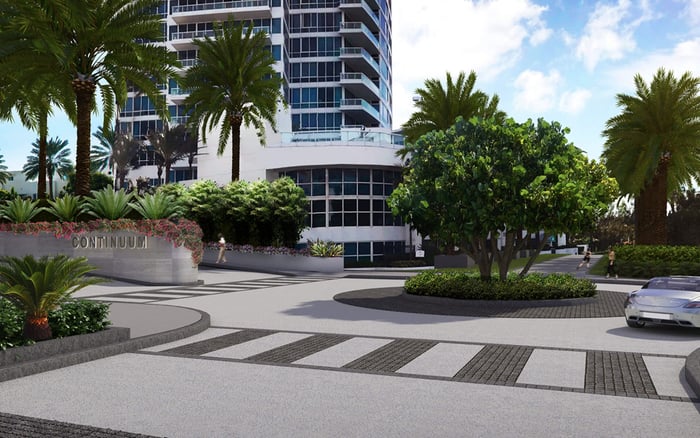
For buyers also considering Continuum on South Beach, the useful comparison rests on a consistent set of written parking and access questions-not an assumption that similarly positioned residences operate under identical rules.
Apogee’s security and private-elevator features do not verify firefighter elevator designation, emergency override procedures, emergency-key arrangements, or a formal responder-access protocol. Ask management to explain how responders reach the residence under both ordinary and disrupted conditions.
Request the current emergency plan, the designated responder entrance route, fire-department connection locations, and emergency-key procedures. Ask which elevators may be used, by whom, and under what restrictions during outages, alarms, storms, or flooding. Private elevator access should not be interpreted as permission to use that elevator during an emergency.
The review should also establish responsibility: who communicates with responders, who can provide access, and what happens if the usual entrance or access system is unavailable. These are requests for clarification, not descriptions of verified Apogee procedures.
Ask whether management maintains a voluntary medical-needs registry and how relevant information may be shared with Miami Beach Fire Rescue with appropriate consent. The discussion should preserve household privacy while clarifying practical coordination. Do not assume a registry exists or that enrollment would guarantee assistance.
For a resale purchase, an operational file can be as important as the residence’s finishes. Request parking and valet rules, relevant electrical diagrams, generator-maintenance records, fire/life-safety and elevator inspection reports, and open violation notices. Review them with the appropriate qualified advisers, focusing on the equipment and access arrangements the household actually needs.
Written responses should distinguish current capabilities from proposed accommodations. If caregiver credentials, a dedicated receptacle, or a loading arrangement requires approval, clarify the approval path before treating it as available. Keep the documentation tied to the residence rather than relying on a broad building description.
A buyer considering Five Park Miami Beach alongside Apogee can apply the same diligence framework without assuming either property offers a particular medical-support capability. Compare confirmed operating arrangements, unresolved questions, and any permissions still required.
Apogee’s private garages and round-the-clock services are established amenities. Their suitability for a household with medical or caregiving requirements depends on details that need separate confirmation. The objective is a residence whose daily elegance is matched by a clearly understood operating plan-not a promise inferred from an amenity description.
For a discreet perspective on South Florida ownership decisions, explore MILLION.
If branded residences are on your mind — as a home or as an allocation — we would be glad to share what we are seeing, privately.
Begin a quiet conversationApogee is at 800 South Pointe Drive, Miami Beach, FL 33139, in South of Fifth, beside South Pointe Park and overlooking Government Cut.
The condominium contains 67 residences across 22 stories and was completed in 2008.
The available amenity information does not confirm residence-level backup circuits or emergency medical-equipment receptacles. Request written confirmation for the specific residence and equipment.
Request supported-circuit details, electrical diagrams, transfer-switch arrangements, generator runtime and refueling information, and generator-maintenance records.
Each residence is described as having a privately enclosed two-car garage on the parking levels. Garage descriptions also identify air conditioning and storage.
Caregiver-specific parking rights are not established by the garage and valet descriptions. Confirm credentials, garage use, overnight access, and valet charges in writing.
The garage description does not establish van clearance, ramp or lift space, or medical-transport loading arrangements. Review the actual vehicle’s requirements with management.
Private elevator access does not establish availability during outages or emergencies. Request the applicable restrictions and responder-use procedures.
A registry is not confirmed in the supplied information. Ask whether a voluntary registry exists and how information may be shared with Miami Beach Fire Rescue with appropriate consent.
Review parking and valet rules, electrical diagrams, generator-maintenance records, fire/life-safety and elevator inspection reports, and open violation notices.