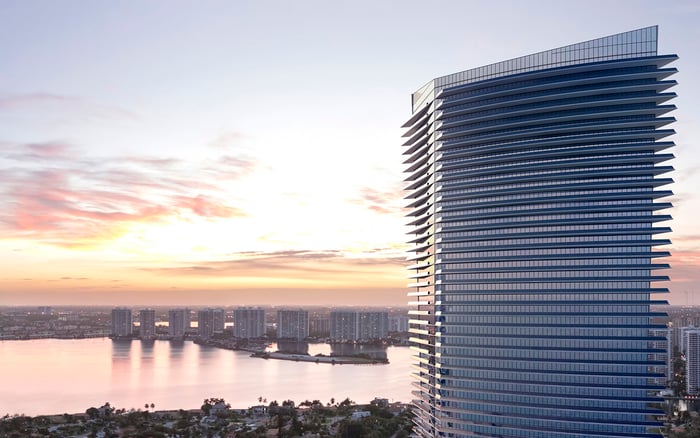
A buyer-focused framework for evaluating association dues, management agreements, reserve funding, and service costs at an existing Miami Beach condominium and a pre-construction Downtown Miami residence.

In luxury ownership, the most consequential question is not simply what the association charges today. It is what that charge supports, how obligations can change, and whether the funding structure can sustain the expected service standard. A beautifully presented residence warrants an equally disciplined review of its operating commitments.
For buyers considering The Ritz-Carlton Residences® Miami Beach and Waldorf Astoria Residences Downtown Miami, one distinction is fundamental: the former is an existing condominium; the latter is marketed as pre-construction. Established association charges and pre-construction estimates are different kinds of evidence, not directly comparable measures of value or operating efficiency.
The goal is to understand the commitments behind the number: staffing, management, maintenance, insurance, reserves, and any separately billed hospitality services.
The Ritz-Carlton Residences® Miami Beach is located at 4701 N. Meridian Avenue, Miami Beach, FL 33140. Monthly association charges range from $4,363 to $9,200 across listed residences. This is not a single building-wide charge and should not be applied indiscriminately to another unit.
A separate maintenance estimate is approximately $1.45 per square foot per month, with actual maintenance varying by residence. Treat it as a reference point, not a substitute for a current unit-specific statement and the adopted association budget.
For an existing condominium, a rigorous review pairs the current budget with three years of prior budgets and actual expenditures. Ask which categories exceeded their allocations, whether those differences recur, and how they were funded. Review insurance renewals, assessment history, the reserve study, and the management agreement together, rather than as isolated documents.
Apply the same discipline to a Miami Beach comparison involving Setai Residences Miami Beach: compare documented obligations rather than assuming similar positioning produces similar costs. A brand name is not a budget specification.
Waldorf Astoria Residences Downtown Miami requires a different review. Its pre-construction positioning means estimated fees should not be presented as an established operating history. The project is described as Hilton-managed, making the relationship between residential management and hospitality services especially important to examine.
Across 11 listings, the median association fee is $6,199 per month, with a median rate of approximately $1.56 per square foot per month. The fee figure excludes special assessments. These are listing-based reference points, not a verified final association budget.
Other maintenance estimates include $1.25 per square foot and $1.70 per square foot. The $1.70 figure is paired with an annual example, leaving the billing period internally inconsistent. Do not convert that figure into a monthly obligation without written clarification.
Rather than averaging incompatible figures, request the estimated and final budgets, their underlying assumptions, and the unit-specific allocation. Confirm the billing period, the area used in the calculation, and whether the estimate includes reserve contributions. For a Downtown Miami buyer, precision matters more than a reassuring headline number.
Neither project's management-contract escalators nor a verified escalation cap are established here. Buyers should not assume increases are limited to inflation or that a quoted first-year expense remains representative over a longer ownership period.
Have advisers identify fixed annual increases, indexation clauses, renewal provisions, and pass-through expenses in the applicable agreements. Ask whether any cap covers only the management fee or also the underlying operating expenses. These are separate questions; an answer to one does not resolve the other.
Review each agreement's scope alongside its price. Which services must be delivered? Who can alter staffing or service levels? What happens at renewal? Are additional expenditures subject to approval? These are diligence questions, not assertions about either property's contracts.
For buyers also evaluating St. Regis® Residences Brickell, the same contract-review framework can guide a broader shortlist without implying that fee structures or management terms are equivalent.
Waldorf's described association coverage includes building maintenance, 24-hour concierge, valet parking, common-area utilities, insurance, and reserve funding. Each inclusion requires confirmation in the governing documents. The full boundary between included services and optional charges is not established here.
Ask for a written service schedule distinguishing association-funded services, individually billed services, and any usage-based charges. Then reconcile that schedule with the budget. Access to a service does not confirm that every use is covered by dues.
Shared facilities warrant a separate review. Request the declaration, hotel and residential management agreements, and cost-allocation provisions. Private and semiprivate elevators are among Waldorf's stated features, but that does not establish who pays for their operation or eventual replacement. The relevant question is how those obligations are allocated to the residence under consideration.
A useful planning exercise tests quoted dues at 10%, 20%, and 30% higher levels. These are affordability scenarios, not predictions of future increases at either property.
For illustration, applying the $1.56 monthly rate to a hypothetical 2,000-square-foot Waldorf residence produces $3,120 a month, or $37,440 annually. At 10% higher, that becomes $3,432 monthly; at 20%, $3,744; and at 30%, $4,056. None is a unit-specific quote, and the exercise excludes special assessments and separately billed services.
Review payroll, insurance, utilities, and reserve contributions independently. A uniform percentage increase can test household capacity, but it cannot explain which expense categories might change or whether capital funding is sufficient.
Neither project's adopted line-item budget, reserve-funding percentage, vendor pricing, nor final stabilized service costs are established here. Reserve adequacy therefore belongs in the document review, not in an assumption drawn from the monthly charge.
For Ritz-Carlton Miami Beach, assemble the current adopted budget, three years of budgets and actuals, reserve study, insurance renewals, assessment history, and management agreement. Reconcile the residence's quoted dues with its documented allocation.
For Waldorf, assemble estimated and final budgets, developer assumptions, the declaration, management agreements, shared-facility allocations, and post-turnover funding arrangements. Identify which figures remain estimates and which obligations are established in executed documents.
The more useful comparison is not which property advertises the lower rate. It is which ownership structure, service package, and funding commitments fit the buyer's expectations and capacity over time.
For a discreet perspective on South Florida ownership and your residential shortlist, explore MILLION.
If branded residences are on your mind — as a home or as an allocation — we would be glad to share what we are seeing, privately.
Begin a quiet conversationNo. Ritz-Carlton Miami Beach is an existing condominium, while Waldorf Astoria Downtown Miami is marketed as pre-construction, so their figures represent different operating stages.
Listing figures range from $4,363 to $9,200 monthly across listed residences. This is not a uniform building-wide charge.
The maintenance estimate is approximately $1.45 per square foot per month, with actual maintenance varying by unit. Confirm the specific residence's current obligation.
It shows a median association fee of $6,199 monthly across 11 listings and a median rate of approximately $1.56 per square foot per month. These are listing-based reference points, not a verified final budget.
No. The listing-based fee figure excludes special assessments, which should be evaluated separately.
The $1.70-per-square-foot estimate is paired with an annual example, leaving the billing period internally inconsistent. It should not be assumed to be monthly.
No verified escalation cap is established in the supplied information. Review fixed increases, indexation, renewal terms, and pass-through provisions in the applicable agreements.
The full billing boundary is not established. Confirm advertised inclusions in governing documents and request a schedule of optional or separately billed services.
Test the quoted amount at 10%, 20%, and 30% higher levels while separately reviewing operating categories and reserves. These are planning scenarios, not forecasts.
For Ritz-Carlton, prioritize adopted budgets, actual expenditures, reserves, insurance, assessments, and management terms. For Waldorf, also examine developer assumptions, shared-facility allocations, and post-turnover funding arrangements.