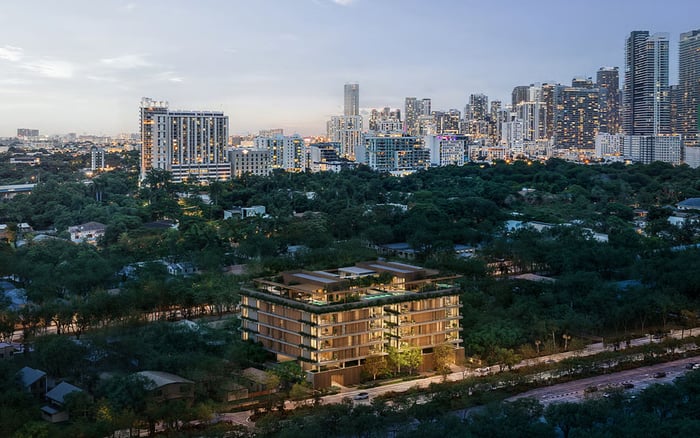
A buyer-focused examination of indicative association dues at Cipriani Residences Brickell and The Residences at Mandarin Oriental Boca Raton, with a framework for evaluating service contracts, insurance, reserves, and five-year ownership costs.

The most useful question about a luxury condominium’s association fee is not whether it seems high or low. It is what the payment supports, how that obligation can change, and which costs remain outside it. For buyers considering Cipriani Residences Brickell and The Residences at Mandarin Oriental Boca Raton, operational planning deserves the same attention as the residence itself.
Indicative dues provide a starting point, not a complete ownership forecast. Neither project’s executed association budget, reserve adequacy, vendor-contract portfolio, or contractual escalation rates is established here. A responsible comparison begins with those indicative figures, then turns to the documents that define payment obligations.
Cipriani is presented as a 397-unit pre-construction condominium at 1420 S. Miami Avenue in Brickell. Indicative monthly association fees include approximately $1,970 for unit #5304, $2,908 for #7003, and $4,891 for #7204. These are unit-specific snapshots, not a project-wide assessment schedule.
A separate maintenance estimate is approximately $1.40 per square foot monthly. It should not be treated as an executed operating budget or applied across residences without confirming the applicable area measurement and assessment allocation.
For Mandarin Oriental Boca Raton, indicative association dues are approximately $4,349 monthly. A separate indicative average is $1.44 per square foot monthly, but it is not a verified project-wide assessment schedule. The proximity of that average to Cipriani’s estimate does not establish equivalent costs or services.
A meaningful comparison requires the same inputs: unit size, assessment allocation, reserve treatment, utilities, insurance, parking, and separately billed services. Buyers also evaluating The Residences at 1428 Brickell should apply the same document-led framework rather than carry assumptions from one building to another.
Indicative maintenance inclusions for Cipriani unit #5304 encompass recreation facilities, pool service, trash removal, cable television, elevators, and water. Building-level maintenance categories also include landscaping, security, exterior and common-area maintenance, management, parking, and sewer. These descriptions help frame questions; they do not establish contractual entitlements.
For Mandarin Oriental Boca Raton, indicative maintenance categories encompass insurance, cable television, pest control, common areas, golf, hot water, gas, structural maintenance, grounds maintenance, and pool service. The unit-specific inclusions for #912 identify insurance, cable television, and hot water. Reconcile these different levels of detail against the documents governing the selected residence.
Golf warrants particular clarification: determine whether any expense is mandatory, optional, or separately allocated. Establish, too, which services are funded collectively and which incur individual charges. For buyers whose Boca Raton search also includes Alina Residences Boca Raton, a consistent inclusion checklist is more useful than a comparison of headline fees alone.
A first-year budget sets a starting point. A service agreement may explain how expenses change thereafter. Buyers should request management and branded-services agreements, along with relevant vendor and shared-facilities contracts, and review their pricing mechanisms with qualified advisers.
Start with fixed versus CPI-linked pricing. Identify annual percentage increases, the base amount to which each increase applies, and whether reimbursable expenses fall outside the stated fee. These are review questions, not established terms at either project.
Next, examine minimum staffing commitments. Ask whether staffing requirements can be adjusted and who has authority to approve changes. The objective is to understand both the service commitment and the association’s flexibility to manage its cost.
Automatic renewals, termination payments, and responsibility for operating deficits deserve equal attention. An apparently attractive fee is not enough to evaluate a contract when its duration, exit obligations, or pass-through expenses remain unclear. Ask advisers to map each material agreement to its budget line, renewal date, escalation mechanism, and party responsible for payment.
An “insurance included” maintenance field invites inquiry; it does not describe coverage. For each residence, obtain the association’s insurance summary and examine coverage limits, deductibles, exclusions, renewal assumptions, and premium-growth projections.
Ask which exposures remain the owner’s responsibility and how a deductible or uninsured expense would be allocated. The presence of insurance among maintenance categories does not mean association dues cover every ownership-related insurance cost.
Apply the same discipline to reserves. Request the reserve schedule or study and the equipment-replacement assumptions supporting it. A monthly figure cannot establish reserve adequacy. Distinguish funding for current operations from funding for future replacement work, and identify any proposed expenditure not covered by those provisions.
Request five-year operating projections rather than extrapolating from a single indicative monthly fee. Keep recurring operating dues, reserve contributions, special assessments, and separately billed owner services visible as distinct categories. Where reserves are already included in dues, separate them analytically without counting them twice.
Build the initial projection from the proposed or current budget and documented contract terms. Then ask advisers to test alternative assumptions for insurance renewals, service costs, and replacement timing. Label those alternatives clearly as scenarios, not predictions or disclosed project terms.
The forecast should also identify who bears shared-facility expenses and potential operating deficits. A practical schedule shows payment timing as well as annual totals, allowing a buyer to assess liquidity needs beyond the recurring monthly charge.
CDD assessments require separate confirmation. A general statement that such assessments, if applicable, fall outside association dues does not establish that Mandarin Oriental Boca Raton has one. Verify applicability rather than inserting an unsupported charge into the model.
Before relying on a cost comparison, obtain the current declaration, bylaws, proposed or current association budget, reserve schedule or study, management and branded-services agreements, shared-facilities agreements, insurance summary, and assessment notices. Request written clarification wherever descriptions of fees and inclusions do not align with contractual provisions.
The final review should answer three practical questions: what must this owner pay now, which mechanisms can increase that obligation, and what remains outside the quoted dues? Until those answers are clear, neither a lower monthly figure nor a familiar hospitality name establishes better long-term value.
The goal is not simply to minimize an assessment. It is to understand the financial commitment required to sustain the service experience that makes the residence compelling.
For a considered approach to South Florida luxury ownership, explore MILLION.
If branded residences are on your mind — as a home or as an allocation — we would be glad to share what we are seeing, privately.
Begin a quiet conversationIndicative fees are approximately $1,970 for unit 5304, $2,908 for 7003, and $4,891 for 7204. These are unit-level snapshots, not a verified project-wide assessment schedule.
The indicative maintenance estimate is approximately $1.40 per square foot monthly. That figure is an estimate rather than an executed operating budget.
Indicative dues are approximately $4,349 monthly, while a separate indicative average is $1.44 per square foot monthly. Neither establishes a verified assessment schedule for every residence.
Not without normalizing unit size, assessment allocation, reserve treatment, utilities, insurance, parking, and service inclusions. Indicative figures do not establish equivalent operating costs.
Indicative inclusions encompass recreation facilities, pool service, trash removal, cable television, elevators, and water. Governing documents should confirm the actual obligations and entitlements.
Golf appears among the indicative maintenance categories, but its treatment is not established. Confirm whether any related expense is mandatory, optional, or separately allocated.
Review fixed versus CPI-linked pricing, annual increases, and reimbursable expenses. Minimum staffing commitments, automatic renewals, termination payments, and deficit liability also warrant review.
No; an insurance inclusion alone does not establish comprehensive protection. Buyers should verify coverage limits, deductibles, exclusions, renewal assumptions, and any costs that remain the owner’s responsibility.
A project-specific CDD assessment is not established here. Language stating that CDD assessments are separate if applicable should not be treated as confirmation of a charge.
Keep recurring operating dues, reserve contributions, special assessments, and separately billed owner services distinct. Avoid counting reserves twice when they are already included in dues.