At Auberge Beach, choosing north or south exposure begins with the rooms you actually use. A practical guide to distinguishing tower names from orientation, testing work and sleeping spaces, and assessing terraces from the specific residence.
At Auberge Beach Residences & Spa Fort Lauderdale, the useful question is not simply whether north or south is better. It is which orientation best serves the rooms where you spend your most important hours. A home office, a primary bedroom, and a terrace dining table can demand very different things, even within the same residence.
The property occupies an Atlantic beachfront site at 2200 North Ocean Boulevard. Its 171 residences span a 17-story North Tower and a 22-story South Tower, with private elevator access among the property's features. Those tower names identify buildings, not the compass direction of every room within them.
Begin with your daily routine. If you work from home, the desk may deserve priority over the formal living area. If this is a seasonal retreat, the terrace may carry more weight. The best exposure supports those choices with the fewest compromises in the rooms you use most.
A South Tower address does not establish a uniformly south-facing home. Residence S1802, for example, has a southeast orientation. Its 18th-floor position offers a concrete upper-floor example, but neither the tower name nor the floor number explains the experience from each window.
Request a compass-marked floor plan and identify the orientation of the living room, primary suite, secondary bedrooms, den, and outdoor space separately. Note the stack, corner position, and neighboring buildings. These details tell you more than a broad north-versus-south label.
Likewise, do not assume that north exposure means coastline views or that south exposure means direct ocean views. Establish ocean, coastline, city, and Intracoastal outlooks from the actual residence. Different total tower heights do not, on their own, establish different elevations for matching floor numbers.
The residences offer one- to five-bedroom configurations and contemporary flow-through floor plans. Their 9-foot-6-inch floor-to-ceiling windows make the relationship between room use and outlook especially important. A compelling view deserves attention, but evaluate it from the position where you will actually sit.
In the living room, test the sofa location rather than standing at the glass. Look toward both the horizon and the proposed television wall. Assess whether the room remains comfortable for conversation and reading at the hours you expect to entertain. A photograph cannot settle those questions.
For a buyer also considering Four Seasons Hotel & Private Residences Fort Lauderdale, the same room-by-room discipline provides a useful basis for comparison. Compare the activities each home must accommodate; a shared city or broad exposure label does not establish equivalent living conditions.
“North for an office” is a hypothesis to test, not a verified Auberge-specific conclusion. Bring a laptop to the proposed workspace and position it where the desk would sit. Check screen reflections, the view behind the chair, and whether shades would need to remain closed during your working hours.
S1802 offers a useful layout example: two bedrooms, three bathrooms, and a den. Its southeast orientation and Atlantic Ocean and coastline outlooks do not, by themselves, establish the den's daylight or suitability for calls. Inspect that room independently before making it a permanent workspace.
For the primary bedroom, consider your preferred waking routine and the window treatments you would require. Evaluate privacy from the bed position, not just the doorway. If sleep takes priority over scenery, make that preference explicit before comparing residences. The available details do not establish measured north-south differences in temperature, glare, or daylight.
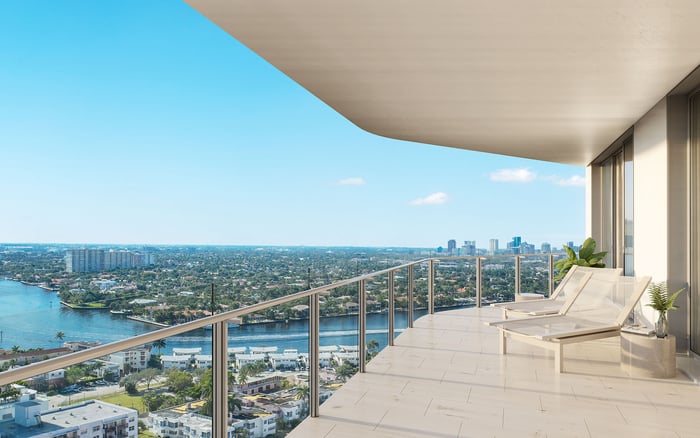
Outdoor spaces deserve a separate assessment. Expansive terraces or balconies have continuous glass railings designed to maximize ocean views. That design intention does not guarantee comfort at a particular dining table or lounge chair.
“South for winter terrace use” should remain a question until tested. Request terrace dimensions, glazing specifications, and any approved shading options. Mark a proposed table and seating arrangement on the plan, then stand in those positions during a visit. Evaluate shade, wind, privacy, and noise alongside the outlook.
A morning visit and a late-afternoon return offer a more useful comparison than a single midday showing. Record the date and time of each observation, and do not assume that one visit represents every season. If winter use is central to the purchase, ask to evaluate conditions relevant to that routine rather than relying on compass direction alone.
Residence S1003 illustrates why a home can require more than one orientation label. It offers direct ocean views through floor-to-ceiling impact-glass windows, alongside west-side views of Fort Lauderdale and the Intracoastal Waterway. Its outlooks also include sunrise and sunset views.
That combination raises a practical question: which rooms and outdoor positions deliver each experience? Before imagining morning coffee facing the ocean and an evening drink toward the city, confirm where those activities would actually take place. Multiple outlooks are valuable only to the extent that the layout makes them usable for your household.
For a broader Fort Lauderdale Beach search that includes St. Regis® Residences Bahia Mar Fort Lauderdale, use the same comparison sheet. Record room orientation, intended furniture placement, outlook, and inspection time for every candidate. This keeps the decision focused on use rather than labels.
Focus the shortlist on the rooms that matter most, then rank your priorities: uninterrupted work, restful sleep, living-room outlook, or outdoor dining. For each residence, distinguish confirmed characteristics from questions that still require inspection. A clear view in one direction does not establish privacy or comfort in another.
Check any broad claim of clear northern views above the second floor from the specific home; do not treat it as a guaranteed view corridor. Look through each relevant window and inspect neighboring-tower sightlines from the intended seating positions.
The right home need not win every category. It should serve your highest-priority activities with the fewest compromises. At Auberge, north or south becomes a meaningful choice only when the floor plan, furnishings, and your daily schedule are considered together.
For a discreet, room-by-room approach to your next residence, connect with MILLION.
If branded residences are on your mind — as a home or as an allocation — we would be glad to share what we are seeing, privately.
Begin a quiet conversationNo. North Tower and South Tower identify the buildings, not the compass exposure of every residence or room.
The North Tower has 17 stories, and the South Tower has 22 stories. Together, they contain 171 residences.
That is a hypothesis to test, not an established Auberge-specific advantage. Evaluate the actual workspace for screen reflections, privacy, and shade requirements.
The available details do not establish that conclusion for individual residences. Inspect the terrace for the conditions and hours relevant to your intended use.
S1802 is an 18th-floor South Tower residence described as southeast-facing. It demonstrates why tower identity and residence orientation must be considered separately.
S1802 has two bedrooms, three bathrooms, and a den. The den should be inspected independently before treating it as a suitable home office.
S1003 is described with direct ocean views and west-side views of Fort Lauderdale and the Intracoastal Waterway. Sunrise and sunset views are also advertised.
Request a compass-marked floor plan, terrace dimensions, glazing specifications, and any approved shading options. Map each room's intended use onto the plan.
Visit during both morning and late afternoon to assess glare, shade, neighboring-tower sightlines, wind, and noise. Do not treat one visit as representative of every season.
No guaranteed view corridor is established. Any broad claim of clear northern views should be verified from the specific residence and relevant seating positions.