A buyer-focused comparison of two branded residential dining programs, from Bellini-led service in Boca Raton to a distributed beach, clubroom, and marina model in Pompano Beach.
For buyers who host with intention, a residence’s dining program is more than a lifestyle flourish. It determines whether an evening can flow gracefully from cocktails to dinner, whether service extends into the home, and whether a larger celebration can be staged without compromising privacy. That distinction is especially relevant when comparing Mr. C Residences Boca Raton with The Ritz-Carlton Residences® Pompano Beach.
Both are branded residences with food, beverage, and hospitality embedded in the ownership proposition. Yet their entertaining frameworks differ notably. Mr. C presents a restaurant-led model shaped by Bellini, in-residence dining, event catering, poolside service, and a rooftop lounge. Ritz-Carlton offers a more distributed resort model, with settings and service points spanning the oceanfront Beach Tower, the Intracoastal-side Marina Tower, outdoor social areas, and private residential spaces.
The amenity is the setting, but the rules determine how a resident may use it.
Planned with 133 private residences, Mr. C places Bellini Restaurant at the center of its culinary identity. The ground-floor venue is designed for refined European dining, with an indoor dining room and a landscaped, European-style terrace. A planned rooftop Mr. C Bar and Lounge introduces a second atmosphere for drinks and social gatherings, while poolside service extends the hospitality into a more relaxed daytime register.
For an owner, the meaningful point is continuity. In-residence dining and event catering suggest a food-and-beverage program designed to extend beyond a conventional restaurant reservation. A hosted dinner may draw upon the same hospitality language experienced elsewhere on the property, reducing the friction of coordinating food, service, and presentation independently.
That promise should still be evaluated against the operating documents. Amenity details do not specify whether Bellini’s dining room or terrace may be reserved exclusively, nor do they define capacities, guest limits, booking procedures, outside-caterer policies, noise cutoffs, or cancellation terms. Some five-star services are identified as à la carte and available at additional cost, so buyers should distinguish included access from chargeable service when estimating the true cost of frequent entertaining.
Within Boca Raton, buyers considering hospitality as part of the residential experience may also examine The Residences at Mandarin Oriental Boca Raton. The useful comparison is not simply which property has the longest amenity menu, but which operating model best matches an owner’s preferred cadence of dining, hosting, and service.
The Ritz-Carlton Residences® Pompano Beach divides its amenity experience between an oceanfront Beach Tower and an Intracoastal-side Marina Tower. The result is a broad lifestyle proposition in which dining and gathering are not concentrated in a single signature room. Instead, they unfold across beach, garden, social, and dockside environments.
At the Beach Tower, a restaurant bar and grill offers indoor and outdoor seating, while food-and-beverage service extends to the beach lounge. The private beach club restaurant serves a seasonal Ritz menu, with beachside wait service for residents and their guests. That access language is useful because it establishes whom the venue is designed to serve, although it does not resolve whether a resident can reserve all or part of it for an exclusive function.
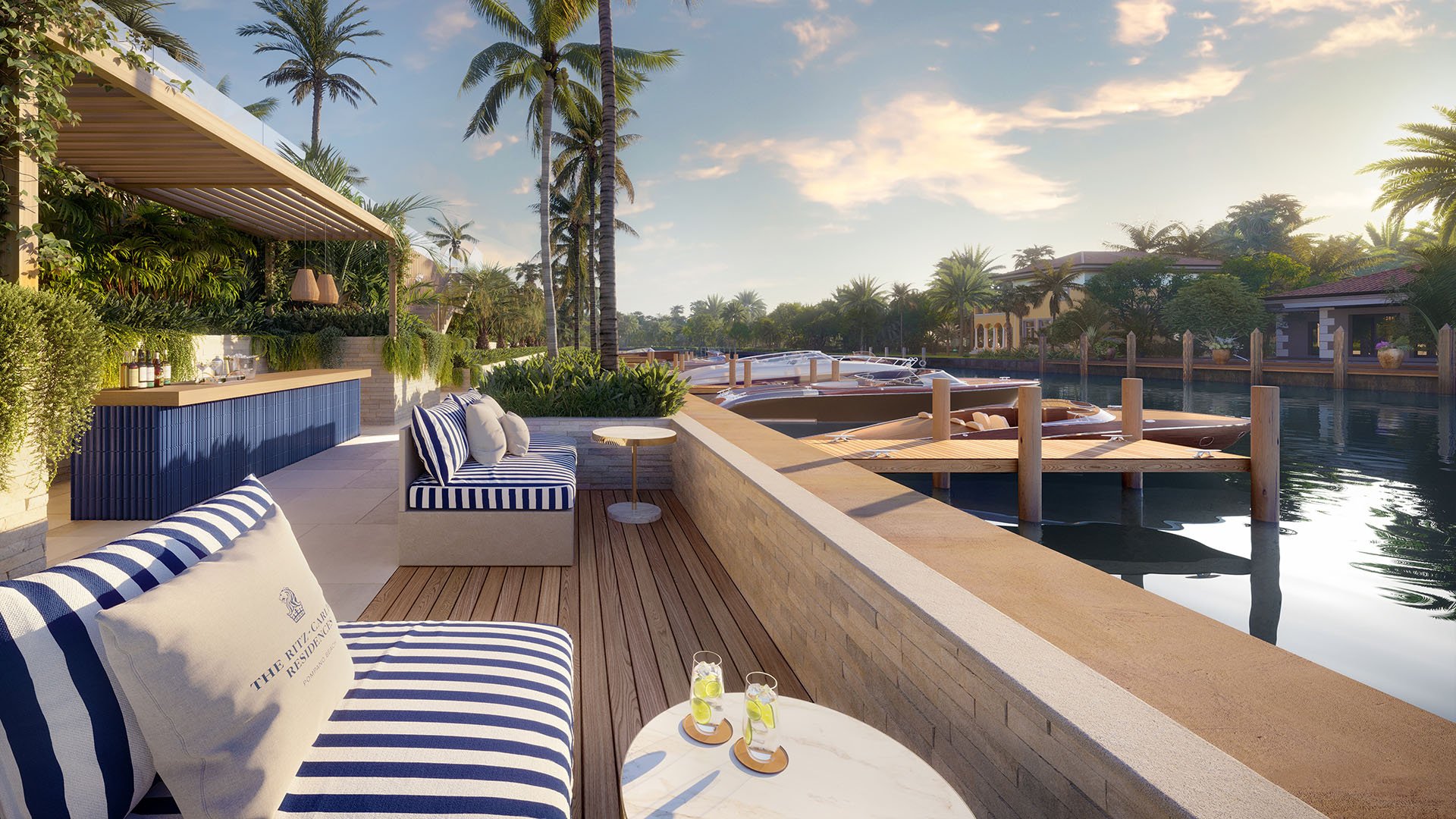
The event framework includes a multipurpose social-event clubroom with a preparation kitchen, along with a catering kitchen, wine-tasting room, and breakfast bar. For casual gatherings, barbecue areas, a pizza oven, covered pavilions, outdoor dining pergolas, and cabanas offer multiple formats. The Marina Tower adds a bar-and-lounge entertainment area connected to the private marina, allowing the social experience to move from oceanfront leisure to a dockside setting.
Personalized resident services include private chefs, housekeeping, personal shopping assistance, 24/7 concierge service, and in-residence dining. Together, these elements create a layered hosting model, from dinner inside a residence to a gathering in a shared social room. Buyers surveying the wider Pompano Beach market might compare this approach with Armani Casa Residences Pompano Beach, particularly when service style and entertaining atmosphere carry equal weight with the residence itself.
A catering kitchen or preparation kitchen is valuable infrastructure, but it does not establish that residents may self-cater or retain any outside chef, restaurant, or event company they choose. Building management may require approved vendors, certificates of insurance, staffing minimums, deposits, security, or supervised deliveries. Alcohol service may be governed by separate rules. None of these operational points should be inferred from the presence of a kitchen alone.
The same discipline applies to in-residence dining and private-chef offerings. Buyers should establish who provides the service, how far in advance it must be requested, whether menus can be customized, and which labor, delivery, gratuity, or minimum-spend charges apply. At Mr. C, the à la carte language makes fee review especially important. At Ritz-Carlton, the breadth of settings makes it essential to understand whether service terms vary by tower or venue.
Amenity descriptions for both properties leave important event controls unstated. For Mr. C, the open questions include venue capacity, guest limits, outside catering, reservation priority, noise cutoffs, and cancellation terms. For Ritz-Carlton, buyers should also clarify rental fees, alcohol rules, commercial-event restrictions, and whether beach, garden, clubroom, and marina settings follow different protocols.
A serious review should include the condominium declaration, current amenity rules, reservation procedures, fee schedules, insurance requirements, guest policies, and approved-vendor rules. Ask whether owners receive priority windows, how often a space may be booked, whether holidays carry restrictions, and whether vendors can use service elevators or loading areas. If a buyer anticipates charity dinners, brand gatherings, or professionally photographed events, commercial-use restrictions deserve direct attention.
This is where MILLION's Buyer's Guides principle is most useful: distinguish a beautifully described amenity from a contractually usable hosting resource. The first shapes aspiration. The second governs execution.
Mr. C is likely to appeal to a buyer drawn to a coherent restaurant identity, with Bellini as the culinary anchor and service extending to the residence, pool, catered event, and rooftop. Ritz-Carlton may better suit an owner who values a choice of settings, moving among beachside dining, a prepared clubroom, outdoor pavilions, a wine-focused space, in-home service, and a marina lounge.
Neither model can be judged responsibly by venue count alone. The decisive questions are access, privacy, cost, lead time, and control. A dining room that cannot be reserved may be less useful than a modest clubroom with clear booking rights. A catering kitchen may be highly functional, but only if vendor access and staffing policies align with the owner’s expectations. For the discerning host, operational clarity is itself a luxury.
For private guidance on South Florida residences shaped around dining, service, and entertaining, connect with MILLION.
If branded residences are on your mind — as a home or as an allocation — we would be glad to share what we are seeing, privately.
Begin a quiet conversationBellini Restaurant is the principal on-site dining venue, with indoor dining and a landscaped, European-style terrace.
Yes. Its food-and-beverage program includes in-residence dining, event catering, and poolside service.
Public amenity details do not specify whether Bellini’s dining room or terrace can be reserved exclusively.
Not necessarily. Some five-star services are identified as à la carte and available for an additional cost.
Dining and service are distributed across the Beach Tower, outdoor resort areas, residential settings, and the Marina Tower.
The beach club restaurant and its beachside food-and-drink service are described as serving residents and their guests.
Yes. The program includes a social-event clubroom with a preparation kitchen, plus a catering kitchen and other gathering spaces.
No. A catering or preparation kitchen confirms infrastructure, but it does not establish permission for self-catering or outside vendors.
Request the condominium declaration, amenity rules, reservation procedures, fee schedules, insurance requirements, guest policies, and approved-vendor rules.
Mr. C is centered on a signature restaurant and related service, while Ritz-Carlton distributes entertaining across beach, clubroom, outdoor, home, and marina settings.