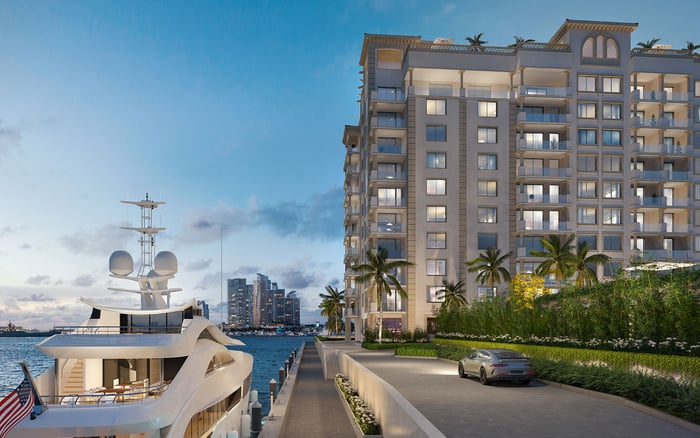
A discreet framework for evaluating security planning in Miami luxury residences, from arrival sequences and private-space design to staffing, technology, emergency protocols, and ongoing governance.

For a luxury buyer, security planning is less about visible hardware than controlled movement, clear accountability and discretion. The strongest starting point is a personal brief: who will occupy the residence, how often it will be used, which guests and service providers require access, and what privacy means to the household.
This buyer’s guide treats security as part of the ownership experience rather than a standalone amenity. A primary home, a seasonal retreat and a frequently vacant residence create distinct operational demands. Family routines, staff, pets, deliveries, drivers and entertaining should all inform the evaluation before a buyer becomes attached to views or finishes.
Distinguish privacy from security. Privacy concerns exposure, observation and information; security concerns access, detection and response. The two overlap, but a residence can feel secluded without a clearly defined response plan, just as a highly controlled building can still create unwanted visibility.
Assess every transition from the street to the private interior. Consider the vehicle approach, pedestrian entrance, parking route, elevator journey, service access and delivery path. The question is not merely whether a gate or desk exists, but whether each handoff is clear and consistently managed.
In Brickell, buyers comparing The Residences at 1428 Brickell with other urban options should ask how residents, guests, household employees and vendors move through the property. Request a live demonstration during both quiet and active periods. Observe whether convenience relies on informal exceptions that could weaken the intended access structure.
Parking warrants equal attention. Review how a resident moves from vehicle to residence, how visitors are received, and what happens when a driver, rental car or service technician arrives. A coherent sequence should remain practical in daily life, not only during a polished presentation.
Once inside, study sightlines, door placement, terraces, secondary entries and the separation of social, family and service areas. Floor level alone does not determine privacy. Nearby buildings, shared outdoor spaces, elevator configuration and the visibility of arrivals may matter more.
When considering Miami Beach, approach a tour of The Perigon Miami Beach with the same disciplined questions applied elsewhere: Where does private space truly begin? Which thresholds are shared? How are approved visitors directed? What happens when a resident is away?
Technology should support the household, not complicate it. Ask who administers credentials, how permissions are changed, what residents can control, and what requires building involvement. Any proposed private system should be reviewed for compatibility, maintenance responsibilities and practical ease of use.
Security infrastructure is only as effective as the operating structure around it. Buyers should understand who supervises access, who can authorize exceptions, how incidents are escalated, and how residents receive time-sensitive communications. Ask whether procedures apply consistently to guests, contractors, brokers, deliveries and private staff.
In Coconut Grove, purchasers considering Four Seasons Residences Coconut Grove should make operational questions part of their broader lifestyle review. The aim is not to seek confidential details, but to determine whether management can clearly explain responsibilities, resident expectations and channels for addressing concerns.
Governance continues to matter after closing. Review the documents available to purchasers, identify which security-related decisions rest with management or the association, and clarify the process for requesting modifications. A buyer planning cameras, access controls, privacy treatments or other installations should obtain written guidance before assuming alterations will be permitted.
Neighborhood selection changes the context, but it does not replace property-level diligence. A buyer may prefer the energy of Brickell, the residential character of Coconut Grove, the coastal rhythm of Miami Beach or the positioning of Bal Harbour. Each choice should be tested against actual routines, including school runs, airport transfers, dining, boating, medical appointments and household staffing.
When reviewing Rivage Bal Harbour or another coastal residence, walk the surrounding approach as well as the interior route. Consider daytime and evening patterns, planned pickup points, and how the household would manage arrivals during busy moments. Do not treat any address or property type as a substitute for a tailored assessment.
Before committing, translate preferences into written questions. Request the purchaser materials available for review, inspect the residence and relevant common routes, and identify any assumptions requiring confirmation. Security consultants, attorneys, insurance advisers, technology specialists and property inspectors can each address a different dimension of the decision.
The objective is not absolute certainty. It is a residence whose design, management and rules align with the buyer’s priorities, supported by an ownership plan that can be maintained without unnecessary friction.
When should security planning begin? Begin before property tours so the household’s priorities can guide the selection of a neighborhood, building and residence.
Is a gated entrance enough to establish security? No single feature resolves the question. Evaluate the entire access sequence, staffing structure and response process.
Should buyers disclose every personal concern during a tour? Share only what is necessary to evaluate the property, and reserve sensitive details for qualified advisers in an appropriate setting.
How should a buyer assess building staff? Focus on clearly defined roles, authorization procedures, communication channels and the consistency of daily operations.
What should be reviewed for a seasonal residence? Ask how access, inspections, maintenance, deliveries and urgent communications are managed while the owner is away.
Does a higher floor automatically provide more privacy? Not necessarily. Sightlines, adjacent structures, elevator arrangements and shared spaces should all be considered.
Can owners add private security technology? Permission and technical compatibility may vary. Obtain written guidance and specialist advice before planning alterations.
How important is parking access? It is central to the arrival path and should be evaluated for residents, guests, drivers and service providers.
What documents merit professional review? Review purchaser materials, governing documents, alteration rules and relevant insurance considerations with qualified advisers.
What is the final test before choosing a residence? Confirm that access, privacy, operations and emergency planning work together for the household’s actual routines.
To compare the best-fit options with clarity, connect with MILLION.
If branded residences are on your mind — as a home or as an allocation — we would be glad to share what we are seeing, privately.
Begin a quiet conversation