A disciplined Stockholm-to-Aventura move prioritizes school continuity, treats new-construction delivery as variable, and uses temporary housing to create flexibility before the permanent move.

For a family leaving Stockholm for Aventura, the most controlled relocation is not necessarily the one with the fewest moves. It is the one that protects continuity for the household while retaining flexibility around a new residence whose completion and closing timeline may change.
Begin by selecting the preferred point in the school year for arriving in South Florida. That decision creates an operational target for temporary housing, travel, enrollment preparation and the shipment of essential belongings. The property schedule can then be organized around the family calendar instead of dictating it.
Protect the family calendar by allowing the property timeline to remain flexible.
This approach separates two decisions that are often combined too early: when the family should establish itself in Aventura and when the permanent residence will be ready for daily life. Treating those moments independently can reduce pressure throughout the relocation.
A projected construction milestone should not be treated as a guaranteed moving date. Before coordinating an international shipment or ending existing housing arrangements, review the latest information available from the appropriate project representatives and the governing purchase documents.
The practical review should focus on the sequence between construction progress, closing notice, the final walkthrough and possession. Buyers should also consider how much time they may need after closing for inspections, utility activation, deliveries, window treatments, technology setup and other essentials.
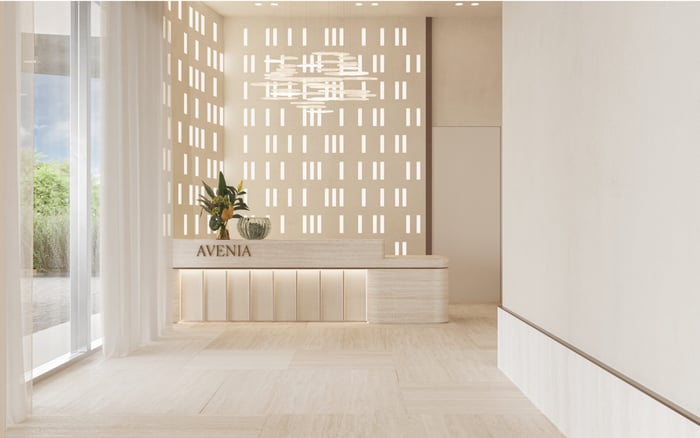
Avenia Aventura may be included in an Aventura-focused residence search. The project decision, however, should account for more than architecture and amenities. The household needs a transition plan that continues to work if the expected handover changes.
A furnished rental can serve as a deliberate bridge between arrival in South Florida and occupancy of the permanent home. It gives the family a local base while preserving room for construction, closing and setup changes.
Choose the initial lease period by working backward from the school-year entry point and forward from a conservative view of residence readiness. Avoid making the lease expire immediately after the earliest anticipated handover. A small timing cushion can be more valuable than a perfectly efficient schedule that leaves no response to delay.
The temporary home should be evaluated for everyday function. Bedroom configuration, workspace, parking, storage, commute patterns and access to regular activities may matter more during this phase than decorative finishes. Confirm all financial and operational terms directly before committing, including what happens if the stay must be extended or shortened.
International movers add another layer. The family may prefer to bring only essential items into the furnished residence while holding larger shipments until the permanent home can receive them. That choice should be coordinated with the mover and the storage provider rather than assumed.
School planning should happen alongside the temporary-home search, not after a lease has been signed. Families should contact the relevant school or appropriate local administrator to confirm current enrollment requirements, timing and any address-related considerations for the intended temporary residence.
Prepare the records requested through the applicable process before departure where possible. If any document must be translated, updated or presented in a particular form, identifying that requirement early gives the family time to respond without compressing the move.
The temporary residence should therefore be assessed as part of a broader household plan. A home that looks ideal in isolation may be less effective if it complicates school preparation, commuting or the later move into the permanent property.
Flexibility is the central feature of a useful bridge lease. The family should seek clear written terms addressing the initial stay, any extension process, notice requirements and the consequences of changing the departure date.
Do not rely on an informal expectation that more time will be available. If an extension is important to the strategy, it should be understood before the lease is executed. The same care applies to deposits, included services, parking, building procedures and move-in or move-out coordination.
A fallback should also be identified even when the preferred rental appears secure. Knowing what the family would do if the lease cannot be extended prevents a timing issue from becoming an urgent housing search.
The permanent move should follow confirmed readiness rather than the first possible opportunity to take possession. A brief overlap between the furnished lease and the completed residence can provide time for the walkthrough, essential installations, deliveries and corrections.
Use a suitable pause in the family calendar when possible. The goal is not to force every task into a single day, but to separate property setup from the household transfer. Children can remain in the established routine while adults address the practical details of the new home.
The overlap should be planned rather than allowed to happen accidentally. Set a readiness checklist for the permanent residence and release the temporary home only when the critical items are complete.
Aventura can remain the center of the search while nearby coastal projects provide useful comparisons. Bentley Residences Sunny Isles and St. Regis® Residences Sunny Isles offer alternatives in neighboring Sunny Isles Beach, while Shell Bay by Auberge Hallandale extends the comparison into Hallandale Beach.
A broader shortlist can help the family compare residence preferences with the practical demands of relocation. Apply the same timing test to every candidate: whether temporary housing, school planning and permanent occupancy can form a coherent sequence.
Geographic flexibility should not weaken the original brief. It should reveal which option best supports the family before, during and after the transition from Stockholm.
The first stage is preparation: select the preferred school-year entry point, organize the necessary records and define temporary-housing requirements. The second is arrival: establish a functional South Florida routine without making the household dependent on an estimated construction milestone.
The third stage begins only when the permanent residence is ready. Complete the essential property setup, preserve enough overlap to solve practical issues and then transfer the household on a schedule that minimizes disruption.
This structure allows the permanent home to remain the destination without asking it to serve as the family’s only timing mechanism. It turns an uncertain delivery process into a manageable series of decisions centered on continuity, flexibility and readiness.
For discreet guidance on coordinating an Aventura residence search with your family’s relocation timeline, connect with MILLION.
If branded residences are on your mind — as a home or as an allocation — we would be glad to share what we are seeing, privately.
Begin a quiet conversationChoose the family’s preferred school-year entry point first. Organize temporary housing and the property timeline around that decision.
No. Treat it as a planning input and wait for confirmed readiness before scheduling the permanent move.
A furnished residence can provide a functional local base while the family waits for closing and prepares the permanent home.
Begin it alongside the temporary-housing search. Confirm current requirements through the relevant school or appropriate local administrator.
Review the stay period, extension process, notice requirements, deposits, included services, parking and building procedures.
It can preserve housing continuity if the residence handover or setup takes longer than expected.
Not necessarily. Coordinate essential belongings, larger shipments and any storage needs with the relevant providers.
An overlap creates time for walkthroughs, installations, deliveries and corrections before the household transfers.
Yes. Nearby South Florida projects can provide useful comparisons when the same relocation and timing criteria are applied.
Leave after the permanent home meets the household’s essential readiness checklist and the transfer can occur with minimal disruption.