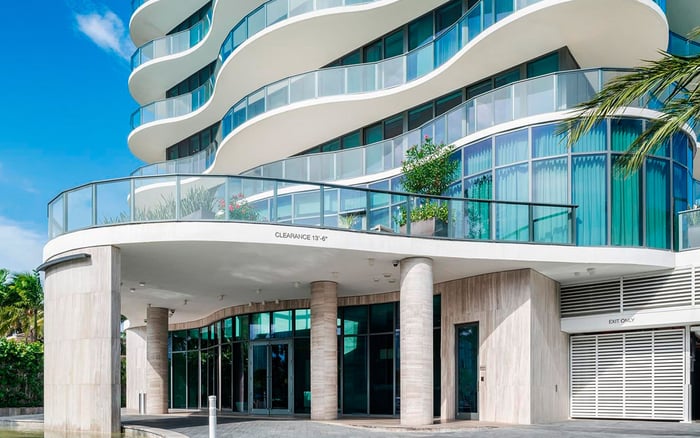
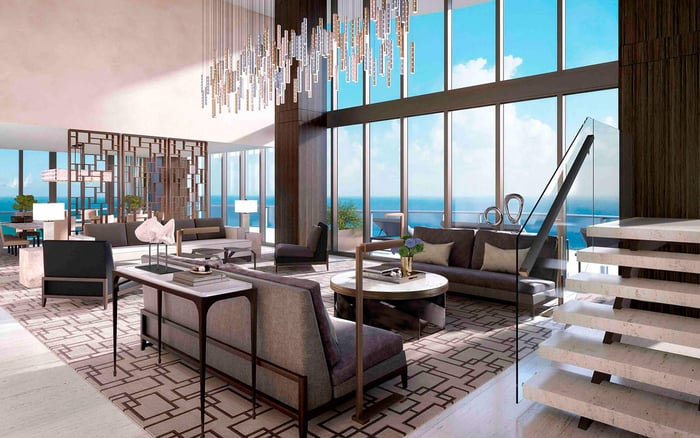
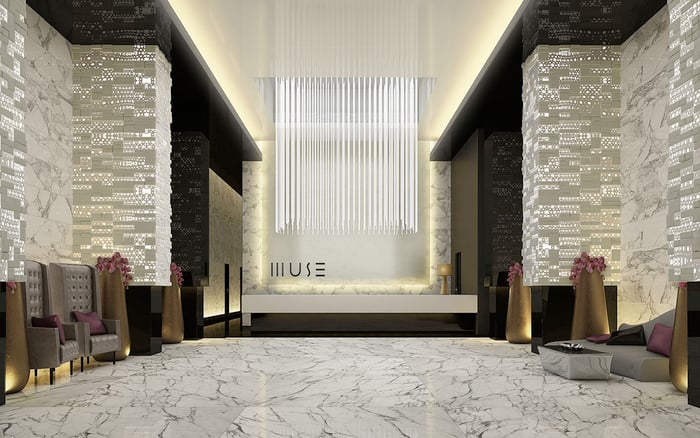
Jade Signature offers privacy, scale, and strong display potential, but collectors should treat art logistics as a due-diligence discipline. Freight dimensions, structural limits, installation approvals, and environmental controls all require written verification before acquisition or delivery.
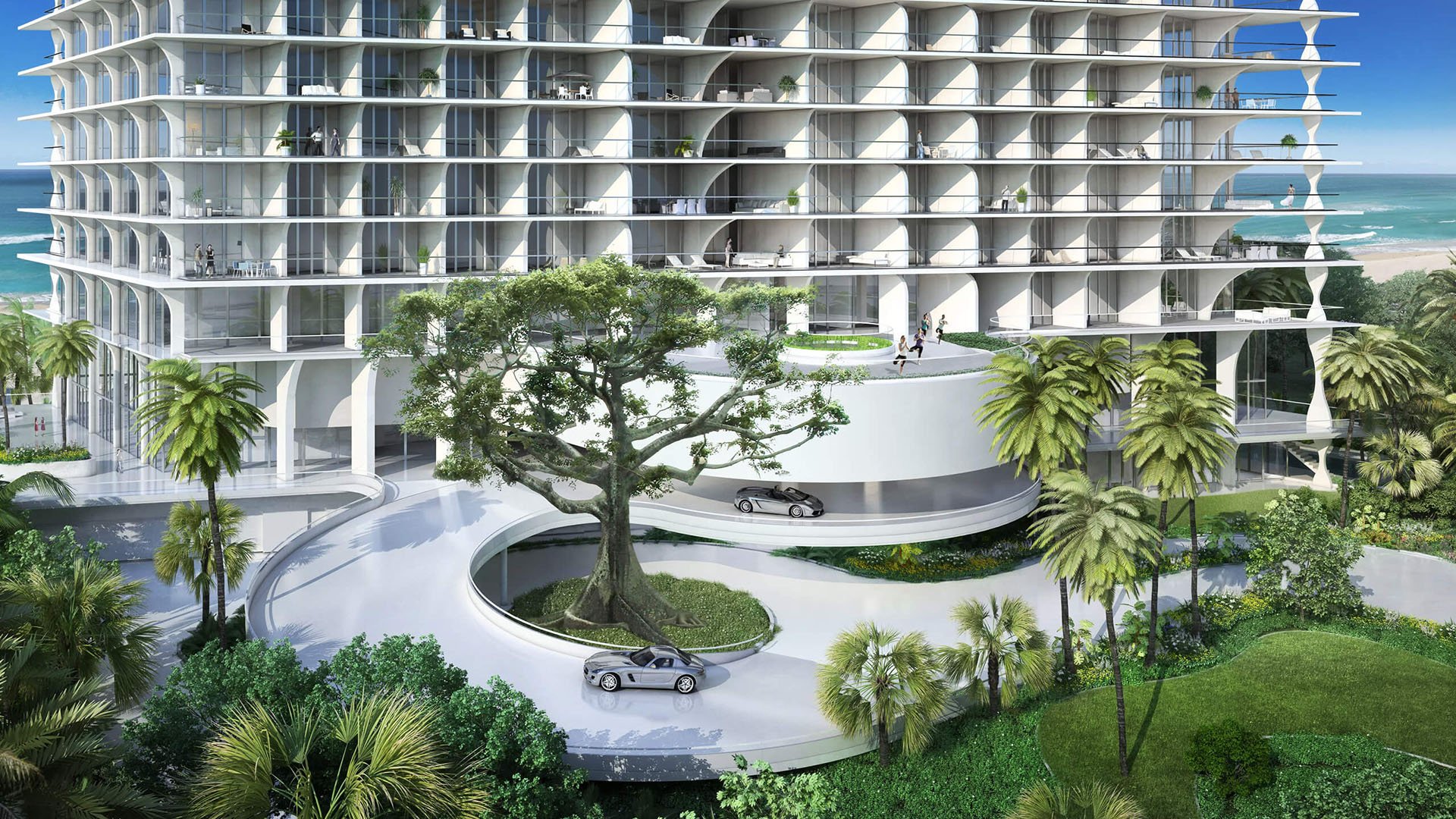
At 16901 Collins Avenue, Jade Signature Sunny Isles Beach offers a compelling architectural setting for a private collection. Designed by Herzog & de Meuron, the oceanfront tower rises approximately 649 feet and encompasses about 1.31 million square feet of gross floor area. Its 192 residences span 57 floors-an average of roughly 3.4 homes per floor-supporting a comparatively private residential experience.
Residence sizes extend from approximately 1,300 to 11,661 square feet, offering buyers a broad spectrum of display possibilities. Standard residences have 10-foot ceilings, while private elevator lobbies provide a discreet point of arrival for valuable works. Yet these qualities address only part of a collector’s brief. A successful installation depends on whether a crated work can enter the building, travel in the designated elevator, negotiate every turn, and rest safely on the intended slab or terrace.
For collectors, the decisive measurement is often the entire route, not the room.
The relevant buyer lenses are Oceanfront, Design & Architecture, Flow-Through-units, and Terrace. Each captures a genuine aspect of the property while introducing a practical question involving light, loading, circulation, or approvals.
The building has high-speed elevator systems, but the service or freight cab’s internal dimensions, clear door opening, and rated capacity are not disclosed. Collectors should obtain those figures directly from management before committing to an oversized painting, sculpture, display case, or densely packed storage component.
A complete logistics request should include cab width, depth, and height; door width and height; rated weight capacity; loading access and truck restrictions; reservation hours; fees; protective-covering requirements; and any limits on crew size or staging. The crate, packing materials, handling equipment, and personnel all contribute to the elevator load. The relevant comparison is not simply the artwork’s weight against a headline capacity.
The route must be treated as a continuous sequence. Measure from the delivery vehicle through the loading approach, building doors, elevator threshold, private foyer, residence entrance, interior turns, and final room. Door hardware, ceiling fixtures, narrow angles, and insufficient turning radius can defeat a move even when the elevator cab appears large enough.
Private elevator lobbies improve discretion, but they should not be treated as temporary warehouse space. They remain subject to condominium rules governing common elements, so prolonged crate staging may be prohibited or tightly scheduled. Low unit density may reduce incidental traffic, but it does not guarantee freight availability or an extended installation window.
Collectors evaluating the broader Sunny Isles Beach market may also consider Jade Ocean Sunny Isles Beach, but another tower’s procedures are no substitute for Jade Signature’s current written policies.
The tower’s overall scale is clear, but residential slab-load ratings in pounds per square foot are not publicly available. That omission matters because a heavy sculpture can create a concentrated load through a small base, pedestal, or set of contact points. Total weight alone does not establish whether a proposed placement is acceptable.
Before installing stone, metal, or another dense work, a buyer should request available structural drawings and written load limits for the precise location. A qualified structural engineer should review concentrated pedestal loads, dense art-storage systems, suspended pieces, and other unusually heavy assemblies. The analysis may need to address load distribution, proximity to structural elements, and whether a larger engineered base is appropriate.
Terraces require a separate assessment. Jade Signature’s oversized, deep terraces may invite outdoor sculpture, but collectors should verify the applicable load rating before placement. Wind exposure, anchoring, drainage, waterproofing, and association approval can be as consequential as weight. No sculpture should be drilled into or fixed to a terrace assembly merely because its dimensions suit the space.
This discipline applies across high-rise collecting environments, including Muse Residences Sunny Isles Beach. Even so, engineering conclusions and approvals remain specific to the building and residence.
Detailed Jade Signature rules for freight reservations, delivery hours, vendor insurance, and invasive art installation require direct verification. Buyers should obtain the current condominium declaration, house rules, alteration procedures, and freight-elevator policies. Verbal guidance is useful for orientation, but written approval is the appropriate standard before a costly mobilization.
Art handlers and installers should satisfy current licensing, insurance, access, and scheduling requirements. Management may also require advance reservations, certificates of insurance, elevator protection, floor protection, supervision, deposits, or fees. Exact requirements should be confirmed rather than inferred.
Heavy wall and ceiling installations warrant early review. Structural walls, columns, mechanical routes, and integrated finishes can limit anchor placement. The same caution applies to slab drilling, wall reinforcement, ceiling suspension, terrace anchoring, UV-control films, and supplemental humidity equipment. Collectors should determine which measures require alteration approval before finalizing design drawings.
A private foyer can make the final transfer more discreet, yet installers still need a precise handling plan. That plan should identify unpacking space, protection for finished surfaces, debris removal, safe tool use, and a contingency if the work cannot clear an interior turn. The objective is to preserve both the art and the residence without assuming flexibility the governing documents do not grant.
Every residence has a flow-through plan from the Atlantic side to the Intracoastal side. This creates varied exposures and long sightlines, but it also produces changing daylight conditions across the home. Floor-to-ceiling impact glass can intensify brightness and ocean glare, making shades, UV-control films, or conservation glazing relevant for light-sensitive pieces.
Collectors should map direct sun and reflected light at intended display locations rather than judge conditions during a single showing. Works on paper, textiles, photographs, and sensitive pigments may require more controlled placement than robust sculpture. Any proposed window film should be checked against association rules before installation.
Ceiling height and room size must also be considered alongside handling tolerances. A painting that fits a 10-foot wall may still be impossible to rotate from horizontal to vertical after entering the room. Likewise, a sculpture may fit visually yet leave insufficient clearance for lifting equipment, assembly, or future removal.
Buyers comparing newer options such as The Ritz-Carlton Residences® Sunny Isles should apply the same work-specific review rather than assume that a newer or larger residence automatically resolves art logistics.
The most effective due diligence begins before either the artwork or the residence is acquired. First, obtain current freight policies and exact access measurements. Second, provide the art handler with crate dimensions, packed weight, required equipment, and installation method. Third, arrange a structural review wherever weight is concentrated or anchoring is contemplated. Fourth, secure written alteration and delivery approvals. Finally, test the proposed display position for daylight, glare, access, and eventual removal.
This process can also shape negotiations and interior planning. A work that cannot travel intact may require approved on-site assembly, a different crate, or another display location. A heavy sculpture may need an engineered distribution base. A light-sensitive collection may justify integrated shades or conservation glazing, subject to approval. These are not peripheral details; they determine whether architectural promise can function as a secure, serviceable setting for significant art.
For discreet guidance on evaluating art-ready residences in South Florida, consult MILLION.
If branded residences are on your mind — as a home or as an allocation — we would be glad to share what we are seeing, privately.
Begin a quiet conversationNo detailed freight-cab dimensions, clear door opening, or rated capacity are publicly disclosed. Collectors should request them directly from management in writing.
Request cab and door measurements, rated capacity, loading access, truck restrictions, reservation hours, fees, and protection requirements.
A private foyer may offer discreet transfer space, but prolonged staging should not be assumed because condominium rules govern common elements.
Public project materials do not provide residential slab ratings in pounds per square foot. Written limits and structural drawings should be requested for heavy installations.
Not by itself. Base dimensions and contact points can create concentrated loads that require review by a qualified structural engineer.
Only after verifying the terrace load rating and reviewing wind, anchoring, drainage, waterproofing, and approval requirements.
Collectors should confirm current licensing, insurance, access, scheduling, and alteration requirements before work begins.
Drilling should be reviewed first because structural elements, mechanical routes, integrated finishes, and alteration rules may restrict anchor placement.
Atlantic and Intracoastal exposures create varied daylight conditions. Light-sensitive works may require careful placement, shades, UV-control film, or conservation glazing.
Evaluate feasibility before buying the work or residence by mapping the full route, confirming clearances, checking capacity, and securing required approvals.