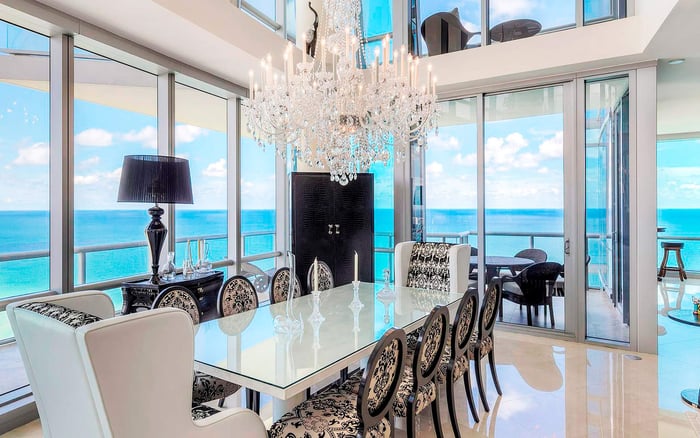
At Jade Ocean, a seller’s property-tax history is not a buyer’s annual budget. Understanding the post-sale reassessment, the combined millage rate and the distinction between taxable value and purchase price reveals the tax component of true ownership carry.

At Jade Ocean Sunny Isles Beach, the distinction between acquisition price and annual carry deserves attention before an offer becomes a contract. The oceanfront condominium at 17121 Collins Avenue, Sunny Isles Beach, sits in Miami-Dade County, where tax analysis begins with the individual residence-not a building-wide average.
A seller’s historical tax bill reflects a previous ownership position. It does not establish the buyer’s future liability. For a non-homestead purchase, reassessment to full market value in the year following the sale can materially change the tax component of ownership, even if association charges and every other expense remain unchanged.
The seller’s bill is neither a reliable forecast nor a guaranteed floor. The direction and size of the change depend on reassessed taxable value, applicable exemptions and the rates in effect. For a luxury buyer, the objective is not to assume a punitive increase. It is to replace an inherited number with a defensible budget.
Jade Ocean residences have individual tax parcels. Unit 3808, parcel 31-22-11-081-2490, has a historical annual tax figure of $42,493 for 2025. Unit 1208, parcel 31-22-11-081-2240, has a figure of $33,226 for the same year.
These figures are useful starting points, but they are not independently verified tax bills or buyer-specific estimates. Nor do they establish either owner’s homestead status. The difference between them is not proof that one residence will retain a similar tax advantage after purchase.
For a buyer also considering Jade Signature Sunny Isles Beach, the comparison should follow a consistent method: distinguish each seller’s tax history from the buyer’s expected liability. Otherwise, a spreadsheet can reward an ownership history rather than identify the more economical acquisition.
Florida non-homestead property is reassessed at full market value in the year following a sale. The seller’s accumulated assessment-cap protection does not preserve the same assessed value for the buyer after that reset.
That timing matters. A budget built around the historical bill can appear comfortable at acquisition while understating the following year’s tax expense. Keep the sale-year figure and the post-reassessment estimate separate; they are not interchangeable annual costs.
A second home without a homestead exemption falls within the non-homestead category. Florida’s non-homestead assessment limitation is 10%; homesteaded property has a separate maximum 3% Save Our Homes assessment cap. These are assessment limitations, not guarantees that the total tax bill can rise by no more than those percentages. They should not be used to project the seller’s bill through a sale-triggered reset.
Equally important, full market value is not automatically the purchase price. Using the proposed price as an assumed taxable value can support an initial underwriting scenario, but it must remain an assumption. A buyer should confirm the expected assessment treatment and applicable exemptions for the particular residence.
For illustration, a 2025 combined Sunny Isles Beach rate of 16.7227 mills equals $16.7227 for every $1,000 of taxable value, or 1.67227%. This is a budgeting reference, not confirmation of a parcel-specific adopted rate or a guarantee of future rates.
The calculation is straightforward: multiply assumed taxable value by 0.0167227 to produce illustrative annual ad valorem tax. Divide by 12 to express that expense as a monthly budget equivalent-not a monthly billing schedule.
| Assumed taxable value | Illustrative annual tax | Monthly budget equivalent | | --- | --- | --- | | $2 Million | $33,445 | $2,787 | | $3 Million | $50,168 | $4,181 | | $5 Million | $83,614 | $6,968 |
Figures are rounded and represent ad valorem tax only. They are not total ownership costs, nor do they establish what any specific Jade Ocean residence will owe.
The marginal change is particularly useful for budgeting. At this illustrative rate, an additional $500,000 of taxable value adds approximately $8,361 annually, or $697 monthly. An additional $1 million adds approximately $16,723 annually, or $1,394 monthly.
With every other ownership expense held constant, those amounts represent the increase in annual and monthly carry. This isolates the effect of reassessment without implying that association dues, insurance or other costs have also been forecast.
Sunny Isles Beach’s municipal rate for the adopted FY 2025-26 budget is 1.7 mills. That is distinct from the combined rate used in the illustration, which covers overlapping taxing authorities. Applying only the city rate would materially understate the full ad valorem tax estimate.
The scale of a municipal adjustment also deserves perspective. A reduction from 1.8 to 1.7 mills saves $200 annually on $2 million of municipal taxable value. That is a different order of magnitude from the approximately $8,361 associated with a $500,000 increase in taxable value at the illustrative combined rate.
A lower municipal rate can therefore coexist with a higher buyer-specific tax budget. Rate headlines and reassessment answer different questions: one concerns the charge applied to value; the other concerns the value to which that charge applies.
When weighing Jade Ocean against Turnberry Ocean Club Sunny Isles, use the same budgeting framework without assuming identical assessments or tax outcomes. Compare each residence’s expected carry under the buyer’s circumstances, not simply the tax line beside the asking price.
Before committing, organize the review around four practical questions:
Does the historical tax figure match the exact parcel and stated tax year?
What reassessed taxable value is reasonable to use for the buyer’s intended ownership?
Which exemptions and combined rates belong in the estimate?
What verified association charges, insurance costs and special assessments must be budgeted separately?
Maintain a historical column and a buyer-estimate column. Show the tax difference explicitly, then add independently confirmed operating costs. Label any purchase-price-based estimate as an underwriting assumption rather than an official valuation.
The result is a more meaningful annual carry figure, not an unsupported all-in range. At Jade Ocean, disciplined tax underwriting allows the residence to be evaluated on its merits without letting the seller’s assessment history set the buyer’s expectations.
For a considered approach to South Florida ownership, explore MILLION.
If branded residences are on your mind — as a home or as an allocation — we would be glad to share what we are seeing, privately.
Begin a quiet conversationJade Ocean is an oceanfront condominium at 17121 Collins Avenue, Sunny Isles Beach, FL 33160, in Miami-Dade County.
The seller’s bill is historical context, not a buyer-specific forecast or guaranteed floor. Future liability depends on reassessed taxable value, applicable exemptions and rates.
Non-homestead property is reassessed at full market value in the year following the sale. The seller’s accumulated assessment-cap protection does not preserve the same assessed value for the buyer.
Full market value is not automatically the purchase price. A purchase-price-based taxable-value calculation should be labeled as an underwriting assumption.
It falls within the non-homestead category. Buyers should confirm the assessment treatment and any applicable exemptions for their specific residence.
The 10% non-homestead limitation and maximum 3% Save Our Homes cap are assessment limitations, not guaranteed limits on total tax-bill growth. They should not be used to carry the seller’s bill through a sale-triggered reset.
The calculations use a 2025 illustrative combined Sunny Isles Beach rate of 16.7227 mills, equivalent to 1.67227%. It is not a parcel-specific adopted-rate confirmation or a guaranteed future rate.
At 16.7227 mills, the illustrative annual ad valorem tax is approximately $50,168, equivalent to $4,181 monthly for budgeting. This is not total ownership carry.
At the illustrative rate, it adds approximately $8,361 annually, or $697 monthly. Holding all other ownership expenses constant, that is also the increase in carry.
The municipal rate is only one component of the combined tax burden. A full estimate must account for overlapping taxing authorities rather than applying the city rate alone.