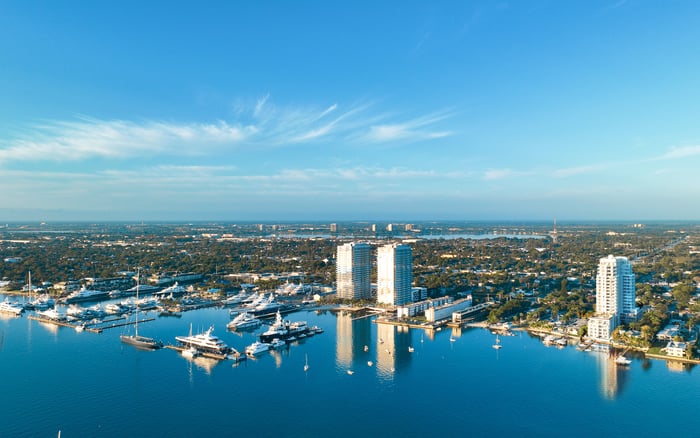
A buyer-focused framework for evaluating Forté on Flagler’s wind, flood, deductible, reserve, and potential assessment exposure before closing.

Insurance diligence at Forté on Flagler West Palm Beach should focus on the coverage and financial documents available during the buyer’s review period. The existence of a master policy alone does not answer the central questions: which property and perils are covered, what limits and exclusions apply, how deductibles are calculated, and who is responsible for an unpaid balance.
A buyer should request the association’s current insurance certificate, declarations pages, endorsements, exclusions, coverage limits, and deductible schedule. These materials should be reviewed alongside the condominium declaration, bylaws, budget, reserve information, financial statements, assessment history, and estoppel documentation available for the transaction.
Wind and flood should be evaluated as distinct parts of the insurance review. Buyers should not assume that evidence of one form of property coverage establishes protection against every peril.
For each policy, identify the insured property, applicable limits, deductibles, exclusions, and owner responsibilities. The review should also determine whether interior improvements, personal property, or other unit-level items fall outside the association’s coverage and therefore require separate protection.
The objective is to align the association’s insurance program with the buyer’s personal condominium policy. Any overlap or gap should be identified before closing rather than after a loss.
A deductible expressed as a percentage can be difficult to evaluate without converting it into dollars. Buyers should ask their insurance adviser and counsel to calculate the applicable amount from the policy documents and explain how the governing documents permit that obligation to be allocated.
The next step is to test the buyer’s personal coverage against that potential exposure. Loss-assessment coverage may be relevant when an association allocates certain costs to owners, but its limits, exclusions, and conditions must be confirmed in the owner’s actual policy.
This analysis should distinguish among a master-policy deductible, an uninsured loss, excluded property, and an assessment for another association obligation. Each can create a different coverage result.
Insurance and reserves perform different functions. Insurance may respond to a covered loss, while association funds may be needed for deductibles, exclusions, coverage shortfalls, or costs outside the policy.
Review the available budget, reserve balances, reserve study, financial statements, assessment history, and disclosed obligations. Ask whether particular funds are restricted, whether planned assessments have been disclosed, and how an unexpected insurance-related expense could be funded.
Because current premiums, deductibles, reserve balances, and claims information can change, buyers should rely on the transaction’s current association and insurance records. A financial review can then model both recurring carrying costs and a potential assessment scenario without assuming that either will occur.
Buyers may also consider Alba West Palm Beach, Shorecrest Flagler Drive West Palm Beach, and The Ritz-Carlton Residences® West Palm Beach. Similar positioning does not establish that different properties have equivalent insurance programs or reserve structures.
For a useful comparison, apply the same framework to every candidate: covered property, wind and flood treatment, limits, deductibles in dollars, exclusions, owner obligations, reserve resources, and assessment provisions. The comparison should be based on current documents rather than branding or marketing descriptions.
Before the applicable review period ends, the buyer’s attorney, insurance adviser, and financial adviser should examine the same document package. Counsel can interpret the governing documents, the insurance professional can assess coverage structure, and the financial adviser can evaluate liquidity under deductible or assessment scenarios.
The closing decision should answer four practical questions: What event or obligation is being evaluated? Which policy may respond? What amount could remain unpaid? Who would be responsible for that balance? Clear answers can place Forté’s less visible ownership obligations into a more useful financial framework.
Does a master property policy establish that flood is covered? Not necessarily. Buyers should verify flood coverage, limits, deductibles, exclusions, and insured property in the current documents.
Which insurance documents should a buyer request? Request the current certificate, declarations pages, endorsements, exclusions, limits, and deductible schedule available for review.
Why should a percentage deductible be converted into dollars? A dollar calculation makes the potential exposure easier to compare with association funds and the buyer’s personal coverage.
Is a deductible necessarily based on the condominium purchase price? Buyers should not assume so. The controlling policy language and applicable insured amount must be reviewed.
Can an insurance-related cost create an assessment? It may, depending on the loss, available coverage, association funds, and allocation provisions in the governing documents.
Which financial records are relevant to reserve exposure? Review the available budget, reserve balances, reserve study, financial statements, assessment history, and disclosed obligations.
Why coordinate a personal condominium policy with the master policy? Coordination can identify responsibility for interiors, personal property, liability, deductibles, and other possible gaps.
What is loss-assessment coverage? It is personal policy coverage that may respond to certain association assessments, subject to the policy’s terms, exclusions, and limits.
Should competing West Palm Beach projects be compared on insurance? Yes. Buyers can apply the same document-based framework to each project rather than assuming their coverage structures are alike.
Who should review the diligence package before closing? Qualified legal, insurance, and financial advisers can review the documents from their respective professional perspectives.
For a confidential assessment and a building-by-building shortlist, connect with MILLION.
If branded residences are on your mind — as a home or as an allocation — we would be glad to share what we are seeing, privately.
Begin a quiet conversation