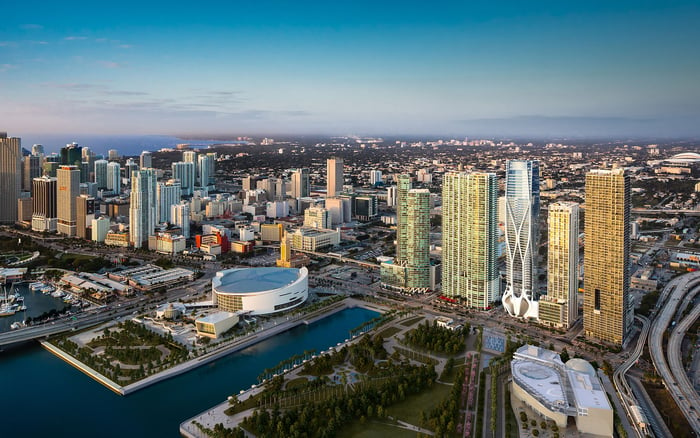
At Waldorf Astoria Residences Downtown Miami, brand identity and ownership obligations are separate considerations. Understanding mixed-use cost allocation, milestone inspections and documented repair exposure can help buyers frame more disciplined negotiations.

At Waldorf Astoria Residences Downtown Miami, ownership extends beyond the residence itself. Marketed as a 100-story, approximately 1,049-foot tower at 330 Biscayne Boulevard, the project combines privately owned condominiums with a Waldorf Astoria-branded hotel. Of its nine stacked cubes, the first three house the hotel, with residences and residential amenities above.
That architectural arrangement raises a practical question: how do the legal documents divide responsibility within a shared building? The answer matters when evaluating maintenance obligations, future structural inspections and potential repair expenses.
Nothing here identifies an existing milestone inspection or structural defect at this project. The distinction is between development-stage document review and future resale diligence when an inspection becomes applicable. Neither the current construction stage nor a project-specific inspection year is established here.
Hilton does not own, develop or sell these residences, and its brand relationship provides no Hilton representations, warranties or guarantees concerning them. Branding, hotel operation and legal ownership are distinct. Buyers should not infer who owns the hotel-or who ultimately pays a shared expense-from the Waldorf Astoria name.
The condominium association has statutory inspection responsibilities. Review the declaration and hotel or shared-facility agreements for the allocation of inspection, maintenance and repair costs. The key questions are who commissions the work, which property components it covers and how the residential share is allocated to an individual owner.
For a buyer also considering Aston Martin Residences Downtown Miami, the useful comparison rests on documents, not names. Review each property's obligations independently; neither a prestigious identity nor a similar location establishes an equivalent ownership structure.
Florida's milestone-inspection framework covers buildings at least three habitable stories tall that are subject wholly or partly to residential condominium or cooperative ownership. A hotel component does not, by itself, exempt a qualifying mixed-use building.
The standard first-inspection deadline is December 31 of the year a building reaches 30 years of age, with subsequent inspections every 10 years. Do not translate that general framework into a specific Waldorf Astoria deadline without confirming the applicable building records and local requirements. An automatic coastal 25-year deadline should not be assumed for this project.
A Florida-licensed architect or engineer must perform the inspection. Phase One generally must be completed within 180 days after the association receives the local enforcement agency's inspection notice. For a future transaction, request any applicable notice and confirm the association's compliance status rather than relying solely on a seller's description.
Phase One is a visual examination of habitable and nonhabitable areas, including major structural components. It provides a qualitative structural assessment intended to identify substantial structural deterioration. If none is found, Phase Two is not required.
In negotiation, that result can narrow a buyer's concerns. It does not establish that reserves are adequate, that every maintenance issue has been resolved or that future repairs will be unnecessary. A milestone inspection and a reserve study answer different questions and should remain separate elements of diligence.
Read a clean Phase One alongside reserve studies, budgets and any approved or proposed special assessments. A buyer may have less reason to seek a structural-risk concession while still needing to understand a separately documented funding obligation. The absence of substantial structural deterioration does not replace a review of the association's finances.
Phase Two is required when substantial structural deterioration is identified during Phase One. It may involve destructive or nondestructive testing selected by the inspecting professional. Its purpose includes assessing whether the building is structurally sound for its intended use and recommending repairs to distressed or damaged portions.
A pending Phase Two signals an unresolved investigation, not a final assessment amount. Buyers should not treat a preliminary concern as either a proven total liability or an issue that branding will resolve. Negotiation should reflect what is known and what still requires professional evaluation.
One option is to request additional time to review the findings and repair scope before committing. Depending on the transaction, parties may consider conditions tied to receiving and reviewing those materials. These are potential negotiated terms-not automatic statutory rights or assurances that a seller will agree.
Where findings identify repairs but pricing remains unsettled, the next step is to quantify the cost. An engineer's recommendation, a repair estimate and an approved assessment are not interchangeable documents.
Once repair costs are documented, negotiation becomes more concrete. The relevant figure is not simply the building-wide amount, but the portion allocated to the residence under the governing documents. In a mixed-use tower, that calculation requires attention to the division between residential and hotel or shared-facility obligations.
Request applicable Phase One and Phase Two findings, reserve studies, current budgets, repair estimates and approved or proposed special assessments. Read them together to distinguish established obligations from estimates and unresolved proposals. Do not treat a proposed expense as though its scope, funding and allocation were settled.
A documented unit share can inform a price reduction, seller credit or negotiated escrow. None is an automatic entitlement. Counsel should address how any agreed allocation will appear in the contract, including responsibility for identified costs and the terms governing an escrow's release. The objective is to replace a broad concern with a clearly defined obligation.
For a development-stage purchase, focus on governing documents, proposed budgets, maintenance obligations and reserve policies. A future milestone inspection does not replace an understanding of those commitments at acquisition. Ask how shared expenses are allocated and which documents establish the buyer's responsibilities.
If the search extends into Brickell and includes Baccarat Residences Brickell, apply the same discipline without assuming identical hotel arrangements, cost-sharing provisions or inspection circumstances. Compare the obligations disclosed for each property, not a generalized notion of branded ownership.
At Waldorf Astoria, the strongest negotiation position rests on evidence: establish the applicable inspection status, distinguish structural findings from funding questions and identify the residence's documented exposure. A clean Phase One, a pending Phase Two and a priced repair program represent different decision points. Each calls for a different conversation, not a predetermined discount.
For a considered approach to South Florida ownership and property selection, connect with MILLION.
If branded residences are on your mind — as a home or as an allocation — we would be glad to share what we are seeing, privately.
Begin a quiet conversationHilton does not own, develop or sell the residences. The brand relationship should not be confused with developer ownership or a Hilton guarantee concerning the residences.
A hotel component does not, by itself, exempt a qualifying mixed-use residential condominium building. Florida's framework covers buildings at least three habitable stories tall that are wholly or partly under residential condominium or cooperative ownership.
The standard deadline is December 31 of the year a building reaches 30 years of age, followed by inspections every 10 years. A specific deadline for this project requires confirmation of applicable building records and local requirements.
A Florida-licensed architect or engineer must perform the inspection. The condominium association has statutory inspection responsibilities.
Phase One visually examines habitable and nonhabitable areas, including major structural components, to identify substantial structural deterioration. If none is found, Phase Two is not required.
No. A milestone inspection is distinct from a reserve study and does not establish reserve adequacy or guarantee that future repairs will be unnecessary.
Phase Two is required when Phase One identifies substantial structural deterioration. It may involve testing to assess structural soundness for the building's intended use and recommend repairs.
It can prompt negotiation, but an unresolved investigation is not a quantified assessment or an automatic entitlement to a credit. A buyer may instead seek additional time to review findings and repair scope.
Review applicable inspection findings, reserve studies, budgets, repair estimates and approved or proposed assessments. The declaration and shared-facility agreements are important for establishing the residence's allocated share.
No existing milestone inspection or structural defect is established here. The discussion distinguishes development-stage ownership diligence from future resale negotiations when inspections become applicable.