At The Ritz-Carlton Residences® Miami Beach, brand affiliation and project ownership are distinct. Buyers evaluating finishes, alteration rights or completion obligations should look beyond marketing materials to the controlling transaction and condominium documents.

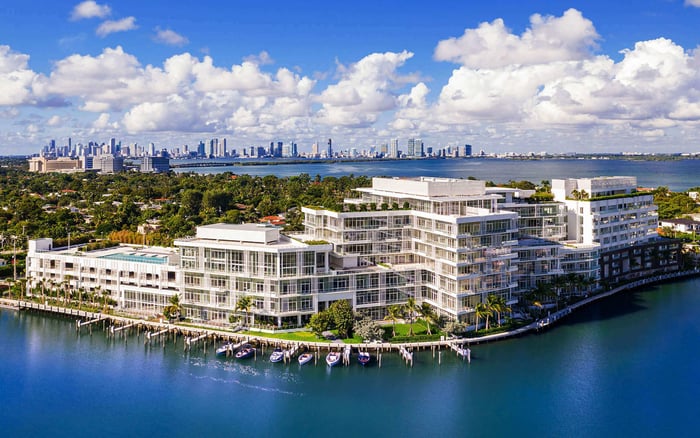
At The Ritz-Carlton Residences® Miami Beach, the name above the entrance does not identify the project’s owner or developer. The development is led by 4701 North Meridian, LLC, a partnership between Lionheart Capital and Elliott Management Corporation. The residences are not owned, developed or sold by The Ritz-Carlton Hotel Company, L.L.C. or its affiliates.
That distinction is foundational. In branded residences, a hospitality identity can shape a property’s positioning and resident experience without making the brand the seller or development principal. Buyers should therefore separate three questions: who developed and sold the residence, which parties administer the condominium, and what contractual role the brand holds. The name alone answers none of them.
The property comprises 111 condominium residences and 15 villas at 4701 Meridian Avenue in Miami Beach. When it received a temporary certificate of occupancy in August 2019, asking prices ranged from approximately $2 million to more than $40 million. At that level, governance details are not peripheral. They can influence the practical scope, cost and pace of a purchaser’s design plans.
In a branded residence, prestige does not replace document-level due diligence.
The project’s public legal language characterized sketches, renderings, plans, specifications, terms, conditions and statements as proposed rather than final. It also reserved broad authority for the developer to modify, revise or withdraw those materials in its sole discretion and without prior notice.
For an original purchaser, that means a brochure finish, visual detail or specification should not automatically be treated as an immutable delivery promise. Enforceability depends on whether the feature was incorporated into the controlling purchase agreement, finish schedule, construction exhibit or condominium documents. Marketing imagery can communicate design intent, but contractual documents determine the protected obligation.
Those public materials do not reveal the complete internal approval chain for a particular stone substitution, millwork package or contractor. Nor do they establish that The Ritz-Carlton brand can veto a specific material or tradesperson. Any claim of such authority requires the relevant agreement, not an inference drawn from branding.
The project identified Lissoni Associati as design architect and Stantec as executive architect. This division of roles indicates that design conception and technical execution were entrusted to separate specialist firms. It does not, on its own, establish who held final contractual approval over every substitution, contractor or installation decision.
That distinction matters because several forms of approval can coexist. A developer may control original construction choices. Architects and consultants may review design compliance. Government agencies may determine whether work satisfies applicable requirements. After turnover, a condominium association may regulate owner alterations through its declaration, rules and architectural-review procedures. The existence and scope of each authority must be confirmed in the applicable documents.
Buyers comparing the property with other Miami Beach offerings, such as Shore Club Private Collections Miami Beach and The Perigon Miami Beach, should not assume that similarly elevated branding or design implies equivalent alteration rights. Each development may have a different declaration, review process, insurance framework and contractor protocol.
An approval right becomes consequential when an owner proposes work that departs from an accepted design vocabulary or affects building systems. Depending on the controlling documents, review may encompass materials, drawings, engineering, waterproofing, noise, working hours, insurance and contractor credentials. These are common review categories, not confirmed project-specific rules for this property.
The necessary diligence must therefore be precise. A buyer considering renovations should request the recorded declaration and amendments, current rules, alteration agreement, architectural-review standards and contractor requirements. The inquiry should establish whether prior written approval is required, who grants it, what submissions are necessary, whether approved materials or vendors are mandated, and which deposits, insurance or supervision provisions apply.
For a resale purchase, the original developer’s modification rights and the current owner’s alteration rights are separate matters. The first concerns what could change during development and delivery; the second, what a resident may change after acquisition. A residence described as move-in ready may still require approvals before custom cabinetry, flooring or other owner-directed work begins.
All improvements, designs and construction were subject to applicable federal, state and local permits and approvals. Because those decisions do not rest exclusively with a developer, an advertised completion schedule can shift even when the design intent remains intact.
The project’s history makes timing risk tangible. Sales began in 2014, and the property was initially marketed as substantially complete by 2017. A temporary certificate of occupancy arrived in August 2019, allowing closings to begin after the earlier target had moved materially. Yet the temporary certificate did not mean every element was finished. The development described itself as entering the “home stretch” after receiving that approval.
This sequence does not establish that design approvals caused the delay. Instead, it illustrates why sophisticated buyers should avoid assigning a single cause without documentary support. Permitting, construction coordination, design decisions and other dependencies can interact, while temporary occupancy and final completion remain distinct milestones.
The same discipline applies when evaluating other waterfront properties, including Five Park Miami Beach. Projected dates should be read alongside contract provisions governing extensions, force majeure, governmental approvals, closing conditions and the legal meaning of substantial completion.
Before committing to a design-sensitive residence, counsel should identify which document controls when promotional language and transaction documents diverge. The review should also determine whether the seller may substitute materials, whether an “equal or better” standard applies, how disputes over equivalency are resolved, and which representations survive closing.
For planned alterations, buyers should request written confirmation of the review sequence and expected response periods. They should also determine whether contractor approval rests on licensing, insurance, experience, union status or another stated criterion. Publicly available materials for this project do not provide those answers; certainty must come from the recorded and contractual framework.
The most important conclusion is measured rather than dramatic. Broad developer discretion and permit contingencies were publicly disclosed, but the full chain governing specific materials, contractors and owner alterations was not. Brand identity, architectural authorship and legal authority are related, but they are not interchangeable. For luxury buyers, the controlling documents remain the clearest map of who may approve what-and when.
For discreet guidance on South Florida’s exceptional residences, connect with MILLION.
If branded residences are on your mind — as a home or as an allocation — we would be glad to share what we are seeing, privately.
Begin a quiet conversationThe developer is 4701 North Meridian, LLC, a partnership between Lionheart Capital and Elliott Management Corporation.
No. The residences are not owned, developed or sold by The Ritz-Carlton Hotel Company, L.L.C. or its affiliates.
The public legal language reserved broad rights to modify, revise or withdraw proposed plans, specifications and related materials without prior notice.
The available public materials do not establish such a veto right. The relevant contracts and condominium documents would need to be reviewed.
Lissoni Associati was identified as design architect, while Stantec was identified as executive architect.
The development received a temporary certificate of occupancy in August 2019, permitting closings to begin.
Not necessarily. The project described itself as entering the home stretch after receiving the temporary certificate.
The property comprises 111 condominium units and 15 villas at 4701 Meridian Avenue in Miami Beach.
Key materials include the declaration and amendments, association rules, alteration agreement, architectural-review standards and contractor requirements.
The disclosed timeline does not establish that design approvals alone caused the delay. Governmental approvals and other construction dependencies can also affect timing.