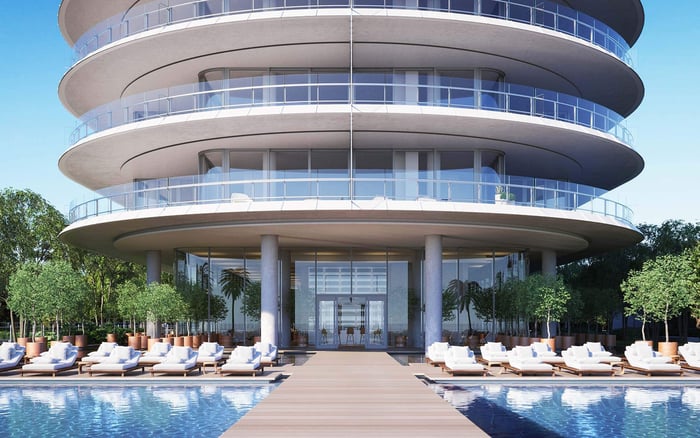
A disciplined acquisition review at Eighty Seven Park should separate the condominium’s present envelope condition, its northern-boundary construction history, and the association’s legal and financial obligations. Allegations tied to the adjacent Champlain Towers South site are material context, but they are not proof of an active defect at Eighty Seven Park.

At 8701 Collins Avenue, Eighty Seven Park Surfside occupies an unusually sensitive position: an ultra-luxury condominium in Miami Beach, immediately south of the Surfside municipal border and adjacent to the former Champlain Towers South property. For a buyer, that geography demands a more layered acquisition review than a conventional inspection of finishes, views, and private-unit systems.
The central task is not to use past allegations as a shortcut to a present conclusion. It is to establish what the condominium owns or controls, which obligations may rest with its association, what was tested along the adjoining boundary, and what current evidence reveals about the building envelope. Terra denied that construction of Eighty Seven Park caused the collapse of Champlain Towers South, even as Terra, the development entity, and the general contractor participated in settlements of related claims.
Past allegations are context; current engineering evidence must establish present condition.
For buyers comparing oceanfront residences across this corridor, including Arte Surfside and The Surf Club Four Seasons Surfside, the lesson extends beyond a single address. Due diligence should follow the property’s physical, legal, and financial boundaries-not stop at the residence door.
A rigorous review divides the record into three files. The first addresses the present condition of Eighty Seven Park’s envelope and common elements. The second reconstructs the adjacency and geotechnical history at its northern boundary. The third examines the condominium association’s legal and financial position.
Keeping these files distinct prevents one category from obscuring another. Evidence concerning excavation or groundwater management at a neighboring property line does not, by itself, establish a current façade or waterproofing defect. Conversely, a clean private-unit inspection does not resolve questions involving common-element waterproofing, historic monitoring, settlement language, reserves, or potential association obligations.
The first request should be for complete, current structural and building-envelope evaluations, including appendices, photographs, test locations, laboratory results, consultant recommendations, and evidence that recommended repairs were completed. A board summary or resale disclosure may help orient the review, but neither replaces the underlying technical record.
The scope should encompass waterproofing assemblies, façade joints, balconies, slab edges, planters, transitions, penetrations, and other plausible points of water entry. Buyers should also request leak logs, work orders, repair invoices, warranties, follow-up inspections, and records showing whether recurring conditions were retested after intervention.
Water intrusion warrants structural scrutiny because persistent moisture can affect more than paint, flooring, or millwork. In 2018, failed waterproofing beneath the Champlain Towers South pool deck and entrance drive was identified as a cause of major damage to the concrete slab below. That history belongs to the neighboring building, not Eighty Seven Park, but it illustrates why moisture pathways should not automatically be classified as cosmetic maintenance.
Testing should answer practical questions. Was the investigation visual only, or did it include probes and controlled water testing? Were façade joints, terrace interfaces, planters, and slab edges evaluated? Did the consultant trace moisture to its origin? Were repaired areas tested again? An independent envelope engineer can assess whether the methods, sample locations, and conclusions are proportionate to the documented conditions.
The adjacency file should focus on excavation, dewatering, sheet piles, vibration monitoring, and post-construction testing at Eighty Seven Park’s northern property line. Disputed allegations included claims that dewatering removed groundwater without adequate monitoring and caused a dangerous drawdown beneath the adjacent Champlain property. Other claims asserted that a sloped walkway or angled site condition directed water toward the neighboring basement, contributing to corrosion of structural supports.
Those statements are allegations, not findings that Eighty Seven Park presently has an envelope defect. Their relevance lies in identifying the records a buyer’s specialists should examine. Post-collapse testing considered whether sheet piles protected the neighboring property from vibration and water intrusion. Court-ordered document production also yielded monitoring evidence showing that construction vibration exceeded a designated threshold near Champlain Towers South.
A serious review should therefore seek original monitoring logs, threshold definitions, exceedance notices, consultant correspondence, corrective actions, installation records, test protocols, photographs, and final interpretations. The engineer should compare timestamps, locations, instrument placement, and subsequent investigation rather than accept a single conclusion detached from its underlying data.
The site history also includes a $10.5 million voluntary contribution to Miami Beach connected with the city’s relinquishment of 87th Terrace, the street that had separated the adjacent properties. That detail reinforces why parcel configuration, approvals, and boundary conditions belong in both the legal and technical files.
This boundary-conscious approach is equally valuable when assessing other coastal options, such as 57 Ocean Miami Beach. Comparable luxury positioning does not make engineering histories interchangeable; each property demands its own records, testing scope, and association review.
The ownership model becomes consequential where developer history meets condominium governance. The development entity, 8701 Collins Development LLC, was registered at the same address as Terra Group, one of the project’s developers. Litigation later expanded to include contractors, engineers, monitoring firms, and the 8701 Collins Condominium Association. Claims asserted that the association assumed certain liabilities and responsibilities from the developers.
Counsel should determine what the governing documents, turnover materials, settlement instruments, releases, indemnities, insurance records, and litigation disclosures actually provide. Participation in a settlement should not be treated as an admission of the disputed causation allegations. Equally, a buyer should not assume that settlement resolved every question concerning defense costs, indemnity, document retention, insurance, or future association obligations without reviewing the operative language.
The financial file should include reserve studies, budgets, special-assessment history, engineering proposals, approved contracts, repair expenditures, insurance information, and meeting records addressing leaks or capital work. The objective is to connect identified physical conditions with evidence of funding and completion. A repair recommendation without an adopted scope and budget remains materially different from a closed project supported by invoices, testing, and consultant sign-off.
For resale purchasers, contract timing should allow structural counsel and an independent engineer to work in parallel. This is not a field for a routine home inspection alone. An inspector can evaluate the residence; specialists must interpret common-element systems, testing adequacy, causation limits, and the contractual allocation of risk.
The correct conclusion is not predetermined. A defensible purchase decision emerges when present-condition evidence, adjacency records, and association obligations align. If documents conflict, the buyer’s team should identify the precise gap, request the underlying data, and quantify what remains unresolved before the contractual review period closes.
For MILLION Buyer’s Guides, the enduring principle is simple: luxury due diligence must be as carefully designed as the residence itself. At Eighty Seven Park, that means distinguishing Surfside litigation history from the current condition of the Miami Beach building, then testing both against original records rather than narrative summaries.
For discreet guidance on South Florida luxury real estate, connect with MILLION.
If branded residences are on your mind — as a home or as an allocation — we would be glad to share what we are seeing, privately.
Begin a quiet conversationIt is at 8701 Collins Avenue in Miami Beach, immediately south of the Surfside municipal border.
No. The claims concerned disputed causation and adjacency issues, while Terra denied that the project’s construction caused the collapse.
Buyers should separate present envelope condition, northern-boundary and geotechnical history, and association legal and financial obligations.
The review should cover waterproofing, façade joints, balconies, slab edges, planters, penetrations, and other potential water-entry points.
Persistent moisture can affect structural materials, so its source, path, damage, repair, and follow-up testing warrant engineering review.
Request excavation, dewatering, sheet-pile, vibration-monitoring, exceedance, corrective-action, and post-construction testing records.
Raw data, test locations, protocols, photographs, and appendices allow an independent engineer to evaluate whether a summary is adequately supported.
Key records include governing documents, litigation and settlement materials, engineering studies, leak logs, reserves, budgets, repairs, and special assessments.
Settlement participation should not be treated as an admission of the disputed causation allegations.
A buyer should engage legal counsel and an independent structural or envelope engineer in addition to a routine home inspector.