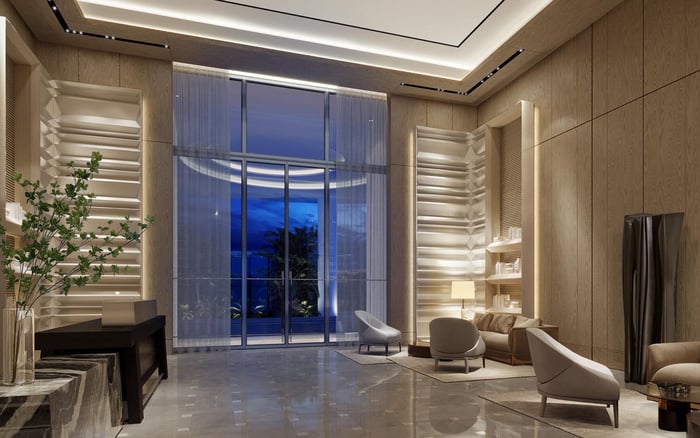
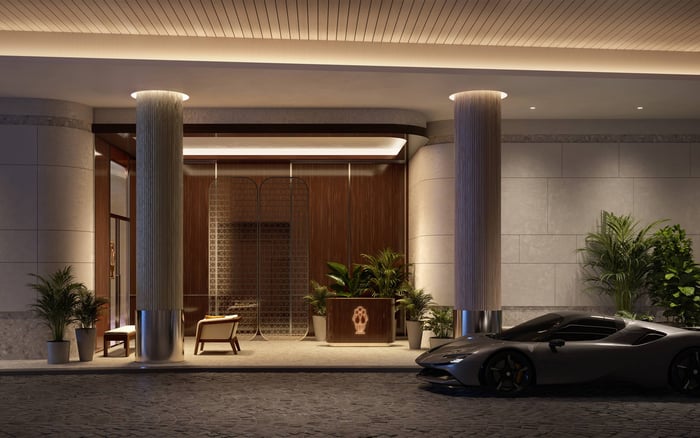
A buyer-focused framework for evaluating privacy, service, arrival circulation, guest access, terraces, and after-dark exposure at Nora House West Palm Beach.

For buyers considering Nora House West Palm Beach, privacy should be assessed as a continuous experience rather than a single feature. The review starts at the curb and continues through every threshold leading to the residence.
During a tour, note where vehicles pause, where visitors wait, how the residential entrance is identified, and whether pedestrian routes intersect with resident circulation. Continue through the lobby, elevator area, corridor, and residence entry without skipping any transition. The goal is to understand how the full sequence may feel during ordinary use, busy periods, and evenings.
Privacy depends on the relationship among design, access controls, staffing, and daily operations. Buyers should separate what they directly observe from what still requires written confirmation.
Ask for a demonstration of several practical routes: an owner arriving by car, a dinner guest checking in, a household employee reporting for work, and a delivery reaching its intended destination. Each scenario can reveal where people wait, who authorizes access, and whether unrelated traffic shares the same circulation path.
Questions about visitor logs, elevator permissions, service access, deliveries, and after-hours procedures should be answered in writing. Broad service language is not a substitute for a clear explanation of who handles each interaction and when.
Buyers comparing West Palm Beach residences can apply the same test at Mr. C Residences West Palm Beach and Mandarin Oriental Residences, West Palm Beach. The useful comparison is not a general impression of service, but the specific route, permission, and handoff required in each building.
A service model should be examined at the operational level. Ask who receives guests, whether residents are notified before access is granted, how repeat visitors are handled, and what happens when the primary desk is not staffed. Confirm whether different categories of visitors receive different credentials or permissions.
Deliveries deserve a separate review. Determine where couriers stop, whether packages are transferred by staff, how oversized items are managed, and whether vendors use resident-facing spaces. Buyers should also ask how access is revoked, how exceptions are documented, and who can resolve an issue after hours.
These questions help distinguish a polished presentation from a service structure that fits the buyer’s expectations for discretion and control.
Daylight alone may not reveal how visible an interior becomes when lights are on. If an evening appointment is available, review the principal living and sleeping areas from plausible exterior sightlines. Consider neighboring elevations, shared spaces, arrival areas, and other positions that may face the residence.
Window-treatment planning should be evaluated alongside privacy. Confirm where shades or drapery can be installed, how they will be powered, and whether the proposed system suits the intended interior design. Buyers should avoid assuming that a rendering establishes the final treatment or level of screening.
Apply the same discipline to terraces. Examine side-to-side views, overlooks from above, exposure to shared areas, lighting, and the position of outdoor seating. A terrace can feel private from inside the residence while remaining open to other vantage points.
Guest access should be traced from arrival to destination. Ask where visitors check in, which elevator they use, what floors they can reach, and how their permissions expire. If guest accommodations or shared amenities are presented during the sales process, request a clear explanation of the associated access and management procedures.
Service personnel require the same route-based analysis. Buyers should identify where household employees, maintenance teams, contractors, and delivery workers enter, wait, and exit. Shared elevator banks or corridors are not automatically problematic, but buyers should understand when and how those spaces are used.
For another Palm Beach County comparison, Forté on Flagler West Palm Beach can be reviewed with the same questions. Consistent criteria make comparisons more useful than amenity counts alone.
Before making a decision, organize unresolved questions by arrival, visitors, elevators, deliveries, vendors, shared spaces, terraces, and after-hours operations. Ask which details are confirmed, which remain subject to change, and which appear in governing or contractual documents.
Keep notes from each appointment and distinguish direct observations from verbal explanations. When a privacy or service feature is important to the purchase decision, request the applicable written material and review it with appropriate advisers.
The central question is whether the complete experience supports the buyer’s expectations at every handoff. Following each person, package, and permission from entry to destination provides a disciplined way to evaluate Nora House without relying on assumptions.
Where should a privacy review begin? Start at the curb or drop-off and follow the same path a resident would take to the front door.
Which arrival scenarios should a buyer test? Review owner, guest, employee, vendor, and delivery arrivals because each may involve different routes and permissions.
Why request access procedures in writing? Written details help buyers distinguish confirmed operations from general descriptions or assumptions.
What should buyers ask about visitor access? Ask where guests check in, who approves entry, which areas they can reach, and when their access expires.
What should be confirmed about elevator permissions? Determine how access is authorized, whether permissions vary by visitor type, and how exceptions are handled.
Why inspect a residence after dark? Evening conditions can reveal interior visibility and exterior sightlines that may be less apparent during daylight.
How should window treatments be reviewed? Confirm installation locations, power needs, design compatibility, and whether the proposed solution provides the desired screening.
What should buyers examine on a terrace? Review neighboring sightlines, overhead exposure, shared-space views, lighting, and outdoor seating positions.
How should service circulation be evaluated? Trace where employees, contractors, couriers, and maintenance personnel enter, wait, travel, and leave.
What should remain in the buyer’s due-diligence file? Retain written answers, relevant documents, appointment notes, and a clear list separating observations from unresolved questions.
If you'd like a private walkthrough and a curated shortlist, connect with MILLION.
If branded residences are on your mind — as a home or as an allocation — we would be glad to share what we are seeing, privately.
Begin a quiet conversation