A buyer-focused look at why Ritz-Carlton branded residences in Fort Lauderdale and Pompano Beach appeal to owners who prioritize service coordination, seasonal ease, privacy and day-to-day household operations.
For South Florida’s most mobile buyers, luxury is no longer defined only by ceiling heights, terraces or the drama of an ocean view. The more revealing measure is operational: how easily can a household arrive, host, depart and return without friction?
That is the context in which The Ritz-Carlton Residences® Fort Lauderdale and The Ritz-Carlton Residences® Pompano Beach become especially relevant. These are not merely names on a skyline map. For buyers who maintain multiple homes, travel frequently, rely on assistants or welcome extended family, the appeal lies in a residential environment shaped around service standards, communication and continuity.
In Broward, where the luxury market spans waterfront privacy, seasonal ownership and resort-adjacent living, household logistics have become a defining filter. A residence must perform whether the owner is present for the season, arriving for a long weekend or away for several weeks. The strongest homes are not only beautiful when occupied. They remain organized, prepared and reassuring when the owner is elsewhere.
A branded residence carries an expectation of professionalized service. For buyers considering The Ritz-Carlton Residences® Pompano Beach, the Ritz-Carlton association is central because it signals a managed residential experience rather than a conventional condominium format. That distinction matters for owners who do not want every household need to become a bespoke, ad hoc arrangement.
The logistics value is not about outsourcing taste. It is about reducing complexity. In a service-led residence, the daily ecosystem may support smoother coordination among residents, building teams, personal assistants, vendors and guests. For a staff-supported household, that can mean fewer informal handoffs and more predictable communication. For a part-time owner, it can mean a property that feels less like a dormant asset and more like a residence ready to receive them.
This is why the comparison between The Ritz-Carlton Residences® Fort Lauderdale and the Pompano Beach offering should be framed around operations as much as location. Buyers may ask first about views and finishes, but the decisive questions often come later: How does arrival feel? How are services coordinated? How private is circulation? How are guests received? How does the building function when the owner is away?
South Florida luxury ownership often follows a distinctive rhythm. Owners arrive from other primary homes, stay intensely, host frequently and then leave the residence secured for a period of time. In that pattern, a building’s operational culture becomes part of the property’s value.
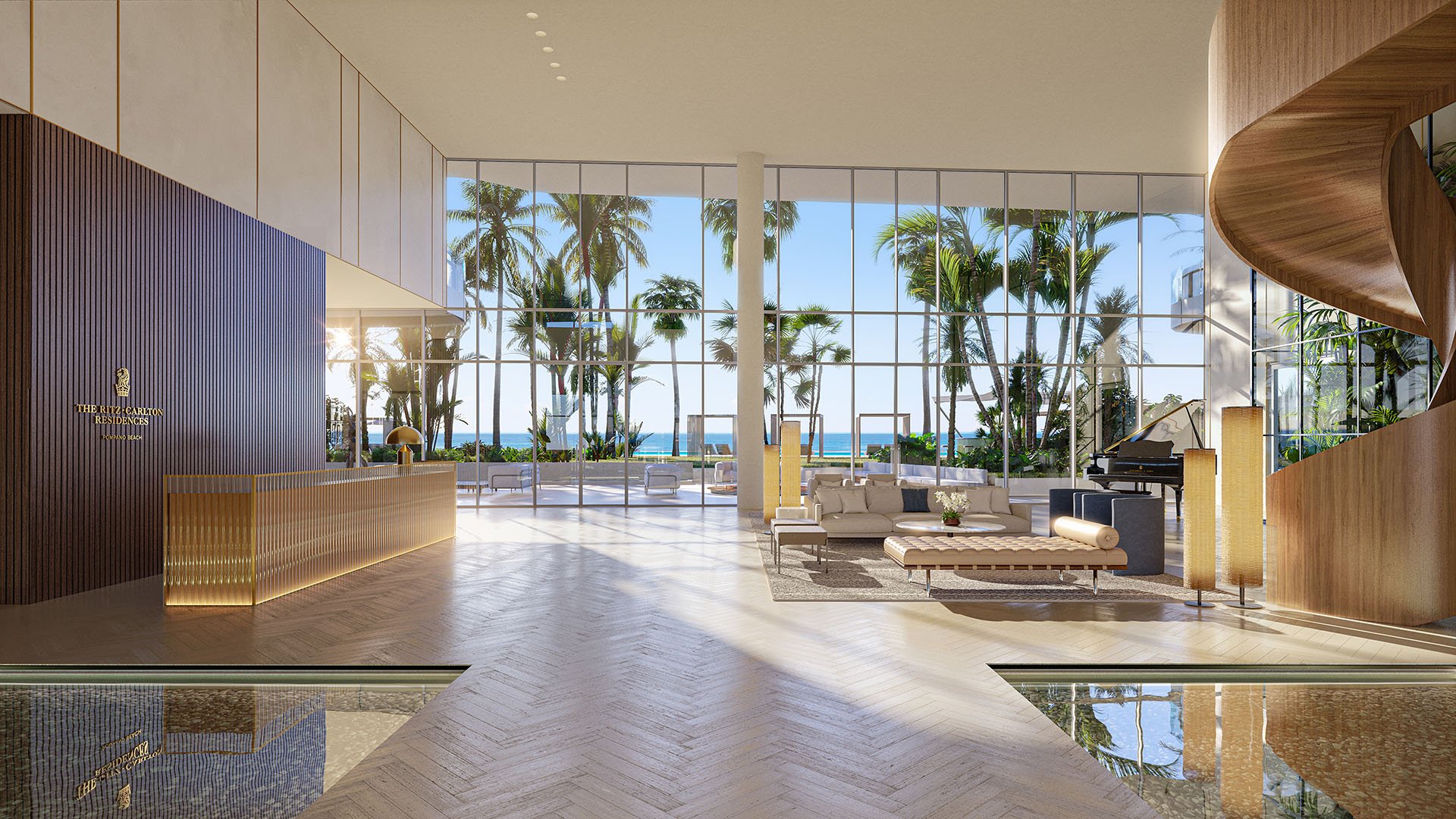
A logistics-minded buyer should evaluate how naturally a residence supports arrival flow. This includes the transition from car to lobby to private residence, the ability to coordinate guests without confusion and the sense that staff, assistants and residents can communicate without unnecessary repetition. The point is not theatrical service. The point is ease.
Absence is equally important. High-frequency travelers need confidence that the residence can be prepared, secured and serviced during the periods between visits. The value of a managed environment is that it can reduce reliance on improvised household systems. That matters for second-home buyers who want the emotional benefit of ownership without turning every arrival into a reset.
In this respect, Pompano Beach’s Ritz-Carlton branded positioning is particularly relevant. It allows buyers to look beyond surface-level luxury and focus on the residential infrastructure beneath it: service coordination, resident support, privacy and the operational rhythm of a building designed for sophisticated ownership patterns.
The Fort Lauderdale and Pompano Beach decision should not be treated as a simple address preference. It should be examined through the household’s actual behavior. A buyer who entertains often may prioritize guest flow and privacy. A family with multiple generations may focus on circulation, service responsiveness and the ability to create separation between residents and visitors. A frequent traveler may value a residence that can remain professionally maintained during extended absences.
In Fort Lauderdale, the broader branded and hospitality-residence conversation also includes properties such as Four Seasons Hotel & Private Residences Fort Lauderdale and St. Regis® Residences Bahia Mar Fort Lauderdale. For the disciplined buyer, these comparisons should not begin with brand hierarchy. They should begin with household use: who arrives, how often, with how much staff support and with what level of service coordination expected.
Pompano Beach introduces a different but closely related proposition. The presence of Waldorf Astoria Residences Pompano Beach alongside The Ritz-Carlton Residences® Pompano Beach reflects how strongly the area has entered the branded-residence conversation. Yet the more important lens remains practical. For buyers who want ownership supported by hospitality-style service, Pompano Beach can be considered through the quality of its managed residential environment and the degree to which it simplifies seasonal living.
The most useful questions are rarely the most glamorous. Buyers should ask how requests are handled, how guest access is coordinated, how vendors interact with the building and how communication flows when the principal owner is not present. They should consider whether the residence supports private routines as effectively as social ones.
Storage should also be viewed operationally, not merely as square footage. The question is whether seasonal wardrobes, sports gear, guest needs and household supplies can be managed without clutter or repeated coordination. Privacy should be assessed in motion: the path from arrival to residence, the experience of guests, and the separation between daily household life and building activity.
For multi-generational families, logistics become even more nuanced. A residence may need to accommodate grandparents, adult children, visiting friends and staff, sometimes simultaneously. The right building helps these groups coexist without making the owner feel like a full-time traffic manager.
The Ritz-Carlton Residences® Pompano Beach is strongest as a consideration for buyers who value this managed, service-oriented framework. Its relevance to household logistics comes from the brand-backed residential model and the expectation of resident support. For the right owner, that framework may be as important as the architecture itself.
At the top of the market, discretion often matters more than display. A home that runs well has a particular calm to it. Guests know where to go. Deliveries do not become disruptions. Assistants have a point of coordination. Owners can arrive without feeling they must immediately solve problems.
That is the understated promise behind branded residences for logistics-focused buyers. The best fit is not necessarily the most dramatic home, but the one that most accurately reflects the owner’s life. For some, that may be the energy and connectivity associated with Fort Lauderdale. For others, it may be the managed residential appeal of Pompano Beach. In either case, the deeper question is the same: does the residence make a complex household feel effortless?
Why are household logistics important for luxury buyers? They determine how smoothly a residence functions for arrivals, guests, staff, vendors and absences. For multi-home owners, that ease can be central to value.
What makes The Ritz-Carlton Residences® Pompano Beach relevant to this topic? Its branded-residence positioning supports a managed residential environment with service-oriented expectations. That makes it appealing to buyers who want more than a conventional condominium experience.
Can Fort Lauderdale and Pompano Beach be compared directly? Yes, but the comparison should focus on lifestyle patterns rather than assumptions. Buyers should evaluate how each setting supports travel, hosting, privacy and service coordination.
Who benefits most from a service-led residence? Frequent travelers, seasonal owners, guest-heavy households and residents with assistant or staff support often benefit most. Their homes require consistent coordination even when they are away.
Is branded service the same as hotel living? Not exactly. In a private residence context, the appeal is residential ownership supported by professional service standards, not a transient hotel experience.
What should buyers ask during a residence tour? They should ask about arrival flow, resident communication, guest procedures, vendor access and how the building supports absences. These details reveal the operational quality of the property.
Does this matter for seasonal ownership? Yes. Seasonal owners need a home that can be prepared, maintained and secured between visits. A managed environment can reduce the burden of reactivating the residence each time.
How should families evaluate privacy? Privacy should be studied through movement, not only floor plans. Consider how residents, guests, staff and service providers circulate through the building.
Are views still important? Views remain important, but they are only one part of the purchase decision. For many ultra-prime buyers, operational ease is what makes a home livable over time.
What is the main takeaway for buyers? The strongest residence is the one that aligns with the household’s real operating rhythm. Service infrastructure can be as decisive as design, location or amenity appeal.
For a discreet conversation and a curated building-by-building shortlist, connect with MILLION.
If branded residences are on your mind — as a home or as an allocation — we would be glad to share what we are seeing, privately.
Begin a quiet conversation