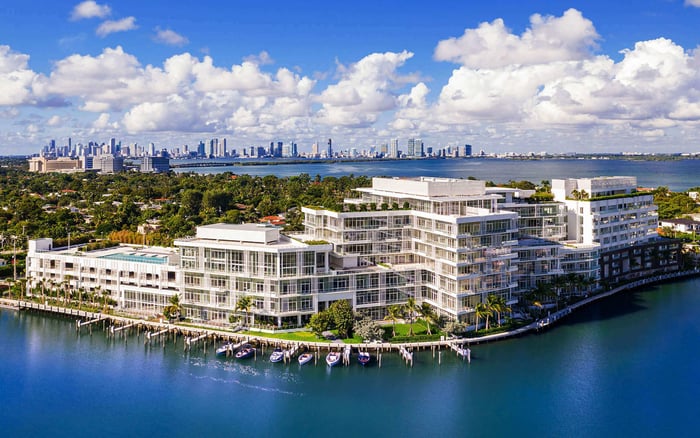
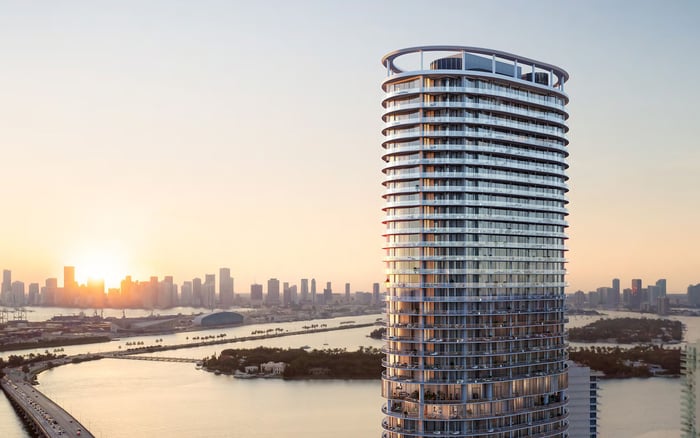
Privacy in luxury real estate is increasingly understood as an operating system: a combination of controlled arrival, discreet circulation, thoughtful service, and personal choice. Three distinctive Miami residential propositions illustrate how buyers can evaluate that promise.

In South Florida luxury real estate, privacy is no longer defined solely by a guarded entrance or secluded address. It is better understood as a sequence of decisions governing how an owner arrives, moves through a property, receives guests, engages services, and retreats into personal space.
That shift matters in Miami Beach, where an exceptional home may occupy a visually prominent setting. The sophisticated buyer is not necessarily seeking isolation. More often, the objective is control: the ability to participate selectively in a social environment without allowing the building's energy to dictate the rhythm of home.
Viewed through this lens, The Perigon Miami Beach, The Ritz-Carlton Residences® Miami Beach, and Delano Residences & Hotel Miami offer three useful frameworks for considering privacy. Their names and residential contexts differ, but each raises the same essential question: How effectively can a property balance access, service, identity, and discretion?
For buyers considering The Perigon Miami Beach, privacy should be evaluated as part of the complete residential experience. The essential inquiry is not simply whether a home feels removed from the city, but whether the transitions among exterior, shared space, and private interior feel calm, legible, and appropriately controlled.
At The Ritz-Carlton Residences® Miami Beach, the privacy conversation naturally intersects with expectations surrounding a hospitality identity. Buyers drawn to branded residences often want responsive service, yet service is most refined when it remains unobtrusive. Privacy therefore depends on whether assistance feels available without becoming visible in daily life.
Delano Residences & Hotel Miami introduces another consideration through its residence-and-hotel identity. Wherever residential and hospitality experiences meet, buyers should examine boundaries carefully. Separate patterns of movement, guest handling, service access, and resident recognition can matter as much as interior finishes.
None of these privacy propositions is inherently superior. The right fit depends on whether a buyer prioritizes residential quiet, hospitality-backed ease, or access to a more animated atmosphere with the option to retreat.
For a buyer, privacy is often judged long before entering the residence. Arrival choreography sets the tone. Buyers should observe where vehicles pause, how visitors are received, whether waiting areas feel exposed, and how directly an owner can move from arrival to home.
Circulation is equally consequential. Elevators, corridors, amenity approaches, and service paths determine how frequently residents encounter guests, staff, deliveries, or activity elsewhere in the property. A beautiful lobby may create a memorable first impression, but repeated daily transitions reveal whether privacy is structural or merely atmospheric.
Within the residence, orientation can reinforce discretion. Buyers should consider sightlines from entry points, the relationship between entertaining and bedroom areas, and whether household support can occur without disrupting personal rooms. These details make privacy practical rather than symbolic.
The best service model expands an owner's options. Some residents want staff to anticipate routines; others prefer interaction only upon request. A privacy-conscious property should accommodate both preferences without making either feel exceptional.
This is especially relevant when comparing residential expectations with a hotel-associated environment. Buyers should ask how requests are communicated, who may authorize access, how deliveries reach the residence, and how guest permissions are managed. The answer is not a single amenity, but an operating culture that respects boundaries.
Privacy also extends to information. Owners may wish to understand how resident preferences, visitors, access credentials, and household instructions are handled. Discretion is strongest when physical planning and day-to-day protocols work in concert.
Miami's social energy is part of its appeal, but lifestyle access need not mean constant exposure. For many buyers, the ideal residence makes engagement effortless while preserving the right to remain unseen. A private home can sit close to dining, wellness, leisure, and cultural activity without becoming an extension of those public experiences.
The practical test is optionality. Can an owner host without opening the entire home? Can family members maintain different schedules? Can guests arrive gracefully? Can residents use shared spaces without crossing the property's busiest routes? Privacy has value when it supports these ordinary choices with minimal friction.
A serious evaluation should unfold at different moments, not solely during a polished presentation. Buyers should consider how the property might feel during active social periods, routine mornings, staff changes, deliveries, and extended absences.
Key questions include who controls access at each threshold, whether residential and service circulation intersect, and how visitors move from arrival to the home. Buyers should also assess the residence for acoustic separation, visual exposure, guest-room placement, and the division between formal and personal spaces.
The ownership structure and operating framework merit equal scrutiny. Rules governing guests, services, shared facilities, and access can shape privacy after closing. The objective is to determine whether the lived experience fulfills the architectural promise.
Privacy is difficult to photograph, yet it can shape long-term satisfaction more profoundly than a dramatic first impression. Features that reduce unwanted encounters, simplify secure access, and allow owners to choose when to engage tend to remain relevant as household needs evolve.
For buyers comparing these three Miami propositions, the decisive issue is personal alignment. The most compelling residence will be the one whose design and operations make discretion feel natural, consistent, and nearly invisible.
Why is privacy important to Miami luxury buyers? It gives owners control over arrival, social interaction, household routines, and retreat within an active destination.
Does privacy require an isolated location? No. Thoughtful access, circulation, spatial planning, and operating protocols can create discretion in a connected setting.
How should buyers compare the three projects? Compare how each handles arrival, guests, shared spaces, service interaction, and the transition into the residence.
What should buyers inspect during a property visit? Observe entrances, waiting areas, elevators, corridors, service routes, sightlines, and the path visitors take to the home.
Can hospitality service coexist with privacy? Yes. The strongest model keeps assistance readily available while allowing residents to limit interaction and visibility.
Why does circulation matter? Circulation determines how often residents cross paths with visitors, personnel, deliveries, and activity elsewhere in the property.
Is interior layout part of privacy? Yes. Separating entertaining, sleeping, guest, and household-support areas can protect personal routines.
Should buyers consider digital privacy? Yes. Access credentials, visitor permissions, resident preferences, and household instructions all warrant careful review.
Can privacy affect resale appeal? It can broaden practical appeal because controlled access and discreet daily movement serve many household types.
What is the most important privacy question to ask? Ask whether the property consistently gives residents a genuine choice between engagement and retreat.
For a discreet conversation and a curated building-by-building shortlist, connect with MILLION.
If branded residences are on your mind — as a home or as an allocation — we would be glad to share what we are seeing, privately.
Begin a quiet conversation