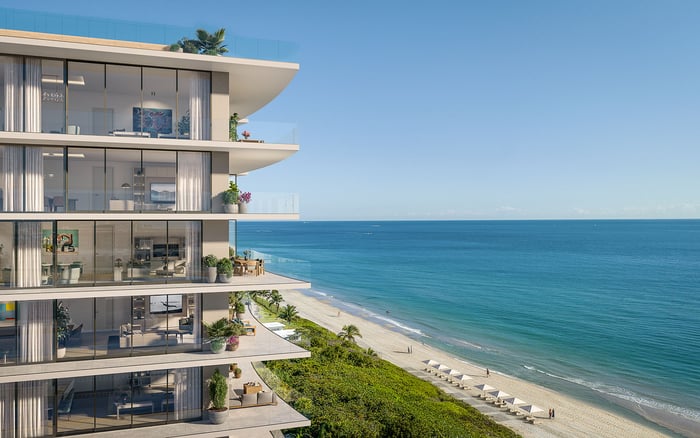
For buyers who travel privately, a Pompano Beach condo search should test the complete journey from aircraft to residence, not simply the home itself. Privacy, transfer predictability, building operations, and waterfront priorities can materially reshape the shortlist.

For buyers who regularly travel by private aircraft, the luxury condo search does not begin in the lobby. It begins with the transition from aircraft to car, continues through the local drive, and ends only when the residence is secure, stocked, and ready for occupancy.
That perspective can reshape how Pompano Beach is evaluated. A spectacular home may lose some appeal if every arrival demands too many handoffs, while a more discreet building may rise on the shortlist because its routines feel effortless. Distance alone is not the defining measure. What matters is the quality, privacy, and predictability of the entire journey.
This is especially important for a second-home buyer whose visits may be brief or arranged with little notice. The residence must perform even when the owner is elsewhere, and the arrival sequence should preserve time rather than consume it.
Before comparing floor plans, define the travel pattern: the aircraft typically used, expected arrival windows, ground transportation preferences, luggage volume, family or staff movements, and tolerance for traffic variability. These practical considerations establish a highly personal standard of convenience.
Apply the same discipline to departures. A building that operates smoothly on a quiet afternoon should also be evaluated for early starts, evening returns, guests, pets, and multiple vehicles. Buyers should determine whether they value the shortest theoretical transfer or the most dependable routine.
In Broward, the condo decision may also sit within a broader network of business, leisure, and family commitments. Aviation access should therefore be assessed as one component of the weekly schedule, not as an isolated amenity.
A focused viewing program might begin with Armani Casa Residences Pompano Beach and The Ritz-Carlton Residences® Pompano Beach. Placing them in the same search does not presume equivalence. It allows buyers to test how each option aligns with their priorities for discretion, service, design, and ease of ownership.
A second comparison could pair Ocean 580 Pompano Beach with W Pompano Beach Hotel & Residences. During each visit, buyers should observe the approach, vehicle staging, lobby circulation, elevator journey, and transition into the residence. These details often reveal more about real-world usability than a presentation focused solely on finishes.
Waldorf Astoria Residences Pompano Beach may also merit inclusion in a broad comparative set. Every project should be judged through verified documents, current disclosures, and direct observation-not assumptions attached to a name.
Private aviation can compress travel time, but the residence must be prepared to receive its owner. Due diligence should cover access protocols, guest handling, package procedures, maintenance coordination, vehicle arrangements, and the process for authorizing household staff or vendors.
Buyers should also examine what happens during an absence. Who can enter, under what authorization, and how is that access documented? How are urgent maintenance matters escalated? Can the owner establish a repeatable pre-arrival routine? The strongest answer is usually a clear operating process, not a vague promise of service.
Privacy deserves equal scrutiny. Review sightlines at the arrival area, the degree of public circulation, elevator access, and how comfortably family members or guests can enter without unnecessary exposure. In this context, luxury is measured by calm control.
Aviation convenience should refine the search, not overwhelm it. Many buyers consider Pompano Beach for its oceanfront setting, water views, beach time, or proximity to a marina. Those daily pleasures may matter more than a modest reduction in transfer time.
The right decision balances two clocks: the travel clock and the lifestyle clock. One measures how smoothly an owner can arrive and depart. The other measures the quality of mornings, weekends, entertaining, wellness, and time on the water. A residence succeeds when it supports both without imposing a persistent compromise.
That balance is personal. A frequent business traveler may place greater weight on repeatable transfers and operational support. A seasonal owner may prioritize light, outdoor space, and a sense of retreat. The search should make those preferences explicit before emotion takes over.
A map estimate is only a starting point. Buyers should test the relevant drive at realistic times, using the vehicle type and arrival routine they expect to maintain. The exercise should extend to the building entrance, not merely the neighborhood boundary.
Repeat the test if the residence will be used across different days or seasons. Note the turns, access points, loading conditions, and whether the arrival feels intuitive after a long flight. If a driver, assistant, or family member will often manage the journey, include that person in the evaluation.
Finally, score each property consistently. A useful matrix can cover transfer predictability, privacy, building access, residence readiness, waterfront enjoyment, and confidence in day-to-day operations. This keeps aviation access in proportion while making trade-offs visible.
Why should private aviation affect a condo search? It shifts the focus from the residence alone to the complete aircraft-to-home journey, including privacy, timing, and building operations.
Is the closest residence automatically the best choice? No. A predictable, discreet transfer may be more valuable than the shortest theoretical drive.
What should buyers test during a property tour? Observe vehicle access, arrival staging, lobby circulation, elevator movement, and entry into the residence.
How important is building staffing? Staffing can be central for owners who expect secure access, maintenance coordination, and reliable pre-arrival preparation.
Should a buyer visit at different times? Yes. Repeating the route at realistic arrival and departure hours can reveal variability that a single tour may miss.
What documents deserve close review? Buyers should review current project disclosures, association materials, operating policies, and any rules affecting access or service.
How does privacy enter the analysis? Consider exposure during vehicle arrival, public circulation, guest handling, elevator access, and authorization procedures.
Can aviation access outweigh an ocean view? It can for some owners, but the better approach is to weigh travel efficiency against the daily value of a waterfront setting.
What matters most for a lock-and-leave owner? Clear access controls, dependable maintenance routines, and a repeatable process for preparing the home are essential considerations.
What is the best way to shortlist comparable options for touring? Start with location fit, delivery status, and daily lifestyle priorities, then compare stacks and elevations to validate views and privacy.
For a confidential assessment and a building-by-building shortlist, connect with MILLION.
If branded residences are on your mind — as a home or as an allocation — we would be glad to share what we are seeing, privately.
Begin a quiet conversation