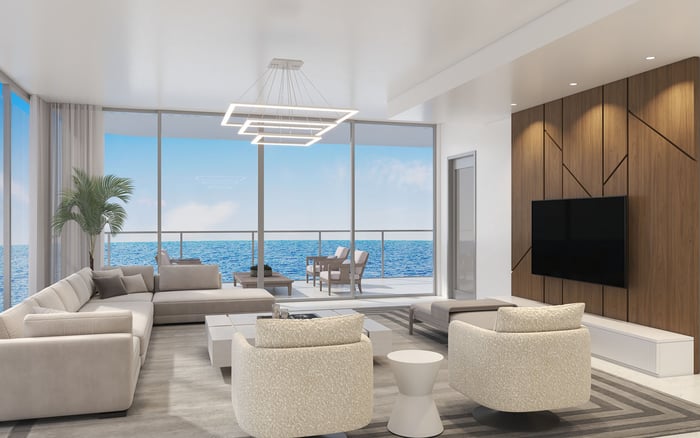
Luxury downsizing is less about reducing standards than refining priorities. In Pompano Beach, the search can shift from maximum square footage toward intelligent layouts, service, privacy, outdoor living, and a condominium association prepared for long-term stewardship.

Luxury downsizing is not a retreat from quality. It is a decision to concentrate it. For an owner moving from a large residence, a successful condominium search begins by separating square footage from usefulness. A smaller home can feel more composed when circulation is efficient, entertaining areas are properly scaled, private rooms are quiet, and storage is planned rather than improvised.
That distinction can reshape a search in Pompano Beach. Instead of asking which residence has the largest interior, buyers can ask which floor plan best supports the life they intend to lead. The relevant measures become the quality of each room, the relationship between interior and exterior space, and the ease with which the home can be left, reopened, and maintained.
This is especially important for a second-home buyer. Occasional occupancy can make simplicity more valuable than surplus. The ideal residence should feel complete upon arrival, without demanding the routines associated with managing a larger property.
Before touring, create a concise brief grounded in actual habits. Identify the number of bedrooms that will be used regularly, the type of guest accommodation required, and whether a separate office is essential. Consider how often formal dining occurs, whether entertaining is intimate or expansive, and which belongings must remain immediately accessible.
Storage deserves its own category. Closets, pantry capacity, utility areas, parking arrangements, and room for seasonal items can determine whether downsizing feels elegant or constrained. Furniture should also be considered early. A beloved dining table or significant artwork may influence wall dimensions, ceiling preferences, and circulation more than an additional bedroom.
Outdoor space belongs in the same analysis. For buyers prioritizing an oceanfront setting, a terrace may function as a principal living area rather than an accessory. Its proportions, privacy, exposure, and connection to the main rooms should be evaluated with the same care as the interior floor plan.
A disciplined search should compare several interpretations of luxury rather than rely on a single visual impression. In Pompano Beach, buyers might place Armani Casa Residences Pompano Beach and The Ritz-Carlton Residences® Pompano Beach within the same initial review, then assess each opportunity against a consistent personal brief.
The purpose is not to choose a name first. It is to understand how the residence, common spaces, arrival sequence, privacy, and service model work together. A buyer should imagine an ordinary week: receiving guests, accepting deliveries, leaving for dinner, returning from travel, and spending a quiet morning at home. Luxury becomes clearer when measured against recurring routines.
The same method applies when considering W Pompano Beach Hotel & Residences. Hotel-associated living may appeal to one buyer, while another may prefer a different residential rhythm. The relevant question is not which concept appears most elaborate, but which aligns with the desired balance of activity, discretion, and independence.
Downsizing can transfer certain functions from the private home to the building. A buyer may no longer need every leisure, fitness, work, or gathering space within the residence when shared spaces are convenient and genuinely suited to regular use. This is where amenity quality matters more than amenity quantity.
Consider how each shared space would fit into daily life. Is it positioned for easy use? Does its atmosphere match the buyer’s expectations? Would it replace space being relinquished, or is it simply an attractive feature unlikely to be used? This practical filter keeps the search focused.
Lifestyle should be defined personally. For some, it means a calm arrival and discreet service. For others, it means social energy and readily available shared settings. Including Waldorf Astoria Residences Pompano Beach in the comparison can help buyers clarify which residential experience feels most natural, without allowing branding alone to determine the decision.
An impeccably finished residence is only one component of condominium ownership. Buyers should review association documents, budgets, insurance information, reserves, rules, pending matters, and the scope of owner responsibilities with qualified legal, financial, insurance, and inspection professionals. The objective is to understand both recurring obligations and potential exposure.
Questions should be specific. Which services are included, and which are billed separately? How are alterations governed? What rules apply to guests, pets, deliveries, leasing, and access? How are maintenance responsibilities divided between the owner and the association? What approvals are required before work begins?
For new-construction opportunities, the inquiry should also cover the purchase agreement, stated timelines, deposit structure, finish selections, closing requirements, and the process for addressing incomplete or corrective work. These are matters for professional review, not assumptions to draw from presentation materials.
A written scorecard prevents a seductive view or dramatic lobby from eclipsing practical priorities. Give greater weight to the elements that shape every day: floor-plan efficiency, natural light, acoustic separation, terrace utility, storage, parking, service, privacy, and ownership costs. Amenities can follow, weighted by the likelihood of actual use.
A starting point becomes most valuable when personalized. A downsizer who hosts extended family will score a residence differently from an owner who travels frequently. Likewise, someone moving full-time may assess neighborhood convenience differently from a seasonal resident.
The search can include a more intimate point of comparison, such as Ocean 580 Pompano Beach. Comparing different residential concepts can reveal whether the buyer values scale, discretion, service intensity, or simplicity most. The scorecard turns those preferences into a defensible decision.
The best downsizing decision should remove friction without diminishing pleasure. It should preserve the spaces that matter, reduce those that do not, and place responsibility where the owner is comfortable with it. That outcome may involve fewer rooms, but it should deliver greater clarity.
In a luxury condominium search, restraint is often a strategic advantage. Buyers who define their nonnegotiables, test floor plans against real furniture and routines, and complete a rigorous ownership review are better positioned to recognize the right fit. The goal is not simply a smaller address. It is a residence that returns time, attention, and mobility to its owner.
What does luxury downsizing mean? It means reducing unnecessary space while preserving the quality, privacy, comfort, and functions that matter most.
Should square footage be the primary search filter? No. Layout efficiency, storage, room proportions, outdoor space, and circulation can matter more than the total figure.
How many bedrooms should a downsizer choose? Base the decision on regular occupancy, realistic guest patterns, and whether another room must serve as an office or flexible space.
Why is storage especially important when downsizing? Well-planned storage helps a smaller residence remain calm and functional without forcing important belongings into visible living areas.
How should buyers evaluate amenities? Prioritize spaces and services that replace functions from the former home or support routines the buyer genuinely expects to maintain.
What should buyers review about the condominium association? Qualified professionals should examine governance documents, budgets, reserves, insurance information, rules, pending matters, and owner obligations.
Does a lock-and-leave objective change the search? Yes. It places greater emphasis on access, maintenance responsibilities, service expectations, security procedures, and ease of arrival and departure.
How should a buyer compare branded residences? Look beyond the name and compare the service model, privacy, common spaces, owner obligations, and compatibility with everyday life.
What deserves attention in a pre-construction purchase? Have professionals review the contract, deposits, stated timelines, finish provisions, closing terms, and procedures for incomplete or corrective work.
When is a smaller condominium the right choice? It is right when the residence supports preferred routines, accommodates essential possessions, and reduces responsibilities without compromising comfort.
For a confidential assessment and a building-by-building shortlist, connect with MILLION.
If branded residences are on your mind — as a home or as an allocation — we would be glad to share what we are seeing, privately.
Begin a quiet conversation