For family buyers in Coconut Grove, the most consequential condominium decisions extend beyond finishes. Resale depth, line-level utility, view durability, and the likely holding period should be evaluated together to protect both daily life and future optionality.
A family residence is first and foremost a home, but the purchase still deserves the discipline of an investment decision. In Coconut Grove, buyers often encounter residences that appear comparable at the building level yet perform very differently when assessed by line, exposure, outlook, and practical utility.
The first question is not simply whether a building is desirable, but whether the specific residence will remain intelligible to the next buyer. A clear floor plan, usable rooms, credible privacy, and an outlook that can be described without qualification tend to create a more legible proposition. This does not guarantee a future result, but it can reduce the number of objections a seller must overcome.
For families, this framing is especially useful because needs evolve. A nursery becomes a study, household staffing may change, and school or work routines can alter the importance of circulation, storage, and arrival sequences. The right purchase should accommodate daily life while preserving a coherent resale story.
Resale depth describes the breadth of plausible future demand for a residence. It is not the same as popularity. A highly distinctive home may attract intense interest from a narrow audience, while a restrained, functional layout may appeal to a wider range of families, couples, and second-home buyers.
Begin by identifying the residence's natural comparison set. A buyer considering Park Grove Coconut Grove should examine not only other available homes within the same property, but also the alternatives a similarly positioned purchaser might consider elsewhere in the neighborhood. The relevant question is whether the residence remains compelling when buyers can substitute another floor, exposure, layout, or building.
Depth is strongest when a residence presents several independent reasons to choose it. These may include efficient planning, privacy between bedrooms, an intuitive relationship between the kitchen and living areas, or a view that is difficult to replicate. If the entire case rests on a single decorative feature, the future audience may be more fragile.
A building name establishes context, but the line determines much of the lived experience. Family buyers should trace everyday movement through the plan: entry to kitchen, kitchen to dining, bedrooms to bathrooms, service areas to living spaces, and interior rooms to terraces. A plan should work on an ordinary weekday, not only during a showing.
When evaluating a residence at Arbor Coconut Grove or another Grove address, test whether furniture can be placed without compromising circulation. Determine where backpacks, deliveries, sports equipment, luggage, and household supplies will go. Consider whether secondary bedrooms are genuinely usable and whether acoustic separation supports different schedules.
Line selection also encompasses what sits beside, above, and below the residence. Elevator proximity, service circulation, mechanical areas, amenity interfaces, and neighboring terraces can affect privacy and quiet. These conditions should be understood before aesthetic preferences take over the decision.
Waterfront appeal and view scarcity are related, but they are not identical. A beautiful outlook may be widely available across several competing residences. A scarce view is harder to reproduce because of its angle, breadth, elevation, privacy, or relationship to surrounding land and structures.
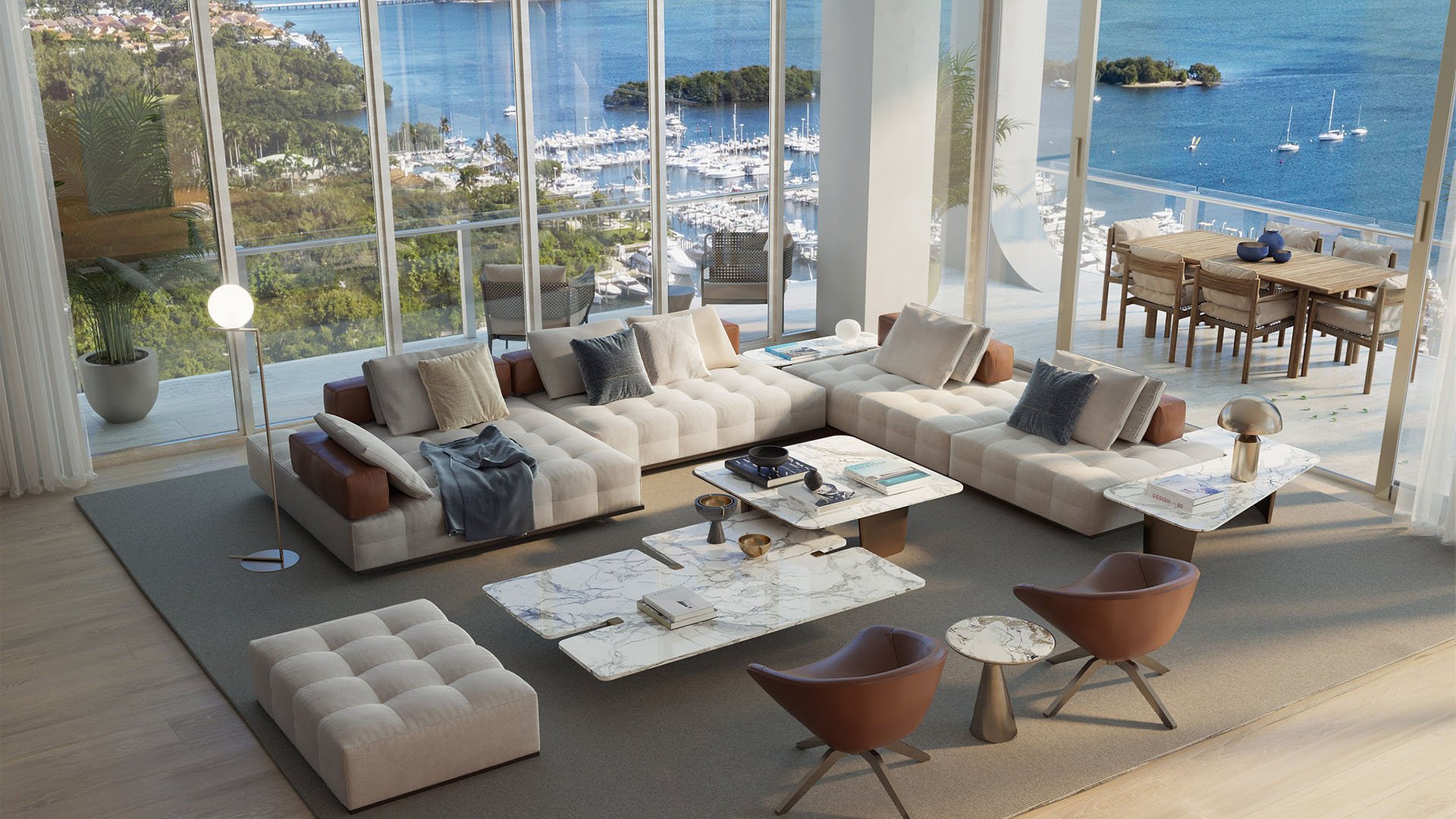
For any waterfront consideration, map the view from the rooms used most often, not merely from the terrace's most photogenic position. Sit at dining height, stand in the kitchen, and look outward from each bedroom. A panorama that works only from one corner may offer less family utility than a quieter outlook visible throughout the home.
At Four Seasons Residences Coconut Grove, as with any contemplated purchase, buyers should distinguish between what is visible today and what appears structurally durable. Review the direction of the exposure, nearby parcels, landscaping, rooflines, and the possibility that a foreground condition could change. The objective is not certainty, but to price uncertainty consciously.
Higher is not automatically better, and lower is not inherently compromised. Elevation can influence openness, privacy, visual connection to the landscape, and the psychological character of a residence. Yet a family may place equal importance on arrival time, terrace comfort, and a sense of connection to the neighborhood.
Compare floors within the same line whenever possible. This isolates the value of elevation from differences in layout and exposure. Then ask whether the premium secures a meaningfully different experience or merely a higher position. The distinction should be visible from the primary rooms and relevant to normal daily use.
Consider the choice in the context of the anticipated holding period. A premium may be sensible when the attribute is scarce and likely to remain important to future buyers. It may be harder to defend when adjacent inventory offers substantially similar utility.
Lifestyle language becomes useful when translated into repeatable routines. Time the morning departure, consider access for guests and caregivers, inspect parking and storage logistics, and imagine returning home with children in poor weather. Assess how the residence preserves privacy when the household is full.
A comparison involving Vita at Grove Isle should therefore extend beyond visual preference. Buyers can score each candidate on family planning, room flexibility, outlook durability, privacy, building circulation, and future substitutability. Weight those categories according to actual household priorities rather than presumed market prestige.
The best decision may not be the residence with the most dramatic single feature. More often, it is the one with the fewest structural compromises, the clearest reasons for future demand, and a plan that remains useful as family life changes.
Before committing, prepare a concise decision sheet for each finalist. Record the line, exposure, primary view, potential obstructions, functional bedroom count, storage logic, privacy conditions, terrace usability, and direct competing inventory. Separate changeable elements, such as finishes, from permanent or expensive-to-change conditions, such as orientation and room geometry.
Then write a one-sentence resale thesis. If the residence cannot be described clearly without relying on decoration or vague prestige, revisit the price and alternatives. A persuasive thesis should identify the likely next buyer and explain why that person would select this home over available substitutes.
Finally, define the compromises accepted at purchase. Every residence has them. The goal is to choose compromises that align with the family's priorities and are unlikely to become dominant objections at resale.
What does resale depth mean for a Coconut Grove condominium? It is the breadth of plausible future demand for a specific residence relative to its realistic substitutes.
Why is line selection more important than finishes? Finishes can often be changed, while orientation, geometry, exposure, and core circulation are substantially more permanent.
How should families compare two units in the same building? Hold layout and exposure constant where possible, then isolate the value of floor height, privacy, condition, and outlook.
What makes a view scarce? Scarcity may come from a difficult-to-replicate angle, elevation, breadth, level of privacy, or protected visual corridor.
Is the highest floor always the best choice? No. The premium should correspond to a meaningful improvement in view, privacy, light, or future buyer appeal.
How can buyers assess possible view obstruction? Examine nearby parcels, rooflines, landscaping, exposure direction, and any foreground condition that could plausibly change.
Which floor-plan qualities matter most to families? Prioritize usable bedrooms, storage, acoustic separation, intuitive circulation, privacy, and adaptable rooms.
Should a buyer favor uniqueness or broad appeal? Favor distinctive attributes that remain practical and intelligible to a reasonably broad future audience.
How should the holding period affect the decision? A longer horizon can support paying for durable utility, while a shorter horizon places greater weight on substitutability and a clear exit.
What should be completed before making an offer? Create a line-level comparison, identify permanent compromises, test daily routines, and write a concise resale thesis.
For a discreet conversation and a curated building-by-building shortlist, connect with MILLION.
If branded residences are on your mind — as a home or as an allocation — we would be glad to share what we are seeing, privately.
Begin a quiet conversation