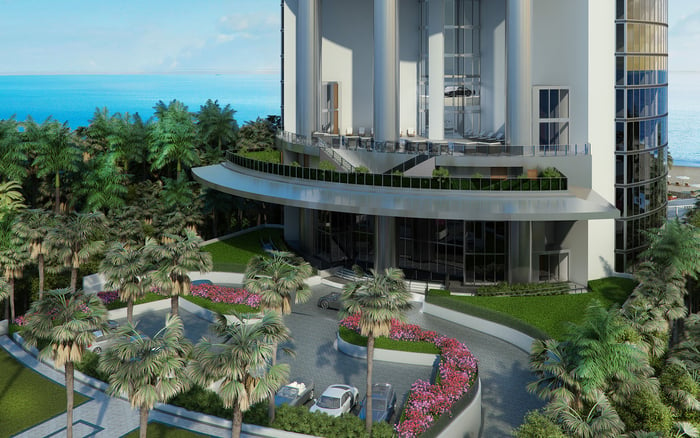
A collector-focused framework for evaluating art delivery routes, installation approvals, structural requirements, environmental stability, glazing exposure, and operating rules before selecting a South Florida residence.
For a serious collector, visual appeal is only the beginning. A residence should be evaluated according to whether each artwork can move safely from arrival to installation and remain in an environment appropriate for its materials.
When comparing Bentley Residences Sunny Isles and Onda Bay Harbor, buyers should request project-specific documentation rather than infer suitability from renderings, amenity descriptions, or building scale.
Create a route survey for the largest crated work in the collection. The review should cover vehicle access, unloading space, elevator doors and interiors, weight limits, corridor widths, ceiling clearances, turning points, residence entry dimensions, and the final path to the installation location.
Ask management to identify the approved route and permitted staging areas in writing. A route is not workable merely because individual dimensions appear sufficient; turns, thresholds, temporary protection, door hardware, and access restrictions can create additional constraints.
Collectors should also determine whether an alternate route is permitted if the standard path cannot accommodate a work. Any proposed use of exterior access, rigging, a terrace, or another nonstandard route requires technical review and written authorization before scheduling.
Residential comfort settings do not by themselves demonstrate collection-grade environmental stability. A conservator and qualified mechanical professional should define suitable temperature and relative-humidity parameters for the specific materials, then assess whether the residence can maintain them.
The review should address zoning, dehumidification, sensor placement, continuous monitoring, alerts, equipment access, and response procedures. Buyers should also consider how normal occupancy patterns, open doors, direct daylight, and maintenance interruptions could affect conditions around sensitive works.
Environmental performance should be tested and documented where possible. The goal is to understand actual conditions in proposed display and storage areas rather than rely on general descriptions of residential systems.
For works placed near windows or exterior openings, commission a daylight and ultraviolet-exposure review. Coordinate artwork locations with shades, lighting, and any alteration restrictions that may affect protective measures.
Outdoor art requires a separate assessment of material compatibility, anchoring, drainage, maintenance, and weather exposure. Placement on a terrace or other exterior area should never be treated as approved solely because the space can physically hold the work.
Heavy sculpture, suspended pieces, reinforced display walls, and large-format installations may require structural or engineering review. Buyers should request the relevant drawings and obtain written confirmation of allowable loads, anchoring locations, drilling limits, and permitted attachment methods.
The art installer, engineer, designer, and conservator should review the same plans. Their coordinated assessment can identify conflicts between structural needs, mechanical systems, lighting, circulation, waterproofing, and finished surfaces before fabrication or transport begins.
Request current rules governing installation hours, elevator reservations, common-area protection, contractor credentials, certificates of insurance, security procedures, rigging, noise, debris removal, and temporary staging. Confirm which party grants approval and how much lead time is required.
Insurance advisers should review the proposed delivery and installation plan alongside the building requirements. Coverage questions should be resolved before the artwork leaves storage, particularly when specialized handling or a nonstandard access method is contemplated.
Apply the same checklist to every property under consideration. A nearby option such as La Maré Bay Harbor Islands should be assessed through the same documented route, environmental, structural, and operational review rather than assumptions based on format or location.
A useful final package includes measured route drawings, environmental findings, proposed artwork locations, engineering approvals, installation rules, insurance requirements, and written building authorizations. Closing and installation decisions can then reflect the needs of the actual collection.
What is the first step in evaluating a residence for an art collection? Inventory the largest, heaviest, and most environmentally sensitive works, including their crated dimensions and installation requirements.
Why is an elevator measurement alone insufficient? The work must also clear loading areas, doors, corridors, ceilings, turns, thresholds, and the residence entry along an approved route.
Should buyers rely on marketing materials for freight planning? No. Buyers should request measured plans, operating rules, capacities, and written confirmation of the permitted delivery route.
When is an alternate delivery route worth exploring? It may be considered when the standard route is unsuitable, but technical feasibility, insurance, weather, safety, and written approvals must be addressed first.
Does residential air conditioning guarantee suitable conditions for art? No. A qualified professional should assess whether the system can maintain the ranges required by the collection.
How should climate conditions be monitored? Use appropriately placed sensors and a documented monitoring plan developed around the materials and display locations involved.
What should buyers review near large windows? They should evaluate daylight, ultraviolet exposure, heat, shading options, artwork placement, and any restrictions on protective treatments.
What is required before installing a heavy sculpture? Obtain an engineering assessment, confirm allowable loads and anchoring methods, and secure all required written approvals.
Which building rules matter during installation? Relevant rules may cover scheduling, access, elevator reservations, surface protection, contractor credentials, insurance, security, noise, and debris removal.
Who should participate in the technical review? The appropriate team may include a conservator, art installer, designer, mechanical professional, structural engineer, insurance adviser, and building representative.
For a discreet conversation and a curated building-by-building shortlist, connect with MILLION.
If branded residences are on your mind — as a home or as an allocation — we would be glad to share what we are seeing, privately.
Begin a quiet conversation