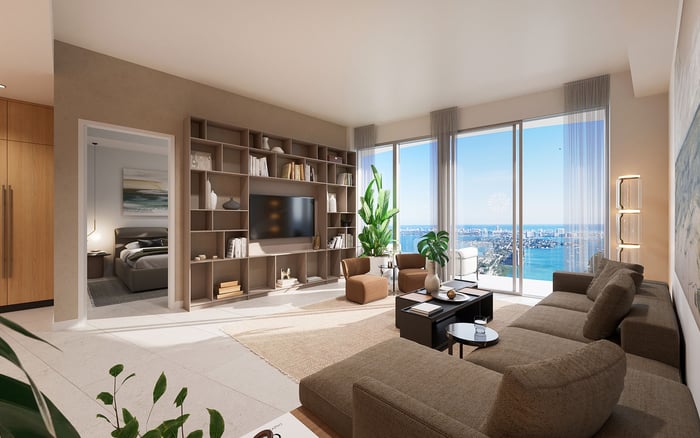
For collectors considering an Edgewater residence, storage, lighting, environmental management, service access, and privacy should be evaluated alongside the purchase itself. Residence-specific plans, current building documents, written management responses, and qualified professional advice can help clarify potential costs and lifestyle fit.

For an art collector evaluating an Edgewater residence, the purchase decision extends beyond finishes and views. The home must also support the collection’s dimensions, materials, display requirements, rotation schedule, and desired level of discretion.
Potential expenses may include off-site storage, specialist handling, installation, lighting work, shading, environmental monitoring, maintenance, and professional advice. Buyers should obtain collection-specific proposals instead of relying on generalized allowances.
A collection-focused review should identify usable wall lengths, circulation clearances, staging areas, storage options, and routes between the service entrance and intended display locations. Measured plans are more useful than assumptions based on total interior area.
When comparing Aria Reserve Miami and EDITION Edgewater, assess each available residence separately. Confirm dimensions, wall conditions, door openings, elevator access, and modification procedures through current plans and written building guidance.
If a home cannot accommodate works that are not on display, buyers can investigate professional off-site options. Any proposal should address handling procedures, access arrangements, insurance coordination, transport, confidentiality, and recurring charges.
Daylight should be considered in relation to orientation, glazing, intended display walls, and the sensitivity of individual works. Visiting at different times can help a buyer understand how natural light moves through a particular residence without assuming that all units perform alike.
A lighting plan may involve fixtures, controls, electrical work, wall preparation, shading, and professional focusing. Before selecting a residence at Lilli Miami Edgewater, request written confirmation of applicable approval procedures, contractor requirements, access conditions, and work restrictions.
A qualified lighting specialist or conservator can help translate collection needs into an appropriate plan. Building management should separately confirm what work is permitted in the chosen residence.
Collection care may depend on environmental stability rather than a single thermostat setting. Buyers should ask how the residence is conditioned, whether zoning or monitoring is possible, and how the proposed approach would function during travel or extended vacancy.
Backup-power coverage should never be assumed. Written building information should identify which systems or circuits, if any, remain available during an interruption and whether in-residence climate equipment is included.
For a home under consideration at The Cove Residences Edgewater, the buyer can prepare an annual operating model covering electricity, monitoring, maintenance, service visits, and professional oversight where appropriate. The resulting plan should reflect the actual collection and occupancy pattern.
Collection logistics can involve vendors, schedules, access records, insurance documents, delivery routes, staging, and elevator reservations. A privacy review should therefore examine the entire service process rather than focus only on the residence entrance.
For large or frequently rotated works, obtain written guidance on loading procedures, elevator dimensions, delivery windows, vendor registration, insurance requirements, staging areas, and installation permissions. Current association documents and management responses should control the analysis.
Buyers should also ask how collection-related information is received, retained, and shared during approvals or deliveries. Any privacy expectations should be documented rather than inferred from branding or verbal statements.
A suitable residence should allow the owner to live comfortably with the collection. Consider how often works will rotate, whether service visits fit the household schedule, how entertaining affects display choices, and whether off-site storage would create unwanted complexity.
When evaluating Villa Miami, bring an inventory organized by dimensions, medium, sensitivity, display priority, and rotation frequency. Pair that inventory with measured plans and a written checklist for management, advisers, and collection-care professionals.
The strongest comparison combines spatial review, operational due diligence, professional input, and a realistic recurring-cost model. That process can reveal whether a particular Edgewater residence supports both the collection and the owner’s preferred way of living.
Why should storage be reviewed before buying an Edgewater residence? Storage choices can affect usable living space, handling frequency, service access, and recurring expenses.
Does more interior space guarantee better display conditions? No. Wall dimensions, glazing, circulation, furniture placement, access routes, and building procedures must also be evaluated.
How should a buyer assess daylight? Review intended display walls at relevant times and ask a qualified specialist to consider the sensitivity of each work.
What lighting questions belong in due diligence? Ask about permitted fixtures, electrical modifications, approval steps, contractor requirements, access rules, and work restrictions.
Can standard residential climate control be assumed to suit a collection? No. A qualified professional should assess the collection’s needs and the residence’s environmental performance.
Should backup power be assumed to support in-unit climate equipment? No. Request written confirmation identifying any covered systems and circuits.
When might off-site storage be appropriate? It may be worth considering when works cannot be accommodated comfortably, provided the buyer evaluates cost, handling, access, and privacy implications.
Which delivery details matter for large works? Confirm loading procedures, elevator and doorway dimensions, staging areas, reservation windows, vendor documentation, and installation permissions.
How can a collector evaluate privacy? Review vendor registration, scheduling, service circulation, access records, document handling, and information-sharing procedures.
What should a buyer use to compare Edgewater residences? Use a collection inventory, measured plans, current building documents, written management responses, specialist advice, and a recurring-cost model.
To compare the best-fit options with clarity, connect with MILLION.
If branded residences are on your mind — as a home or as an allocation — we would be glad to share what we are seeing, privately.
Begin a quiet conversation