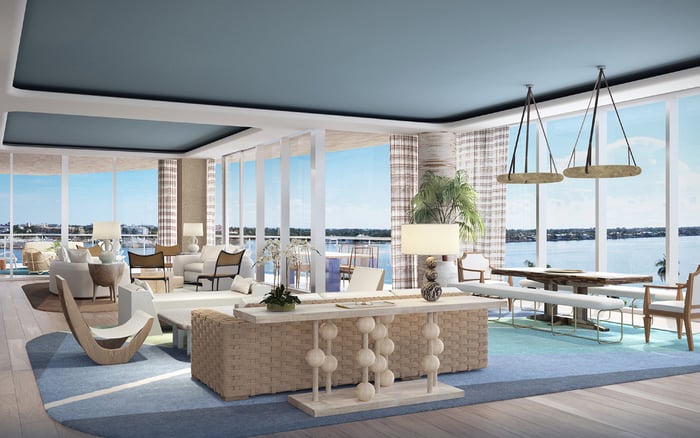
A discreet readiness framework for West Palm Beach residences, covering camera placement, access records, incident preservation and privacy before seasonal arrivals. The priority is clear responsibility, not simply more surveillance.

For a household arriving by private aviation, readiness extends beyond the transfer and a perfectly prepared residence. Before the first arrival, the owner should know which entrances are recorded, who can review the recordings, how access events are documented and how footage is preserved when needed. Discretion depends as much on those decisions as on the cameras themselves.
In West Palm Beach, and for buyers considering the broader Palm Beach area, the starting point is a written operating policy-not an equipment shopping list. Seasonal travel is a reason to review that policy, not a basis for assuming heightened crime or adopting a universal surveillance schedule.
For buyers evaluating Alba West Palm Beach, the due-diligence question is straightforward: what security information would the owner control, and what would remain under building management? Resolve that question rather than assume anything about the property's systems.
A coverage review should follow the anticipated arrival, from vehicle approach to the residence entrance. Ask a qualified security professional to assess relevant entry points, service access and transitions between shared and private space. The objective is usable evidence of an event, not indiscriminate observation of everyone nearby.
Request a demonstration of recorded playback, not just a live image. Ask whether the intended event can be understood under expected arrival conditions. Camera placement should also undergo a privacy review, especially where coverage could extend into neighboring space or areas unrelated to the household's security purpose.
At Forté on Flagler West Palm Beach, a prospective purchaser can use the same framework to ask where building-managed coverage ends and owner responsibility begins. A property's positioning or presentation should not be taken as evidence of a project-specific camera configuration.
The deliverable should be a simple coverage map identifying each camera's purpose, the responsible operator and the person authorized to retrieve footage. Any proposed additions should remain subject to professional review and applicable building permissions.
Access records and video serve related but distinct purposes. Separate records of entry activity from audit records showing who accessed the surveillance system. Ask what each system actually records rather than assume every credential event or footage export is traceable.
A sound operating policy assigns viewing and export permissions by role. The person coordinating a delivery need not automatically have the same authority as the owner or designated security lead. Audit records should identify who viewed or exported footage and when, making the handling of recordings as accountable as the activity they capture.
Consider retaining entry logs at least as long as associated video. Longer retention, potentially measured in years, may be appropriate after reviewing purpose, privacy and applicable obligations. It is a planning choice, not a blanket residential mandate. Establish a review schedule and assign responsibility for removing permissions when a staff or service relationship ends.
For a buyer considering Mr. C Residences West Palm Beach, the management questions are practical: who administers credentials, who handles an incident request and which records can lawfully be made available to an owner?
The essential distinction is between police recordings and private residential footage. Florida's minimum 90-day retention requirement for law-enforcement body-camera recordings does not establish a mandatory retention period for a home's security system. Nor does it establish that 90 days would be sufficient for a particular household.
Review a private residence's retention decision against the property's circumstances and applicable obligations. Insurance claims, police requests and civil disputes are reasons to document that decision. Have counsel and the relevant insurance adviser evaluate the proposed schedule rather than treating a familiar number as a compliance shortcut.
Separate routine retention from incident preservation. Routine retention defines when ordinary footage is overwritten or deleted. An incident procedure should address how relevant material is identified and protected while the appropriate adviser determines what must be kept and for how long.
Before travel, ask the operator to demonstrate retrieval and export within the selected retention window. Record the chosen schedule, the person responsible for administering it and the escalation route if an event is discovered close to deletion. A policy should be executable, not merely filed.
Registration with West Palm Beach's camera registry does not give police direct access to private cameras. The registry allows police to identify nearby cameras and request footage after a crime or critical incident. Registration information is protected, non-public information accessible only to authorized users.
Within that framework, police and the camera-platform provider require the owner's explicit written permission before accessing a camera. Registration, camera access and the release of a particular recording should therefore remain distinct decisions in the household's procedure.
Designate someone to receive requests and someone with authority to approve a response. Record the request, authorization and material released. Route requests that raise legal questions to counsel rather than asking household staff to resolve them informally.
A residence's privacy policy should address camera placement, viewing permissions, retention, log reviews and release authority together. Collecting footage is only the first decision; controlling its subsequent use deserves equal attention.
Florida's drone restrictions address imaging-based surveillance of privately owned real property or its occupants that violates a reasonable expectation of privacy without written consent, subject to statutory exceptions. They should not be read as a general placement rule for fixed residential cameras. Likewise, public-records treatment of security recordings in a governmental setting does not make all private-home footage public records.
When evaluating Shorecrest Flagler Drive West Palm Beach, ask for a clear division between private-residence decisions and building-managed procedures. The purpose is to establish responsibility, not to presume a particular privacy or security specification.
Before seasonal occupancy, assemble the coverage map, permissions register, retention schedule and incident contacts into one controlled handover. Name a decision-maker and a backup. Rehearse a footage request so retrieval, approval and preservation do not depend on improvisation during an arrival or absence.
The strongest readiness plan is one the household can explain without ambiguity: what is captured, who may see it, when it is deleted and who intervenes when an incident changes the rules.
Explore West Palm Beach residences with a more informed approach to ownership at MILLION.
If branded residences are on your mind — as a home or as an allocation — we would be glad to share what we are seeing, privately.
Begin a quiet conversationNo. Registration allows police to identify nearby cameras and request footage after a crime or critical incident; it does not provide direct camera access.
West Palm Beach camera-registry registration information is protected, non-public information accessible only to authorized users.
Within the registry framework, police and the camera-platform provider require the owner's explicit written permission before accessing a camera.
The Florida 90-day minimum discussed here applies to law-enforcement body-camera recordings, not private residential systems. A household should determine its retention schedule with appropriate legal and insurance advice.
Review relevant entrances, service access and transitions between shared and private space. Ask a qualified professional to assess recorded playback and privacy implications, not just live views.
Consider keeping entry logs at least as long as associated video. A longer period may be appropriate after reviewing purpose, privacy and applicable obligations, but it is not a universal residential requirement.
Assign permissions by role and operational need. Maintain audit records showing who viewed or exported recordings and when.
A written procedure should address protecting relevant incident material from routine deletion. The appropriate adviser should determine preservation obligations and duration.
No. The drone restrictions address specified imaging-based surveillance and include statutory exceptions; they are not a general fixed-camera placement rule.
Ask who controls shared-area recordings, administers credentials and handles incident requests. Clarify which responsibilities belong to the owner and which remain with management.