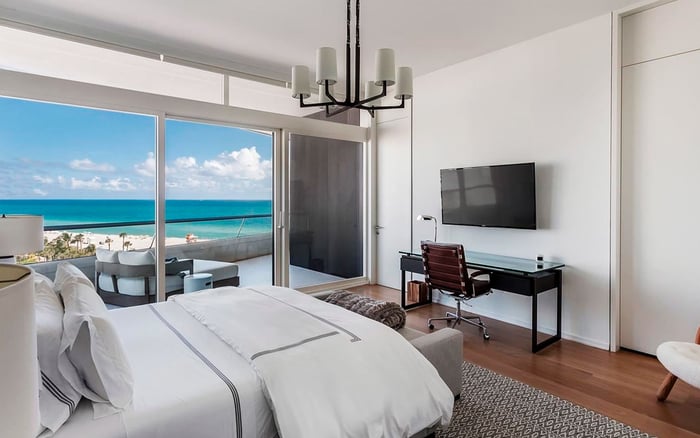
A branded residence requires more than borrower approval. Buyers should distinguish project eligibility from title diligence, confirm the applicable reserve standard, and understand why lender overlays and review waivers do not erase hotel-like-use restrictions.

The appeal of a branded residence is the promise of a considered daily life: a private home complemented by hospitality. Financing poses a more concrete question. Is the property an eligible residential condominium, or do its legal structure and operations place it in an excluded hotel-like category?
For a South Florida buyer, three inquiries should remain distinct: the borrower's qualification, the condominium project's eligibility, and the property's title. Strength in one does not settle the others. A substantial down payment does not make an ineligible project eligible, and project approval is not a title opinion.
A buyer considering St. Regis® Residences Brickell should make that distinction before relying on financing. This is a diligence principle, not a determination of that property's eligibility. The same qualification applies to every residence referenced here.
The Full Review framework described here generally requires the association's budget to allocate at least 10% of annual budgeted assessment income to replacement reserves for capital expenditures and deferred maintenance. This is a recurring budget allocation-not simply a measure of the cash the association holds today.
A special assessment cannot substitute for the required budget reserve allocation. Buyers should distinguish money collected for a specific undertaking from the association's continuing provision for future capital needs.
A higher, 15% reserve requirement is reported to take effect January 4, 2027. It should not be presented as universally applicable to purchases completed in 2026. Ask the lender to identify the effective rule, transition provisions and calculation that apply to the transaction, particularly if the anticipated financing timeline crosses into 2027.
Make the request precise: obtain written confirmation of the reserve standard the lender will apply and the budget documentation needed to demonstrate compliance. A general assurance that the building has reserves leaves the essential question unanswered.
Under the described Full Review framework, a qualifying reserve study can support an alternative to the standard allocation if it provides equivalent financial protection and funding meets or exceeds its recommendations. That alternative requires analysis, not merely possession of a study.
The lender's project-approval file must contain both the study and the lender's evaluation. Full Review also requires a substantive assessment of whether the projected budget meets operating needs. A reserve line item alone does not establish the adequacy of the association's finances.
For a buyer evaluating Four Seasons Residences Coconut Grove, the document request should bring the budget, reserve recommendations and services agreements into a single review rather than treat each in isolation. Branding supports no conclusion about that project's budget.
Request the study early. The condominium questionnaire asks whether the association has completed one within the previous three years. That question is a useful diligence prompt, not an independent assurance that a particular study will satisfy the lender.
Hospitality branding alone does not resolve eligibility. The lender must consider the project's legal structure and actual operation, including rental arrangements and restrictions on owner occupancy. A concierge desk or housekeeping offering should be assessed within the complete operating arrangement, not in isolation.
Predominant use for short-term rentals of fewer than 30 days is a warning sign: that is the threshold used to identify primarily transient occupancy. Buyers should request the rental restrictions and hotel-services agreements, then ask how those documents relate to actual use.
The project's legal or common name also matters. Names containing “hotel,” “motel” or “resort” are generally excluded, subject to an exception for historical terminology that no longer reflects the project's residential-condominium use. Sound diligence neither overlooks the name nor treats it as the only test.
When considering Four Seasons Hotel & Private Residences Fort Lauderdale, buyers should obtain a project-specific classification from the lender rather than infer an outcome from the address or name. This discussion establishes neither approval nor ineligibility for that property.
Commercial space generally cannot exceed 35% of the condominium project or of the building in which it is located. The calculation includes below-grade areas; a review confined to residential floors above ground can miss relevant space.
Request the commercial-space calculation and ask the lender to confirm its scope. The issue is not how residential the arrival experience feels, but whether the applicable project and building calculations satisfy eligibility requirements.
For a Miami Beach search that includes The Ritz-Carlton Residences® Miami Beach, this belongs in the same early diligence package as the declaration and budget. The reference implies no particular commercial allocation at that residence.
A revised framework reportedly eliminates Limited Review for established condominium projects with more than 10 units, requiring Full Review regardless of the buyer's down payment or credit strength. Confirm its applicability and effective timing with the lender. Do not assume that a larger equity contribution reduces the project review.
Projects with 10 or fewer units reportedly have an expanded pathway to a waiver of project review, subject to applicable conditions and exclusions. A waiver is not blanket approval and should not be read as overriding hotel-like-use exclusions or other project-eligibility requirements.
Lender overlays introduce another distinction. An individual lender may impose requirements stricter than the baseline. Ask which conditions arise from the applicable framework and which are additional lender requirements. Satisfying the baseline does not guarantee financing; an assumed exception cannot replace a documented decision.
Review the declaration and amendments for what they establish about the condominium's legal structure, use restrictions and operating relationships. These documents do not, by themselves, establish property-specific title status or title-insurance coverage.
Ask counsel and the title professional to address liens, easements and coverage through the transaction's actual title materials. A financing decision and a title conclusion answer different questions. Neither should serve as shorthand for the other.
Before relying on financing, assemble the declaration and amendments, HOA budget, reserve study, master insurance policy, rental restrictions, hotel-services agreements, commercial-space calculation, and structural or litigation disclosures. Alongside the separate title review, request written identification of unresolved project conditions and lender overlays.
The objective is clarity before commitment: know which rules apply, which documents support the decision, and which questions remain open.
For a considered approach to your South Florida residential search, connect with MILLION.
If branded residences are on your mind — as a home or as an allocation — we would be glad to share what we are seeing, privately.
Begin a quiet conversationNo. The condominium project must independently satisfy the applicable eligibility requirements, including restrictions on hotel-like projects.
It generally requires at least 10% of annual budgeted assessment income to be allocated to replacement reserves for capital expenditures and deferred maintenance.
No. A 15% requirement is reported to take effect January 4, 2027; confirm the effective rule and transition provisions with the lender.
No. A special assessment cannot substitute for the required recurring budget reserve allocation.
A qualifying study may support an alternative providing equivalent financial protection, with funding meeting or exceeding its recommendations. The lender must retain the study and its analysis.
The complete legal and operating arrangement must be evaluated, rather than amenities or branding alone. Rental arrangements and owner-occupancy restrictions are relevant.
A project is identified as primarily transient when its predominant use is short-term rentals of fewer than 30 days.
Commercial space generally cannot exceed 35% of the condominium project or the building containing it. The calculation includes below-grade areas.
No. The reported waiver pathway for projects with 10 or fewer units remains subject to applicable conditions and exclusions.
No. Property-specific title and coverage require separate review, while lender overlays can impose requirements beyond the project-eligibility baseline.