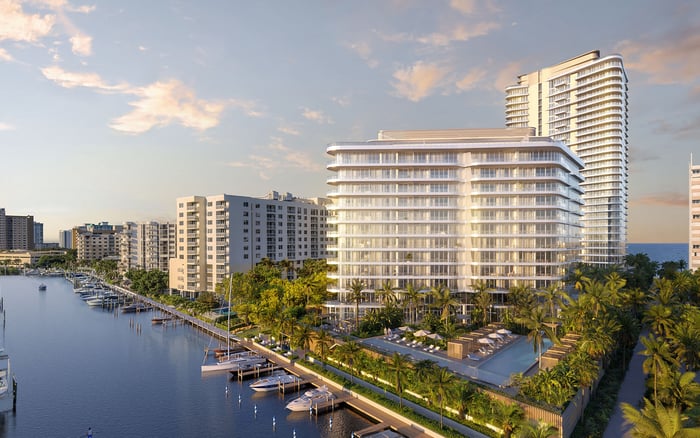
A disciplined ownership comparison of Casamar and Waldorf Astoria Residences Pompano Beach, separating maintenance estimates, purchase milestones, reserve funding and service charges from the contractual obligations buyers should confirm.

The most useful luxury condominium comparison begins where the presentation ends: with the obligations that remain after closing. At Casamar and Waldorf Astoria Residences Pompano Beach, buyers should distinguish three commitments: purchase payments, association assessments and services billed outside the association budget.
These distinctions matter more than a simple comparison of maintenance rates. An estimate is not an adopted budget, a deposit milestone is not an operating-cost escalator, and access to a service does not mean its use is included. For a long-term Pompano Beach owner, the objective is not necessarily the lowest assessment. It is a clear understanding of what the assessment funds and where additional costs may arise.
Casamar, at 900 N Ocean Blvd., Pompano Beach, FL 33062, has an early estimated maintenance figure of $0.98 per square foot. Treat that figure as an estimate-not a guaranteed long-term assessment or a substitute for the current, unit-specific obligation.
September 2026 fee figures offer more specific, though still limited, reference points. Unit 1202 carries a stated monthly maintenance fee of $3,250; Unit UPH03 carries a stated monthly HOA fee of $3,854. Other stated condominium fees range from approximately $1,890 to $5,114, reflecting differences among residences rather than a universal building charge.
These figures do not establish an increase from the original estimate. A valid comparison requires matching the residence, assessable square footage, billing frequency and included services. The figures are dated snapshots, not adopted budgets or audited financial statements.
For a residence under consideration, request the assessment amount in writing and reconcile it with the association’s allocation formula. Then compare that obligation with the adopted budget and assessment history. This makes the quoted figure useful for ownership planning without assuming every residence bears the same cost.
Waldorf’s disclosed purchase-payment schedule is 20% at contract, 10% at groundbreaking, 5% at top-off and 65% at closing. These milestones establish when purchase funds become due, not how association assessments or management charges might change after ownership begins.
The available maintenance estimates are $1.61 per square foot without reserves and $1.74 per square foot with reserves. Neither figure specifies a billing period, so neither should become a monthly ownership assumption without written confirmation.
At the reserve-inclusive rate, multiplying 2,097 square feet by $1.74 yields approximately $3,649 per billing period. For 3,557 square feet, the calculation yields approximately $6,189 per billing period. These are illustrations, not verified unit assessments, and remain subject to the applicable assessment-area formula.
Before relying on either example, confirm the billing frequency, the governing area measurement and whether the quoted rate still applies. Keep the purchase-payment schedule in a separate cash-flow model to distinguish acquisition liquidity from recurring carrying costs.
Casamar’s stated fee inclusions cover common-area and building maintenance, insurance, water, sewer, trash, internet, parking, security and recreation facilities. The stated inclusions for UPH03 also identify grounds maintenance, cable television and hot water. These descriptions are useful starting points, not evidence of identical service schedules for every unit.
Unit 802 has a separately stated association fee of $3,250, with no membership fee required. That does not establish that all services are included or that no usage-based charges apply.
For either property, request the adopted budget, actual financial statements, assessment history, reserve balances and studies, insurance terms, and pending or proposed special assessments. Review operating expenses and reserves separately, then reconcile them with the total assessment. If reserves are already included, counting the same contribution again would overstate carrying costs.
The available figures establish neither project’s specific escalation clauses or management-fee formula. Buyers should not assume a fixed annual increase, a particular inflation index or a contractual cap.
Have counsel review the purchase agreement separately from management and service agreements. In the purchase documents, ask whether any provision changes the amount payable, what triggers the change and what rights accompany it. In the management documents, examine escalation language, pass-through expenses, renewal and termination rights, and staffing obligations.
The practical questions are straightforward: Which costs can change? Who bears them? Is there a formula, a limit or a notice requirement? Which obligations continue upon renewal? These are questions for document review, not descriptions of confirmed clauses at either building.
A service-oriented residence warrants a service-by-service cost review. Obtain written confirmation of what is included and what is billed separately, particularly for branded hospitality, valet, housekeeping, food and beverage, and in-residence services. Do not assume any particular offering exists at either property without confirmation.
For each applicable service, establish whether the expense falls within the association budget, carries a separate recurring charge or arises only when used. Clarify any minimums, gratuities or other additions before setting a personal annual allowance.
If your Broward shortlist also includes The Ritz-Carlton Residences® Pompano Beach, apply the same questions rather than carrying over assumptions from another branded property. Compare the documented service obligations, not simply the names above the entrances.
Build the ownership model around the confirmed assessment, then add property taxes, unit insurance, financing, excluded utilities and optional services as separate line items. Include a special-assessment contingency without presenting it as an announced charge.
For a seasonal owner, distinguish obligations that remain payable from expenses tied to actual use. A lighter occupancy schedule should not reduce a fixed obligation in the model unless the governing terms support that treatment.
Use a baseline and a higher-cost scenario, clearly labeling every assumed increase rather than presenting it as a forecast. Consider how changes in insurance, staffing, service use or reserve funding would affect the total. The purpose is to test your comfort with the cost of ownership, not to predict either association’s future budget.
Before committing, reconcile three records: the signed purchase obligations, the applicable association assessment and the written service schedule. Resolve any difference between a quoted estimate and a contractual obligation before it becomes an ownership surprise.
Casamar’s unit-level fee snapshots and Waldorf’s maintenance estimates offer different starting points. Neither replaces a current, residence-specific review. The stronger purchase decision rests on clear obligations, understood exclusions and sufficient flexibility for future costs.
For a discreet perspective on your next South Florida residence, connect with MILLION.
If branded residences are on your mind — as a home or as an allocation — we would be glad to share what we are seeing, privately.
Begin a quiet conversationCasamar is located at 900 N Ocean Blvd., Pompano Beach, FL 33062.
No. It is an early per-square-foot estimate, not a guaranteed long-term assessment or confirmation of a current unit’s obligation.
Unit 1202 had a stated monthly maintenance fee of $3,250, while Unit UPH03 had a stated monthly HOA fee of $3,854. These are dated, unit-specific listing figures.
No. Establishing an increase requires matching the unit, assessable square footage, billing frequency and included services across the comparison.
The schedule is 20% at contract, 10% at groundbreaking, 5% at top-off and 65% at closing. These milestones are separate from operating-cost escalation provisions.
The estimates are $1.61 per square foot without reserves and $1.74 with reserves. The billing period must be confirmed before treating either figure as monthly.
It produces approximately $3,649 for 2,097 square feet or $6,189 for 3,557 square feet per billing period. Neither calculation is a verified unit assessment, and the assessment-area formula requires confirmation.
Request the adopted budget, actual financial statements, assessment history, reserve balances and studies, insurance terms, and pending or proposed special assessments.
Do not assume inclusion or availability. Obtain a written schedule distinguishing association-funded services from separately billed or usage-based services.
Have counsel review purchase and management agreements separately for escalation provisions, pass-through expenses, renewal and termination rights, and staffing obligations. The available figures do not establish either project’s specific escalation formula.