Public materials identify developer construction financing, but not a condominium-association reserve line of credit. Buyers should treat any reserve borrowing as a conditional underwriting issue and examine the governing documents, budgets, reserve schedule, repayment terms, and turnover provisions before committing.

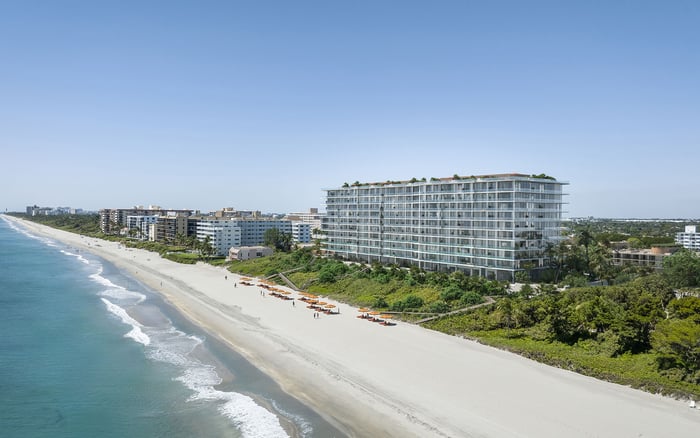
At The Ritz-Carlton Residences® Pompano Beach, the architecture and setting are readily legible: a dual-tower condominium development at 1380 S. Ocean Boulevard, positioned between the Atlantic Ocean and the Intracoastal Waterway. The program encompasses 205 residences-117 in the Beach Tower and 88 in the Marina Tower. The east side centers on beachfront facilities; the west side brings waterfront amenities and a private marina into the ownership proposition.
The financing question demands a more exacting lens. The publicly disclosed $259 million loan obtained by Fortune International Group and Oak Capital is developer construction financing. It should not be confused with a condominium-association line of credit intended to fund reserves. No association reserve facility is publicly identified, nor are its potential borrower, collateral, repayment schedule, or treatment in an initial association budget.
That absence does not establish that such a facility exists or will exist. It means the question remains conditional and must be resolved through the offering and governing documents rather than marketing materials.
A reserve credit facility matters only when its obligations are traced into the owners’ budget.
A condominium association may use reserves to prepare for major common-element expenditures over time. If an association instead borrows to establish or supplement reserves-or to address an operating shortfall-the loan can shift part of today’s funding requirement into tomorrow’s ownership costs.
For a future owner, that shift may take several forms. Regular common charges could include principal and interest. A maturity date could introduce refinancing risk. A special assessment could become necessary if the repayment source proves inadequate. Depending on the governing documents and loan agreement, later owners may contribute toward an obligation created before they purchased or before control of the association transferred from the developer.
Borrowing is not inherently problematic. A credit facility can provide liquidity and timing flexibility. The underwriting concern is whether buyers can see the full economics: the amount available, amount drawn, rate structure, maturity, security, covenants, repayment source, and consequences of default. Luxury service levels do not remove those variables. They make budget clarity more important because staffing, amenity operations, insurance, maintenance, and debt service must coexist within a single financial plan.
The Beach Tower has been described as 31 stories and the Marina Tower as 14 stories. Fortune International Group and Oak Capital are the principal developers, with Fairwinds also identified as a developer participant. Lissoni & Partners and Revuelta Architecture International are part of the design team.
Construction broke ground in 2022, when the project was described as more than 75 percent sold. Work is underway, with delivery targeted for 2026. A 2024 construction-cost estimate placed the project at $350 million. The one- to four-bedroom residences range from 898 to 6,824 square feet, and the development is labeled sold out.
These facts define an ambitious branded-residences proposition, but they do not resolve the reserve question. Neither does the construction loan. Developer debt funds development activity; association debt would sit within the condominium’s post-closing financial structure. Buyers and advisers should keep those balance sheets conceptually separate.
The essential review begins with the condominium declaration, initial budget, projected budgets, reserve study or reserve-funding schedule, and turnover provisions. Buyers should also request every association loan, line-of-credit agreement, term sheet, or proposed financing authorization, together with any applicable amendments and board approvals.
For any reserve facility, counsel and a condominium accountant should identify the legal borrower and confirm whether the lender has recourse to association revenues, assessments, reserve accounts, or other collateral. The review should establish whether interest is fixed or variable, when principal amortization begins, whether the loan includes a balloon payment, and whether prepayment carries a cost.
The next question is funding intent. Will reserves be fully funded at closing, contributed by the developer, accumulated through scheduled owner payments, or supplemented with borrowed money? The answer should reconcile with the initial budget. If a line is available but undrawn, buyers should determine who may draw on it, for what purposes, and under what approval standard.
Turnover deserves particular scrutiny. Any obligation that survives developer control may become part of the owner-controlled board’s opening financial position. The documents should state whether the facility must be repaid, refinanced, or retained at turnover-and whether purchasers inherit debt service through common charges.
Pompano Beach is attracting a broader field of new-construction and branded offerings. A buyer may include Armani Casa Residences Pompano Beach, Waldorf Astoria Residences Pompano Beach, and Ocean 580 Pompano Beach in the comparative set, but a useful analysis extends beyond finishes or brand identity.
For each property, normalize the projected annual carrying cost, separating operating expenses, reserve contributions, debt service, and discretionary amenity spending. Then test the budget against the residence’s intended use. A primary resident, seasonal owner, and long-horizon investor may assign different values to immediate liquidity, predictable assessments, and future resale transparency.
Waterfront complexity also warrants disciplined review. Beachfront facilities, marina components, and two towers can create distinct maintenance responsibilities or cost allocations. Buyers should confirm which common elements serve all owners, which expenses are tower-specific, and whether marina-related costs or obligations are allocated separately. No allocation should be inferred from the physical plan alone.
For MILLION's Buyer's Guides audience, the central conclusion is measured. No association reserve line of credit is publicly identified. The disclosed $259 million facility is a construction loan to the developers, not evidence of reserve borrowing by the eventual condominium association.
Still, the economic possibility matters. If association borrowing is introduced, future owners could encounter it through budgeted debt service, higher common charges, a special assessment, or a payoff obligation that survives turnover. The decisive evidence will be contractual: the offering documents, budgets, reserve schedule, loan papers, and turnover language.
A sophisticated purchase review should therefore model both the stated budget and any contingent borrowing. The objective is not simply to ask whether a line exists, but to understand who can use it, who must repay it, and when that responsibility could enter the cost of ownership.
For discreet guidance on South Florida’s luxury condominium market, connect with MILLION.
If branded residences are on your mind — as a home or as an allocation — we would be glad to share what we are seeing, privately.
Begin a quiet conversationNo association reserve line of credit is identified in the reviewed public-facing project materials. Buyers should verify the position in the offering documents and initial budget.
No. It is characterized as developer construction financing obtained by Fortune International Group and Oak Capital.
Repayment could appear through debt service in the budget, increased common charges, a special assessment, or a payoff obligation surviving turnover.
Confirm the borrower, available and drawn amounts, interest structure, maturity, collateral, covenants, repayment source, and prepayment terms.
Request the reserve study or funding schedule, initial and projected budgets, condominium declaration, turnover provisions, and all association financing agreements.
A loan that survives turnover could become part of the owner-controlled association’s opening financial position and ongoing budget.
Published project descriptions identify 205 residences, comprising 117 in the Beach Tower and 88 in the Marina Tower.
Construction is underway, and current public-facing project information targets delivery for 2026.
The official project profile advertises one- to four-bedroom residences ranging from 898 to 6,824 square feet.
No. Buyers should rely on the governing documents, budgets, reserve schedule, and any loan agreements reviewed with qualified legal and accounting advisers.