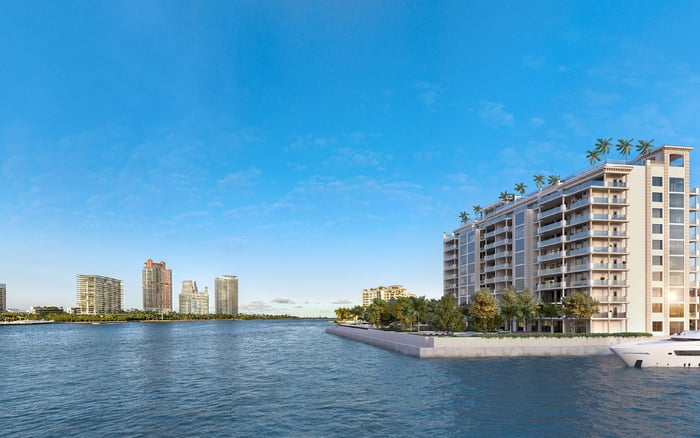
Waterfront costs depend less on the view than on the legal rights and obligations attached to a residence. Buyers should verify any shoreline, dock, marina, baywalk, or off-site facility exposure and trace responsibility through title documents, budgets, reserves, permits, and engineering records.

For buyers exploring Delano Residences & Hotel Miami, the first waterfront question is not what can be seen from the residence. It is what the purchaser will legally own, use, fund, maintain, or indemnify.
A water view does not by itself establish responsibility for a seawall, dock, marina, channel, baywalk, or dredging. Any exposure should be confirmed through the condominium declaration, title materials, offering documents, easements, shared-facility agreements, and operating agreements.
This distinction is especially important in branded residences, where hotel operations, residential association expenses, commercial components, and shared amenities may sit within different legal and accounting structures. Buyers should request a written schedule identifying each waterfront component, the party that controls it, the users entitled to access it, and the party responsible for routine and capital expenses.
A water view does not establish a waterfront obligation; the governing documents do.
If the property has direct or shared shoreline exposure, seawall condition can affect repair planning, permitting, engineering work, insurance review, reserve funding, and assessment risk. Buyers should not rely on appearance alone. A wall that looks finished from an amenity area may still require a technical review of its structure, elevation, adjoining conditions, and maintenance history.
Relevant records can include inspection reports, surveys, engineering evaluations, repair proposals, permits, closed and open violations, invoices, warranties, and correspondence concerning neighboring property or public infrastructure. Counsel and qualified professionals can then determine which records apply to the residence and whether the governing documents allocate responsibility clearly.
Comparison shopping should follow the same property-specific approach. Buyers considering Shore Club Private Collections Miami Beach or The Perigon Miami Beach should review the legal parcel, common elements, easements, maintenance covenants, engineering files, and reserve treatment rather than infer obligations from location or marketing.
A landscaped shoreline, waterfront walkway, or shared access area can be governed by recorded agreements that assign maintenance, repair, replacement, access, and indemnity duties among different parties. In a condominium or hotel-residential structure, responsibility may sit with the residential association, a master association, a commercial unit, the hotel operator, another parcel owner, or a combination of parties.
Counsel should trace each obligation from the declaration and exhibits through title exceptions, reciprocal easement agreements, operating agreements, and cost-sharing provisions. The financial review should mirror that legal map. A broad repairs category in a budget is less useful than a component schedule showing the responsible party, inspection cycle, anticipated work, available funding, and assessment authority.
A purchaser reviewing The Ritz-Carlton Residences® Miami Beach should apply the same allocation analysis. Amenity access and capital responsibility should be verified separately because the right to use a facility does not necessarily reveal who must pay for major work.
If the Delano residential package includes rights in a dock, marina, channel, or bayfront facility, buyers should identify the applicable permits, authorized scope, maintenance history, current conditions, sediment-management plan, and responsible party. The review should distinguish maintenance intended to restore an authorized condition from work intended to change depth, width, footprint, or use.
That distinction matters because different work can involve different review, engineering, environmental, notice, disposal, timing, and cost considerations. A purchaser should obtain written documentation rather than rely on an informal description such as “deep water” or “yacht access.” A marine professional can evaluate whether the documented conditions suit the intended vessel and use.
Buyers should also ask whether dredging serves the entire property, a limited group of slip holders, hotel operations, or an adjacent parcel. The answer can determine whether an expense belongs in the association budget, a marina allocation, an operator account, a user charge, or a separate cost-sharing arrangement.
Dock costs can appear in both annual operations and long-term capital planning. Routine items may include inspections, minor repairs, hardware, utilities, cleaning, and safety-related work. Larger projects may involve structural repairs, replacement, shoreline work, utility upgrades, or dredging.
The useful question is whether the subject property has defined the scope, beneficiaries, maintenance cycle, decision-making authority, and funding mechanism for each component. Buyers should examine inspection history, unresolved recommendations, insurance treatment, vendor contracts, reserve schedules, and any planned or deferred projects.
Cost allocation deserves particular attention. Expenses may be shared by all owners, assigned to marina or slip users, charged to an operator, allocated to another parcel, or divided under a recorded formula. The governing documents and budgets should support the answer consistently.
Monthly charges are easier to compare after they are normalized for residence size and separated by function. Hospitality staffing, security, pools, wellness facilities, insurance, and hotel-shared services should be distinguished from seawall inspections, shoreline work, dock operations, dredging planning, engineering, and permitting.
This reconstruction helps a buyer identify whether a waterfront component is adequately funded or largely absent from the current budget. It also clarifies whether a low recurring charge reflects efficiency, limited responsibility, deferred work, or an expense carried outside the residential association.
Reserve balances should be reviewed alongside the documents that define responsibility. Funding held by one entity may not be available for a component owned or controlled by another. Buyers should therefore connect every reserve line to the relevant asset, responsible party, and authority to approve work or levy an assessment.
Before contract deadlines expire, request the declaration, amendments, easements, title exceptions, current budget, reserve materials, engineering reports, surveys, permits, violation records, dock inspections, vendor agreements, and available maintenance history. If a marina or navigable facility is involved, seek written confirmation of its authorized scope, current condition, access rights, operating rules, and funding structure.
Finally, require a clear responsibility schedule for seawalls, docks, walkways, dredging, environmental work, utilities, insurance, and off-site facilities. For a waterfront purchase, that legal and financial map can distinguish an included amenity from a separate or unpriced obligation.
For discreet guidance on evaluating the residence, its documents, and its waterfront cost structure, connect with MILLION.
If branded residences are on your mind — as a home or as an allocation — we would be glad to share what we are seeing, privately.
Begin a quiet conversationNo. Responsibility depends on the ownership structure, governing documents, easements, and cost-sharing agreements.
Review the declaration, title exceptions, surveys, easements, operating agreements, budgets, and engineering records.
Engineering records can reveal evaluated conditions, recommended work, repair history, and matters that may affect future planning.
Confirm access, assignment, transfer, operating, and cost obligations in the governing and title documents rather than relying on marketing descriptions.
Maintenance and expansion work can involve different engineering, permitting, environmental, timing, and cost considerations.
Ask for applicable permits, maintenance history, condition reports, project plans, sediment-management information, and cost allocations.
Depending on the documents, costs may be allocated to all owners, designated users, an operator, another parcel owner, or several parties.
Routine work may appear in operating expenses, while major repairs or replacement may require capital or reserve planning.
Normalize charges for residence size, then separate hospitality and general services from shoreline, dock, engineering, and dredging expenses.
It should identify each component, its owner or controlling party, permitted users, maintenance obligations, funding source, and assessment authority.