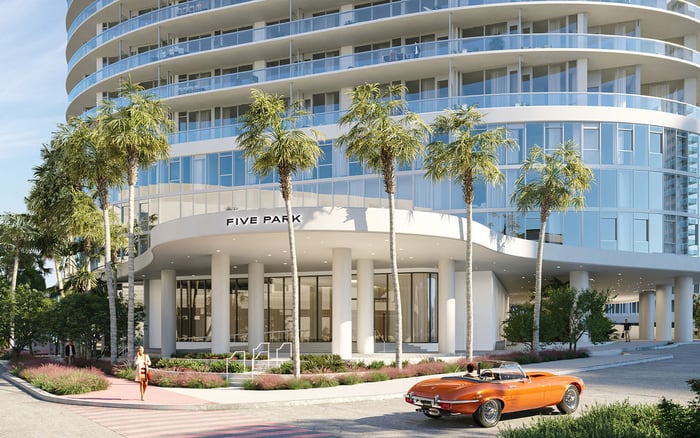
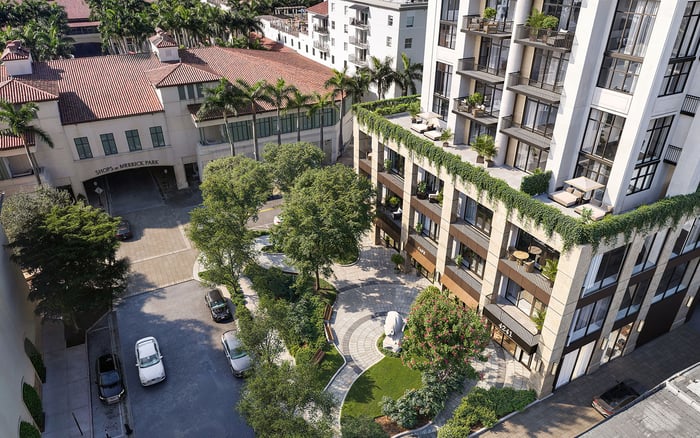
Five Park and Cora Merrick Park illustrate two distinct approaches to landscape-led urban living: a substantial public park in Miami Beach and a smaller on-site garden connected to shopping and dining in Coral Gables.
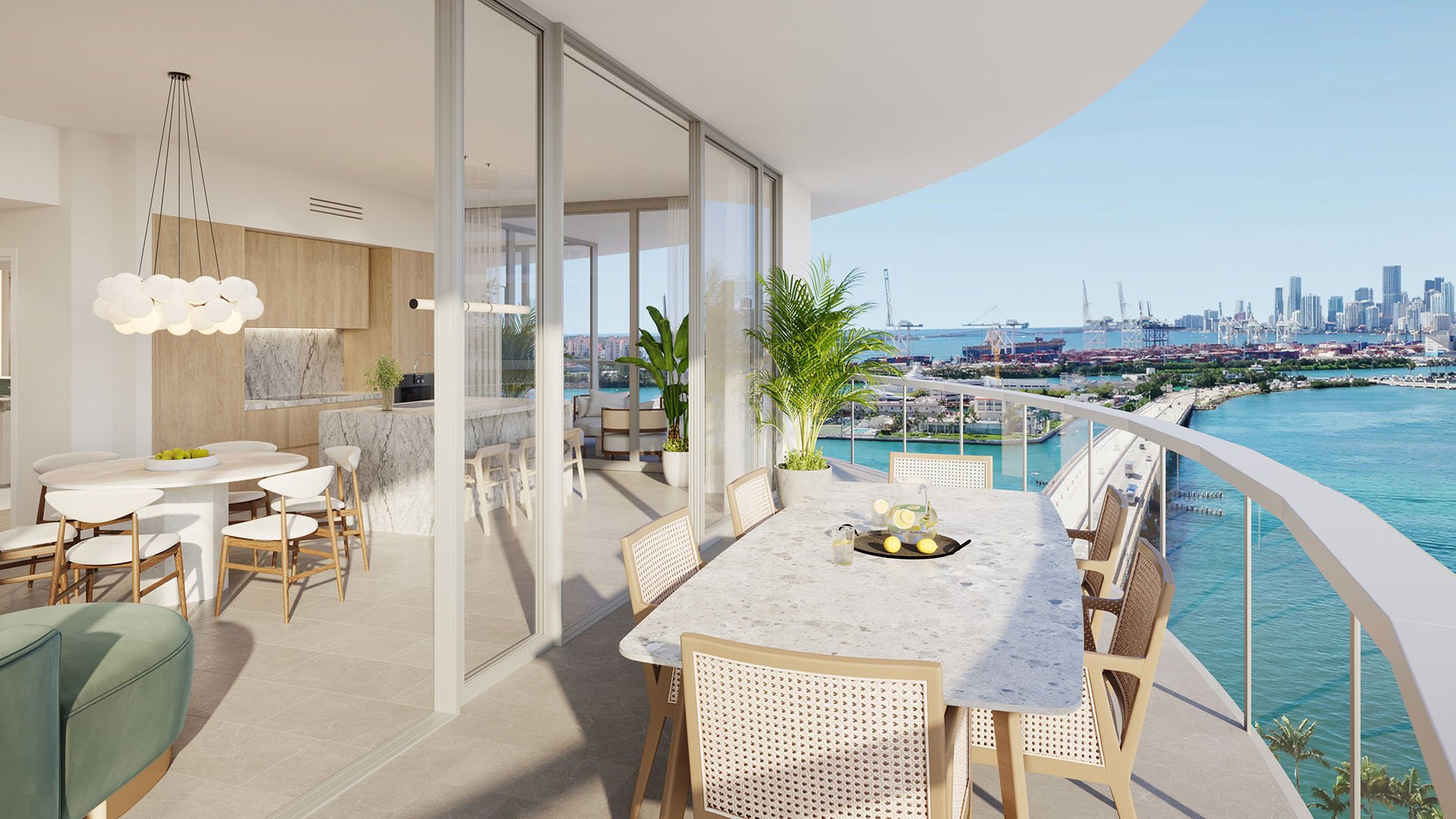
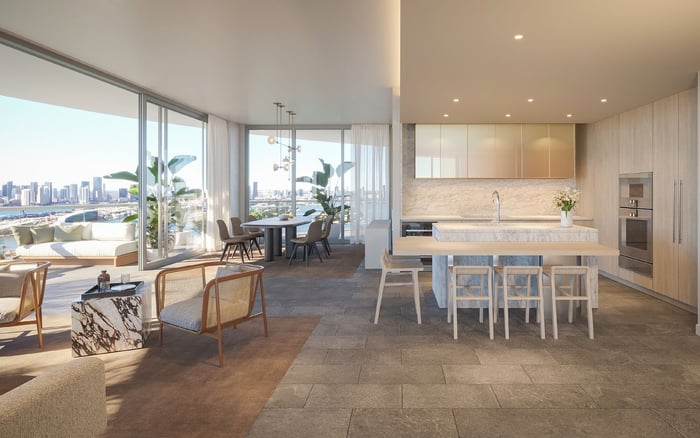
An urban home's appeal does not stop at its terrace. The landscape outside the building shapes how easily an owner steps out for exercise, takes a child outdoors or pauses between appointments. For a luxury buyer, the distinction is not simply whether greenery exists, but whether it supports daily life without requiring a separate excursion.
Five Park Miami Beach and Cora Merrick Park offer two different answers. At Five Park, the setting includes a substantial public landscape with recreation, planting and art. At Cora, the proposed experience is more intimate: a landscaped on-site park connected to shopping and outdoor dining in Coral Gables.
These are not interchangeable propositions. Canopy Park is public; buyers should not assume equivalent access at Cora. Both illustrate why landscape deserves an assessment separate from a building's private amenities-and why a park's usefulness matters more than its presence in a rendering.
Located at 600 Alton Road, Five Park Miami Beach sits beside the three-acre Canopy Park. That scale accommodates a varied outdoor program rather than a single garden function. Features include a botanical grove with Florida-native trees and plants, a MONSTRUM playground, an outdoor gym and a dedicated dog park.
For buyers, these distinctions are practical. A playground serves a different household need from an exercise area, while a dog park offers something a decorative planted entrance does not. An event lawn provides flexible space for gatherings and picnics. Together, these uses offer several reasons to step outside, rather than one prescribed way to enjoy the landscape.
The public character is equally important. Canopy Park is not an exclusively residential courtyard. Its openness is part of its identity: a neighborhood landscape can broaden the experience of home, but it is not the same proposition as a secluded residents' garden.
Canopy Park's appeal extends beyond recreation. A bioswale conceived as a dry river incorporates stormwater management into the landscape. It gives the planting scheme a functional dimension, though buyers should not interpret that feature as a guarantee of protection for an individual residence or the surrounding neighborhood.
Public art adds another layer. The park features Snow White, an installation by Miami-based sculptor Mark Handforth. Alongside the botanical grove, it makes the landscape more than a collection of activity areas. Art, planting and open space offer reasons to linger even when exercise or children's recreation is not on the agenda.
The buyer's question is how these elements work together. Walk the route from the residential entrance, consider where you would pause, and distinguish an attractive view from a place you would actually use. A landscape can be visually compelling without fitting every household's routine.
In Coral Gables, Cora Merrick Park plans a 5,000-square-foot landscaped on-site park. The design centers on trees, shaded areas and seating, with an installation by artist Jaume Plensa as a defining feature. The emphasis is on relaxation and informal social use rather than Canopy Park's broader recreational program.
Cora's park is designed to connect directly with the adjacent Shops at Merrick Park and its shopping and al fresco dining. That relationship is central to the comparison. A smaller landscape can still be useful when it forms part of a route to destinations an owner expects to visit regularly.
Access requires a separate inquiry. The park's on-site designation does not establish public-entry rights, operating hours or unrestricted use. Buyers should confirm those details rather than equating an inviting design with a public park. The distinction is especially important when comparing Cora's proposed setting with Canopy Park's public character.
At Five Park, the planned 50,000 square feet of residential amenities complement the adjacent landscape. The amenity deck includes adult and family-friendly pool areas, cabanas, shaded gathering spaces and a meditation deck. The sixth-floor terrace program includes an indoor/outdoor café, covered dining, a hot tub and a hammock area.
Cora's planned private program includes a rooftop resort-style pool with cabanas, fitness facilities, coworking areas and outdoor dining. Its wellness offering also includes a spa with a sauna, steam room, and hot and cold plunges. These facilities address needs that a landscaped park does not necessarily serve.
The distinction is not about deciding which category is superior. Public green space can extend daily life into the neighborhood; resident amenities provide a separate setting for recreation and relaxation. Evaluate both, but do not count a public lawn as exclusive outdoor space or assume every private feature is already operational. Confirm current availability and access before purchase.
Start with the activities your household would repeat. At Canopy Park, that might mean children's play, an outdoor workout or time with a pet. At Cora, it might mean a shaded pause before shopping or dinner. Neither pattern is inherently better; the stronger fit depends on what you would use consistently.
Then examine the connection between residence and landscape. Ask about entry points, access rules, maintenance responsibilities and any restrictions on the uses that matter to you. Visit at the times you expect to be outdoors, paying attention to shade, seating and the character of the shared space.
Buyers also considering Ponce Park Coral Gables can apply the same questions without assuming an equivalent park arrangement. Compare each property's documented relationship to its surroundings, not simply the promise suggested by a name or presentation.
There is no established home-price premium attributable solely to either park in this comparison. The sounder assessment is personal and practical: what does the landscape let you do, how readily can you reach it, and what access is actually assured?
Five Park offers the clearer public-park proposition, with a larger, activity-oriented landscape. Cora presents a smaller landscaped setting designed around relaxation and a connection to shopping and dining. Each can enrich urban living in a different way. The discerning purchase is the one whose outdoor setting supports the life you intend to lead, rather than merely enhancing the view from home.
Explore South Florida residences with a considered approach to setting and everyday living at MILLION.
If branded residences are on your mind — as a home or as an allocation — we would be glad to share what we are seeing, privately.
Begin a quiet conversationFive Park is located at 600 Alton Road in Miami Beach, beside the three-acre Canopy Park.
Canopy Park is described as a public park, rather than an exclusively residential courtyard.
Its program includes a MONSTRUM playground, an outdoor gym, a dedicated dog park and an event lawn for gatherings and picnics.
The park includes a botanical grove with Florida-native trees and plants, as well as Snow White, an installation by Mark Handforth.
The dry river is a bioswale that incorporates stormwater management into the landscape. It should not be treated as a guarantee of flood protection.
Cora advertises a 5,000-square-foot landscaped on-site park with trees, shaded areas, seating and an installation by Jaume Plensa.
Its public-access status and operating hours are not established here. Buyers should confirm entry rules rather than assume the same access as Canopy Park.
The park is designed to connect directly with the adjacent Shops at Merrick Park and its shopping and al fresco dining.
No. The projects' advertised residential pools, wellness facilities and other private amenities should be evaluated separately from their associated landscapes.
No premium attributable solely to either park is established in this comparison. Buyers can instead assess documented features, access and usefulness to their routines.