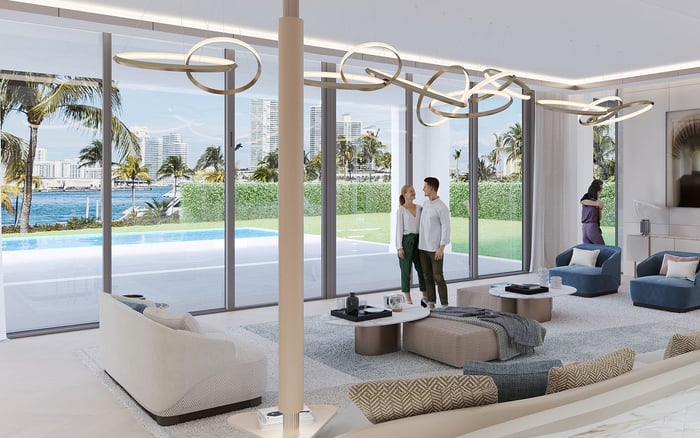
A disciplined first-year cash model for Six Fisher separates recurring assessments from closing contributions, then adds Fisher Island community, club, tax, insurance, and transaction costs.

For buyers considering The Residences at Six Fisher Island, first-year liquidity should not be reduced to the purchase price plus 12 monthly condominium payments. A more rigorous framework separates recurring assessments from capital contributions, working-capital funds, community charges, club costs, taxes, insurance, and transaction expenses.
The planned 10-story, 50-unit condominium occupies Fisher Island's last developable parcel. Its development team includes Related Group, Teddy Sagi, BH Group, and Wanxiang America RE Group, and the development has secured a $400 million construction loan from Madison Realty Capital. These particulars establish scale and scarcity, but they do not disclose the final owner-level funding schedule.
A final Six Fisher capital-contribution amount, working-capital formula, and complete first-year fee schedule have not been established. The governing condominium documents, adopted or proposed budgets, applicable community and club schedules, and closing statement therefore remain decisive.
First-year liquidity should be modeled by timing and purpose, not as one blended fee.
The first bucket is the regular condominium assessment. It supports the property's ongoing financial life, commonly including staff, security, common-area utilities, elevators, landscaping, pool and spa maintenance, management, master insurance, and reserve contributions. It is recurring and should be projected from closing through the ownership period, with any proration shown explicitly.
The second bucket is a capital contribution due at closing, if required by the final documents. A buyer should identify its amount, purpose, refundability, transfer treatment, and whether it is credited against any later obligation. It should not be folded into annual assessments because its timing and economic function may differ.
The third bucket is a working-capital payment, again only if required. Its treatment depends on the governing documents and applicable law. Buyers should not assume that an initial payment is available for ordinary operations or that a familiar formula from another condominium applies here. Capital and working-capital labels may sound interchangeable in conversation, but the documents control.
The regular association-fee estimate is $3.50 per square foot per month. It is not an identified final adopted budget, so it belongs in underwriting as a scenario rather than a settled obligation.
At that rate, every 1,000 square feet adds approximately $3,500 per month, or $42,000 per year. A 4,000-square-foot residence would imply approximately $14,000 monthly and $168,000 annually in regular association fees. Under this assumption, regular assessments alone cross $100,000 annually at roughly 2,381 square feet.
The calculation is straightforward: multiply interior square footage by $3.50, then by 12. The interpretation requires more care. Buyers should run a base case using the available estimate, then replace it with the developer's current budget figures and the unit's actual assessment allocation when supplied.
Building-level assessments are only one component of ownership on Fisher Island. Community-association charges and club dues can sit outside the individual condominium budget, and each warrants a separate line in the first-year schedule. The same principle applies when comparing established island residences such as Palazzo del Sol and Palazzo della Luna: similar geography does not make fee structures interchangeable.
Fisher Island Community Association reserve planning is also separate from the Six Fisher building budget. Its 2022 reserve study projected a $9.4 million reserve-fund balance at the start of fiscal 2023 and recommended approximately $21.5 million in budgeted reserve contributions for the upcoming fiscal year. Those historical community figures do not substitute for current charges, but they illustrate why island-level obligations require independent review.
Buyers comparing condominium ownership with a different residential format at The Links Estates at Fisher Island should likewise compare the full obligation stack, not simply a headline monthly figure.
Reserves are designed for major long-term components, including roof replacement, elevator upgrades, and façade repairs, rather than routine daily operations. For qualifying Florida condominiums, stronger structural reserve requirements can increase predictable recurring assessments while reducing dependence on deferred maintenance or later emergency assessments.
Associations subject to structural integrity reserve study requirements may have access to loans, credit lines, and special assessments as reserve-funding sources. For qualifying unit-owner-controlled associations adopting budgets on or after December 31, 2024, owners generally cannot vote to fund covered reserves below required levels. The practical diligence question is not merely whether reserves exist, but how the budget funds them and which assumptions support the schedule.
A disciplined model begins with the purchase price and buyer closing costs. It then adds any building capital contribution and working-capital payment as separate closing-date entries. Next come prorated building assessments from closing through year-end, followed by a full 12-month forward view of stabilized ownership.
Add FICA charges, club initiation or recurring costs where applicable, property taxes, homeowner insurance, and any known special assessments. Do not net one-time contributions against regular assessments unless the documents expressly permit that treatment. Identify any developer subsidies or deficit-funding arrangements, including their duration and the budget effect when they end.
For a 4,000-square-foot illustration, the $168,000 annual building-fee scenario represents only the recurring association line. It excludes community charges, club costs, buyer closing expenses, taxes, insurance, and any one-time capital or working-capital payment. This distinction prevents an attractive monthly shorthand from understating closing liquidity.
Before approving the cash plan, request the declaration, proposed operating budget, reserve schedule, assessment allocation, developer-subsidy terms, community and club fee schedules, and notices of known special assessments. The closing statement should then reconcile deposits, prorations, contributions, and other buyer charges.
The central concern across Buyer's Guides, New-construction, Pre-Construction, and Pricing & Trends coverage is clear: precision should increase as closing approaches. Early estimates are useful for screening, but only unit-specific documents can convert a scenario into an actionable first-year requirement.
Six Fisher's scarcity and limited 50-residence scale make it a distinctive proposition, yet exclusivity does not simplify financial diligence. The strongest evaluation classifies every charge by its timing, beneficiary, purpose, and governing document. That approach reveals both the cash required at closing and the recurring cost of maintaining the residence after the first year begins.
For confidential guidance on South Florida's most exceptional residences, connect with MILLION.
If branded residences are on your mind — as a home or as an allocation — we would be glad to share what we are seeing, privately.
Begin a quiet conversationAn external comparison estimates $3.50 per square foot per month, but this has not been identified as the final adopted budget.
The illustration produces approximately $14,000 per month, or $168,000 per year, in regular association fees.
It should be modeled separately unless the governing documents expressly provide otherwise, because its timing and purpose may differ.
Publicly available information does not establish a final working-capital formula for the project.
No. Treatment varies by governing documents and applicable law, so the condominium documents control.
They commonly support staffing, security, common utilities, elevators, landscaping, amenities, management, master insurance, and reserves.
Not necessarily. Community-association charges and club dues can be separate from the individual building's condominium assessment.
FICA reserve planning concerns the broader community and is distinct from Six Fisher's building-level operating budget.
It should include price, closing costs, one-time contributions, prorated assessments, community and club costs, taxes, insurance, and known special assessments.
Buyers should review the declaration, operating budget, reserve schedule, subsidy terms, applicable fee schedules, special-assessment notices, and closing statement.