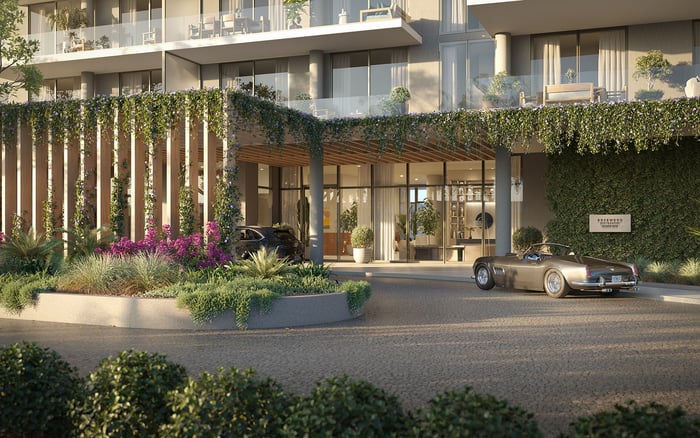
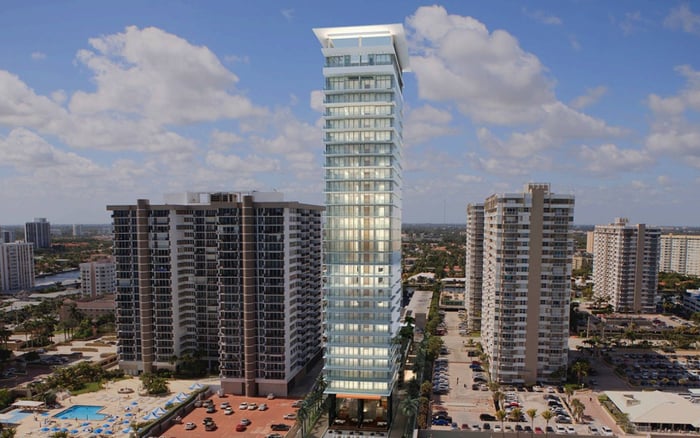
Regalia offers exceptional residential privacy, but private aviation buyers should assess it as a door-to-aircraft proposition. Real-world tests to OPF and FLL, supported by comparisons with MIA and PBI, reveal more than an idealized map estimate.
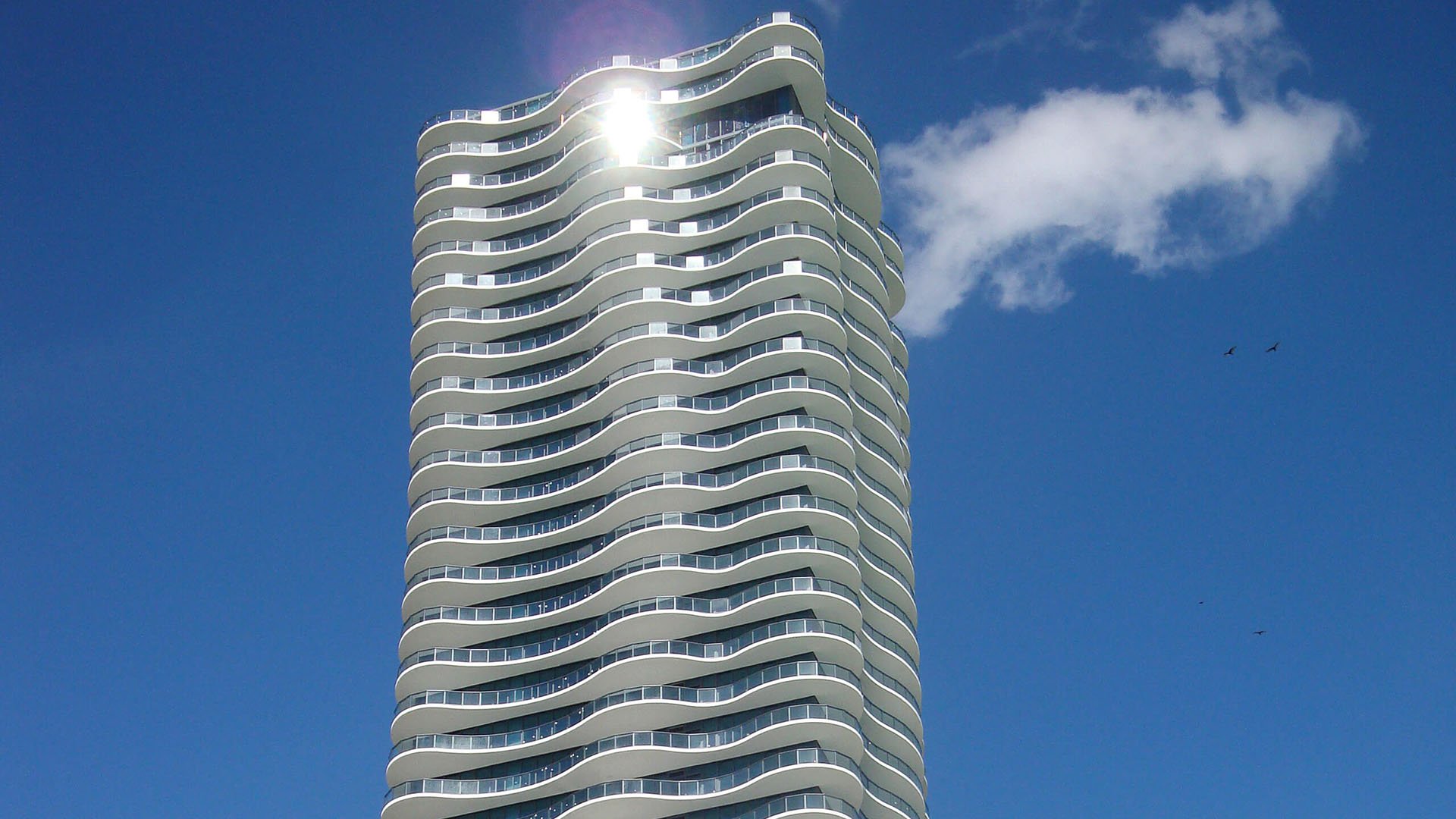
For a private aviation buyer, evaluating Regalia Sunny Isles Beach requires looking beyond the tower’s sweeping terraces and singular floor plans. The more consequential question is operational: how reliably can an owner travel from 19575 Collins Avenue to the aircraft entrance at the airport they actually use?
Regalia presents a compelling residential proposition. Delivered in 2014, the 46-story oceanfront tower was designed by Bernardo Fort-Brescia of Arquitectonica, with interiors by Charles Allem of CAD International. It contains 39 full-floor residences, along with a two-level Beach House and duplex penthouse. That exceptionally low density affords a degree of privacy that remains unusual even within Sunny Isles Beach.
Yet privacy upstairs does not eliminate friction at street level. Most airport journeys begin with a local-road segment along the coastal corridor before connecting to faster inland routes. For owners whose schedules revolve around wheels-up times, that transition should be tested, not assumed.
Standard residences were conceived as one home per floor, generally with four bedrooms and 5.5 bathrooms. Typical plans offer approximately 5,515 square feet under air, accompanied by a roughly 2,100-square-foot wraparound terrace. Some property records and listings may instead show approximately 4,992 square feet, so buyers should normalize the measurement convention before comparing price per square foot.
The financial profile is equally rarefied. Asking prices have started around $9.5 million, while one 4,992-square-foot residence was offered at $11,999,999. Another residence carried monthly association fees of $9,102. These figures place Regalia firmly in the eight-figure, full-service segment, where lifestyle fit and recurring carrying costs merit equal scrutiny.
Buyers comparing the tower with nearby alternatives such as Bentley Residences Sunny Isles or The Ritz-Carlton Residences® Sunny Isles should make airport access part of the comparison matrix. This is the distinction between admiring an oceanfront address and understanding how it performs.
The most useful baseline is not the fastest map result, but a conservative planning band that accounts for the local departure from Collins Avenue, congestion on I-95 and the airport’s inland approach.
Opa-locka Executive Airport, or OPF, may take approximately 20 to 30 minutes in lighter traffic. During weekday peaks, a 30-to-40-minute allowance is more prudent. For many private flyers, OPF is the first airport to test because it combines relative proximity with an executive-airport use case.
Fort Lauderdale-Hollywood International Airport, or FLL, deserves an equally serious trial. Sunny Isles Beach is approximately 11.6 road miles from FLL, although the exact distance varies by origin. A typical journey from Regalia may take around 25 to 35 minutes, extending toward 35 to 40 minutes in heavier conditions. The practical planning band is therefore similar to OPF, even though the route dynamics differ.
Miami International Airport, or MIA, is generally a 30-to-45-minute proposition in normal traffic, with longer journeys possible during peak congestion. A 35-to-45-minute planning range is sensible when punctuality matters. MIA remains relevant for owners who combine private flying with commercial connectivity.
Palm Beach International Airport, or PBI, is materially farther away. An estimated 70 to 90 minutes makes it more plausible as a contingency or operational choice than as a routine gateway from Regalia. Owners who regularly base aircraft or crews in Palm Beach County should treat this distance as a central purchase consideration.
A meaningful test should replicate actual use. Schedule a weekday morning departure, a late-afternoon return and a weekend leisure run during the season in which the residence will be occupied. Record door-to-terminal or door-to-FBO time-not merely highway time-and include the Collins Avenue segment.
OPF and FLL warrant side-by-side testing because congestion can change which option is faster. MIA should be tested if international or commercial connections are routine. PBI should be driven at least once by any buyer considering it operationally viable.
The same discipline applies when assessing another coastal option such as Turnberry Ocean Club Sunny Isles. A building can be geographically close to Regalia yet deliver a different lived result depending on departure timing, pickup procedures and the first local intersections. For a second-home owner arriving on concentrated holiday weekends, those variables may matter more than annual averages.
Regalia’s architectural case is clear: full-floor living, substantial outdoor space and extremely limited residential density at an oceanfront address. Its suitability for a private flyer, however, depends on where the aircraft operates and when the owner travels.
A practical underwriting assumption is 30 to 40 minutes for OPF or FLL, 35 to 45 minutes for MIA and 75 to 90 minutes for PBI. These are planning estimates, not guarantees. A buyer who validates them during actual occupancy windows gains a far more useful picture of the property than one who relies on an uncongested routing screen.
For aviation-oriented purchasers, the decisive luxury is not simply proximity. It is predictability.
Where is Regalia Sunny Isles Beach? Regalia is at 19575 Collins Avenue, Sunny Isles Beach, Florida 33160.
How private is the building? It contains 39 full-floor residences, along with a two-level Beach House and duplex penthouse.
How large is a typical residence? Typical plans offer about 5,515 square feet under air, while some records show approximately 4,992 square feet.
How long should buyers allow for OPF? Allow roughly 30 to 40 minutes for planning, although lighter traffic may produce a 20-to-30-minute trip.
How long should buyers allow for FLL? A practical allowance is 30 to 40 minutes, with typical journeys estimated at around 25 to 35 minutes.
How long should buyers allow for MIA? Plan for approximately 35 to 45 minutes, and test peak-period journeys for possible extensions.
Is PBI practical for routine use? At an estimated 70 to 90 minutes, PBI is generally less convenient than OPF, FLL or MIA.
Which airports should private flyers test first? OPF and FLL deserve the closest comparison because congestion can change which route performs better.
When should airport test drives occur? Test weekday mornings, late-afternoon returns and weekend leisure windows during the intended occupancy season.
What else should be verified before purchasing? Confirm the interior-area convention, current asking terms, association costs and door-to-aircraft timing.
If you'd like a private walkthrough and a curated shortlist, connect with MILLION.
If branded residences are on your mind — as a home or as an allocation — we would be glad to share what we are seeing, privately.
Begin a quiet conversation