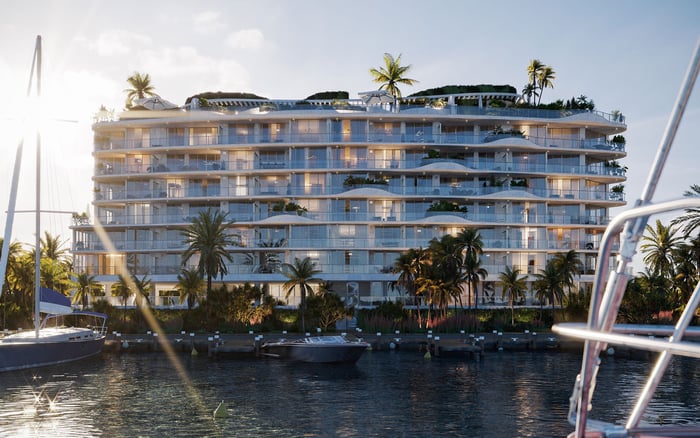
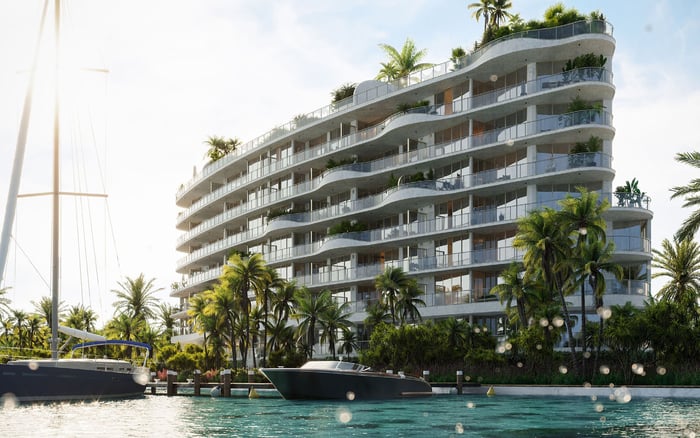
At Onda Bay Harbor, a meaningful security review follows the entire arrival sequence. Buyers should distinguish advertised amenities from operating procedures, verify their residence’s elevator arrangement, and include service entrances, storage and marina access in their diligence.
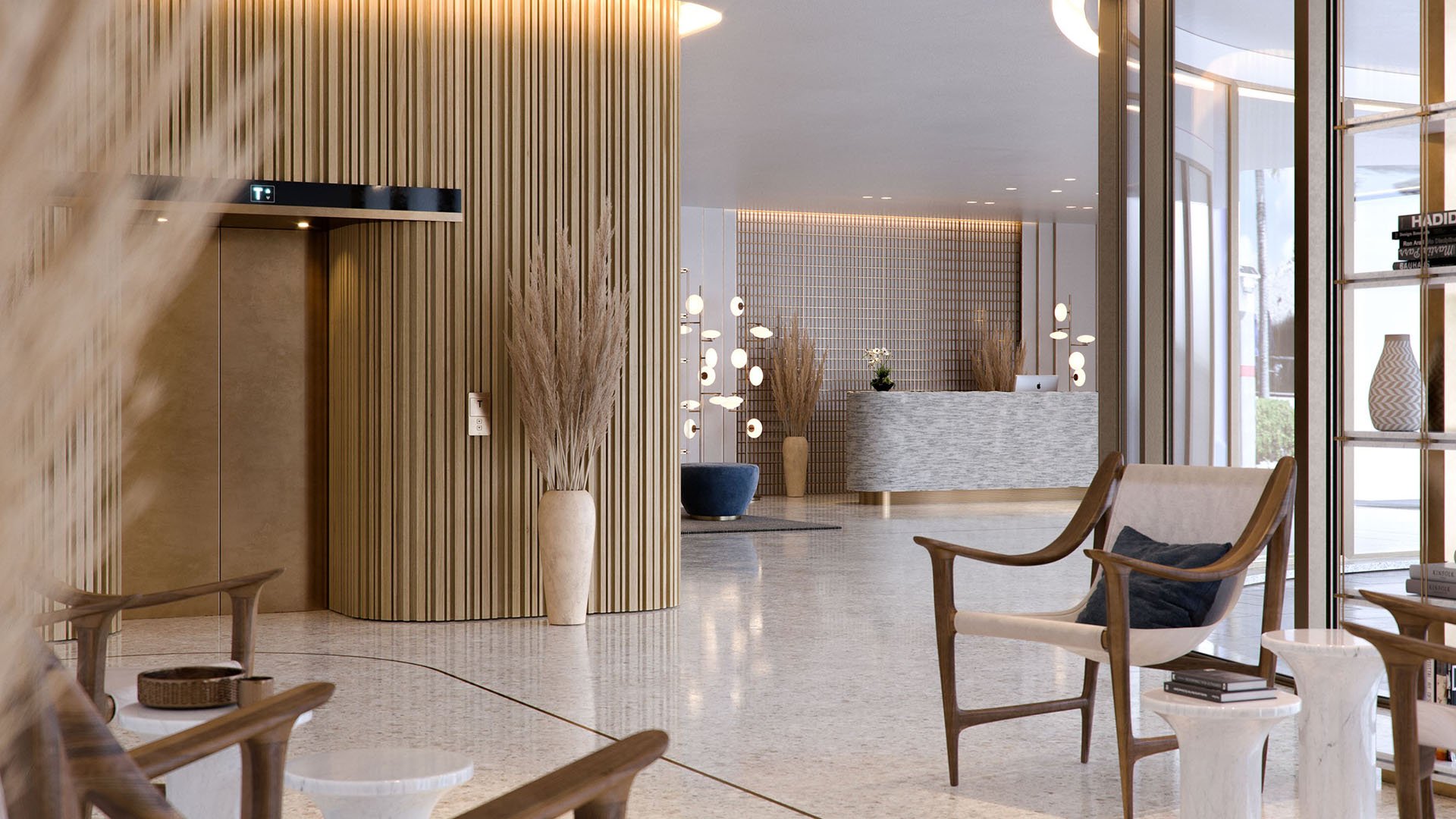
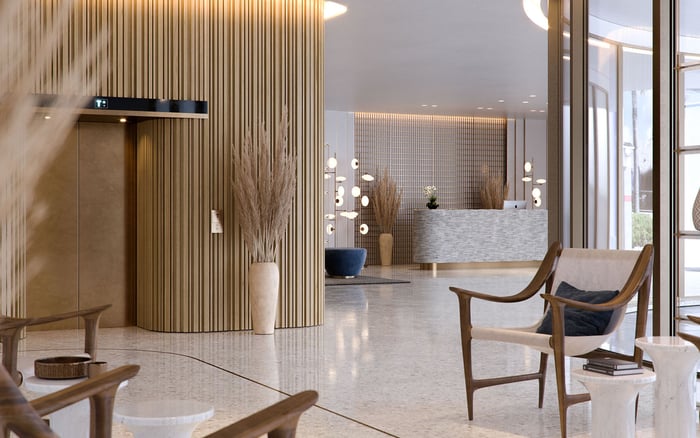
The most persuasive expression of privacy is not simply an elevator opening into a residence. It is an arrival sequence in which every transition feels discreet, understandable and appropriately controlled. At Onda Bay Harbor, a 41-residence boutique condominium at 1135 103rd Street, Bay Harbor Islands, FL 33154, that evaluation should begin at the curb, not the apartment door.
Advertised amenities include a covered valet drop-off, front-desk reception, 24-hour valet service and 24-hour security video surveillance, along with private and semi-private residential elevators. Together, these features offer a useful framework for a buyer’s walkthrough. They do not, however, explain every access permission, staffing responsibility or visitor procedure along the way.
The question is not whether the building can be described as secured. It is how an arrival becomes an authorized visit-and how that authorization extends to the selected residence.
A covered drop-off sets the scene for arrival. Buyers should look beyond convenience and ask management what happens next: who greets an unfamiliar visitor, who contacts the resident and where a guest waits until permission is granted. These are distinct responsibilities, even when the experience appears seamless.
The advertised 24-hour valet service should be evaluated as an arrival and vehicle-handling service. It does not, by itself, establish round-the-clock security-guard staffing. Likewise, front-desk reception identifies a service, not its full operating schedule or scope of authority.
During an accompanied visit, ask management to explain both resident and guest arrivals. Include a late return, a visitor arriving before the owner and a driver collecting a household member. The purpose is to understand normal procedures, not to test or circumvent controls. A polished arrival should be supported by clear answers about who makes each access decision.
The next transition deserves equal attention. Unit 506’s security descriptors include “Doorman,” “Secured Garage/Parking” and “Lobby Secured.” These terms identify features to discuss, but do not establish how the garage, lobby and elevators work together in daily operation.
Ask management to describe the authorized route from parking to the residence. Clarify whether visitor permission is limited to a particular destination, how resident credentials are managed and what happens when a credential is lost. Establish who handles access questions outside normal daytime hours.
For buyers also considering Bay Harbor Towers, the same sequence offers a useful comparison framework: curb, parking or lobby, elevator and residence threshold. Asking identical questions is more meaningful than comparing amenity labels. It does not presume that the two properties use the same equipment, staffing or procedures.
The advertised mix of private and semi-private residential elevators makes the selected home’s configuration essential to the review. A building-wide description cannot replace an inspection of the actual landing, foyer and entrance arrangement serving the residence under consideration.
The unit descriptions illustrate why precision matters. Unit 504 is described as having a private elevator opening directly into the residence. Unit 405 is described as having a private elevator opening to a foyer leading into the living room. Unit 606’s described features include private elevator entry alongside “Doorman,” “Elevator Secure” and “Card Entry.” These descriptions do not establish an identical configuration or permission system across all homes.
Ask whether the selected residence has a private foyer or shared landing, how destination access is authorized and how guests reach the home after approval. Confirm which parts of that sequence the resident controls and which require staff involvement.
Private elevators support privacy, but do not alone prove restricted access. The distinction is between the physical arrangement and the rules governing its use. Buyers should understand both before treating direct elevator entry as a complete security proposition.
The advertised provision of 24-hour security video surveillance does not establish camera coverage, whether footage is continuously watched or what response procedures apply. Concierge service and 24-hour security are also advertised, but these descriptions are not an operational audit.
A practical review separates three questions: what is recorded, who is present and who responds when assistance is needed. Ask management to explain its policies at an appropriate level, including the resident contact procedure and responsibility for handling concerns after hours. Sensitive technical details need not be publicly disclosed for a buyer to understand accountability.
Neither 24-hour valet nor 24-hour video surveillance should be taken to mean continuous guard staffing. Equally, the available descriptions establish no specific operational failure or vulnerability. The objective is a clear understanding of service and access, not a presumption of weakness.
The formal arrival is only part of the review. Unit 402 is described as having both direct private-elevator entry and a separate service entrance. For that residence, the service entrance belongs in the walkthrough alongside the main arrival route. For any other home, verify the actual configuration rather than assuming the same arrangement.
Ask how deliveries, household staff and service providers are authorized, where they are received and whether permission can be limited to an agreed visit. Secured individual residential storage is also advertised. Clarify how residents access that space and how any authorized third-party access is handled.
The advertised private marina adds another arrival route to consider. Buyers should ask about marina guest procedures and the permissions governing movement between waterfront areas and residential spaces. A private marina is an amenity designation, not a complete explanation of access control.
For an owner who travels frequently, the central issue is how permission works when the residence is unoccupied. Ask how management handles approved contractors, expected deliveries and guests arriving in the owner’s absence. Establish how authorizations are updated or withdrawn, without assuming any particular technology is installed.
If La Maré Bay Harbor Islands is also on the shortlist, carry the same household scenarios into that evaluation. Comparisons should rest on confirmed arrangements for the home being considered, not on an assumption that privacy-oriented descriptions promise equivalent operations.
Before committing, request the applicable resident rules and a management-led review of the selected home’s access sequence. The strongest conclusion is residence-specific: you understand the route, the permissions, the service entrances and the people responsible for each handoff. That clarity allows discretion and convenience to be evaluated together, rather than asking a private elevator to stand in for the entire building.
For a discreet conversation about evaluating South Florida residences, connect with MILLION.
If branded residences are on your mind — as a home or as an allocation — we would be glad to share what we are seeing, privately.
Begin a quiet conversationOnda is at 1135 103rd Street, Bay Harbor Islands, FL 33154. It is a 41-residence boutique condominium.
Onda advertises a covered valet drop-off, front-desk reception and 24-hour valet service. Buyers should confirm how those services coordinate visitor authorization.
No. Twenty-four-hour valet describes an advertised service and does not independently establish continuous security-guard staffing.
Marketing specifies 24-hour security video surveillance. It does not establish camera coverage, monitoring practices or response procedures.
Onda advertises both private and semi-private residential elevators. Buyers should verify the arrangement serving their particular home.
Unit 504 is described as having a private elevator opening directly into the residence. Unit 405 is described as having a private elevator opening to a foyer leading into the living room.
No. A private elevator supports privacy, but buyers still need to verify destination permissions, guest authorization and control of the residence threshold.
Unit 402 is described as having a separate service entrance as well as direct private-elevator entry. That additional route warrants its own review of service-provider authorization and access procedures.
Onda advertises a private marina, making waterfront arrival another relevant access context. Buyers should clarify marina guest procedures and permissions for movement into residential areas.
Request applicable resident rules and a management-led walkthrough of the selected home’s access sequence. Clarify visitor, delivery, after-hours and service-provider procedures rather than relying solely on amenity descriptions.