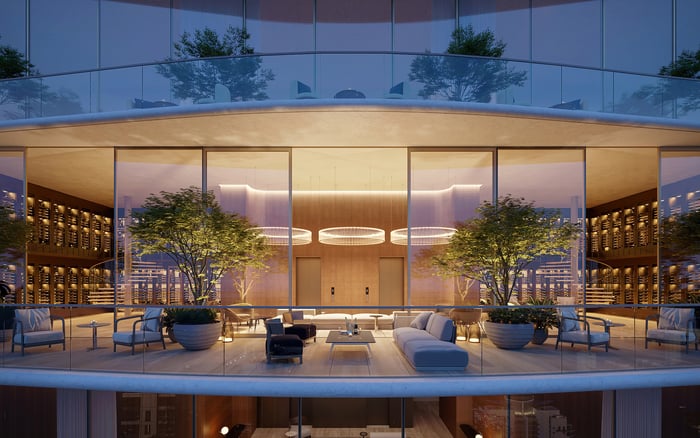
For collectors buying in Brickell, a wine amenity is the beginning of diligence, not its conclusion. Examine backup-power coverage, delivery handling, climate histories, and contractual responsibility before entrusting a collection to residential storage.
.jpg)
A private cellar or beautifully appointed tasting room can make a Brickell residence feel exceptionally well suited to a collector’s life. Yet the essential purchase questions begin behind the cabinetry: what keeps refrigeration running, who receives a shipment, and what records demonstrate stable storage conditions?
Advertised wine amenities describe a property’s offering. They do not, by themselves, establish generator coverage, delivery procedures, or historical climate performance. For a buyer assembling a serious collection, that distinction is essential. Treat the cellar as both a lifestyle feature and an operating system that warrants its own diligence file.
At The Residences at 1428 Brickell, advertised offerings include an Owners Club with a double-height wine and spirits lounge, an individual wine cellar for every resident, and a beverage director and sommelier to advise owners on purchases for private-cellar storage. The wine-storage areas, however, are provided for convenience only, without a representation that they are suitable for wine storage. That qualification belongs alongside the amenity description in the buyer’s assessment.
Begin by distinguishing in-residence appliances, individually assigned cellars, and shared amenity spaces. Each warrants separate questions about equipment, access, maintenance, and responsibility. A tasting room describes an experience; it does not specify how bottles will be protected between visits.
Baccarat Residences Brickell offers a wine cellar and tasting room, with Sub-Zero wine storage among its specified kitchen appliances. Evaluate those two offerings separately rather than assume the appliance and amenity share power arrangements, monitoring, or service obligations.
Elsewhere, Brickell City Centre Reach specifies a Uline 48-bottle, temperature-controlled wine-storage unit for residence kitchens. The 1050 Tower at 1060 Brickell offers temperature-controlled wine-storage cabinets within a wine-and-cigar lounge, along with personal cigar humidors. These are distinct storage formats, not interchangeable assurances of collection care.
Request the equipment schedule and documents describing the specific storage allocated to your residence. Establish who maintains each component and whether the advertised offering applies to the home under consideration.
The useful question is not simply whether a building has a generator. It is whether the specific wine-storage equipment, its controls, and its monitoring systems are connected to supported circuits-and under what operating conditions.
Request electrical panel and circuit schedules identifying the relevant loads. Ask for details of the full refrigeration-and-monitoring load supported, generator capacity, fuel arrangements, and generator and automatic-transfer-switch test records. Have a qualified specialist reconcile those documents with the actual equipment rather than rely on a general assurance about building backup power.
Distinguish refrigeration from alarms and communications. Ask what continues operating during an interruption, what happens during transfer, and whether monitoring can still alert the responsible person. Any statement about runtime should be supported by the specified load and fuel arrangements, not treated as a promise independent of those conditions.
These are recommended diligence questions, not findings about any named property. The advertised amenities discussed here do not establish their backup-power coverage.
A temperature-controlled label identifies an intended function. A timestamped operating history is more useful for assessing how consistently that function has been maintained.
Request at least 12 months of temperature, humidity, alarm, and corrective-action records where an operating history exists. Ask for sensor locations, calibration records, operating limits, and escalation procedures. Read the records together: an alarm entry should be accompanied by an explanation of the response, not left as an isolated event.
Sensor placement also deserves attention. Ask whether readings reflect the actual bottle-storage area and how temperature uniformity is assessed. A single display should not substitute for an understanding of conditions across the space.
At 888 Brickell by Dolce & Gabbana, advertised features include private wine cellars and a humidor room. Each warrants a separate request for operating limits and monitoring arrangements. Do not assume that the presence of both establishes appropriate conditions for either.
Where a storage system has not yet accumulated an operating history, ask how commissioning, calibration, monitoring, and record retention will be documented. Keep planned processes and demonstrated performance clearly distinct in the purchase decision.
Wine-storage diligence begins before a bottle reaches its shelf. Obtain written procedures covering authorized receivers, loading-dock access, delivery hours, and handling when the owner is absent.
Ask who accepts responsibility at each handoff, where shipments wait, and how temperature exposure is managed. The procedure should address bottle inspection, inventory entry, damage reporting, and rejected shipments. Clarify what staff may do without owner approval and who contacts the owner when a delivery cannot be accepted as expected.
2200 Brickell offers wine coolers in selected units-not every residence-as well as a contactless digital package-delivery system with cold storage. Confirm both the appliance specification for the chosen unit and the intended use of that package facility.
Package cold storage should not be equated with wine-cellar conditions. Request its actual temperature range, maximum holding time, access controls, and outage operation. For an owner who travels frequently, a clearly documented handoff can matter as much as the final storage destination.
Ask counsel to review governing documents and any storage agreement alongside the operational materials. Identify who is responsible for maintenance, access, staff handling, and response to equipment failures. An amenity description is no substitute for enforceable obligations.
Review insurance exclusions and applicable coverage for spoilage, theft, flooding, mechanical failure, power loss, and staff handling. Establish which risks are covered, which remain with the owner, and what documentation a claim would require. Do not assume that a managed amenity means the bottles themselves are insured.
Consider an independent technical inspection addressing temperature uniformity, humidity, door seals, condensate drainage, alarms, water intrusion, and backup-power transfer. Match the inspection scope to the specific appliance or cellar, and document unresolved questions before moving the collection.
A disciplined comparison keeps four files together: equipment and power documentation, climate histories, delivery procedures, and contractual risk allocation. Review each against the intended use of the collection, not the elegance of the presentation.
The strongest buyer position is not to presume a problem, but to establish what is promised, what is demonstrated, and who is accountable. That distinction allows a wine amenity to be valued with the same care as the residence surrounding it.
For a discreet perspective on Brickell residences and the details behind their amenities, explore MILLION.
If branded residences are on your mind — as a home or as an allocation — we would be glad to share what we are seeing, privately.
Begin a quiet conversationNo. An amenity description does not establish backup-power coverage, delivery procedures, or historical climate performance.
The offerings include a double-height wine and spirits lounge, an individual wine cellar for every resident, and purchasing advice from a beverage director and sommelier. The storage areas also carry a convenience-only qualification without a representation of suitability for wine storage.
Request electrical panel and circuit schedules, the supported refrigeration-and-monitoring load, generator capacity and fuel arrangements, and generator and automatic-transfer-switch test records.
Request at least 12 months of timestamped temperature, humidity, alarm, and corrective-action records where an operating history exists. Also ask for sensor locations, calibration records, and operating limits.
Ask how commissioning, calibration, monitoring, and record retention will be documented. Keep planned procedures distinct from demonstrated operating performance.
They should cover authorized receivers, loading-dock access, delivery hours, owner absence, temperature exposure, bottle inspection, inventory entry, damage reporting, and rejected shipments.
Do not assume equivalence. Verify the actual temperature range, maximum holding time, access controls, and outage operation before using it for wine shipments.
No. Wine coolers are advertised in selected units, so buyers should confirm the specification for the particular residence.
Baccarat advertises a wine cellar and tasting room among its amenities, with Sub-Zero wine storage identified in residence kitchen specifications. Evaluate the shared amenity and in-residence appliance separately.
Review spoilage, theft, flooding, mechanical failure, power loss, and staff handling. Establish responsibility through governing documents, storage agreements, and applicable insurance coverage and exclusions.