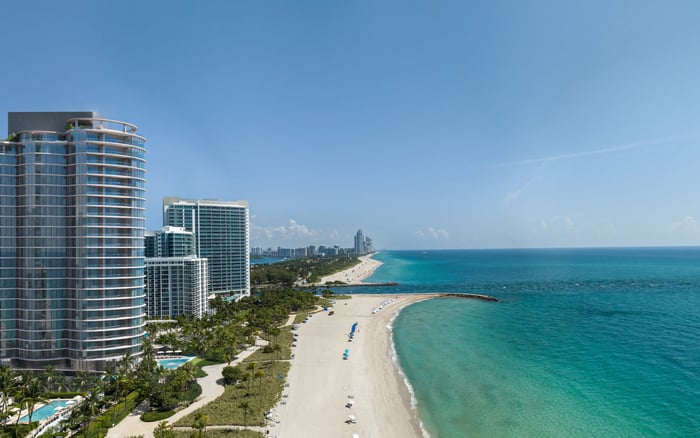
A disciplined Bal Harbour purchase requires more than a reserve balance. Read structural funding schedules, insurance renewals and capital-project commitments together to understand the obligations behind the residence.

In Bal Harbour, the view may establish the emotional case for a residence. The association’s documents should establish the financial one. A considered purchase requires reading three connected records together: the reserve schedule, the insurance renewal and the pipeline of capital work. Each can appear reassuring in isolation while leaving a material question unanswered.
For a buyer considering Oceana Bal Harbour, the discipline is to separate the residence’s appeal from the evidence supporting its ownership costs. A cash balance does not explain when a roof must be replaced, whether an insurance renewal is reflected in the budget or how an approved project will be funded.
The objective is not to predict every future assessment. It is to distinguish funded obligations from estimates, conditional financing and unresolved decisions. Nothing in this framework establishes the financial condition, coverage or project status of any named property.
A Structural Integrity Reserve Study, or SIRS, is a forward-looking funding assessment. Its value lies in the relationship between component life spans, estimated repair or replacement costs and planned contributions. Today’s balance is only the starting point.
Covered categories include specified structural and life-safety components such as roofing, load-bearing members, fireproofing, plumbing, electrical systems, waterproofing, windows and exterior doors. For each relevant component, ask what work is anticipated, when it is expected and how much money is scheduled to be available then.
Read the milestone inspection alongside the SIRS, not as a substitute. The inspection evaluates structural condition; the SIRS addresses future repair and replacement funding. Completing the inspection does not establish that the work is adequately funded.
A practical review places the reserve schedule beside engineering follow-up memoranda and the current budget. If engineering recommendations bring work forward, ask whether the funding schedule reflects that timing. Judge a reserve plan by whether its assumptions still match the work under consideration.
Under Florida’s 2025 legislative framework, SIRS and milestone-inspection requirements apply to qualifying buildings with three or more habitable stories. Qualifying residential condominiums generally must complete a SIRS at least every 10 years.
That framework generally set December 31, 2025 as the initial SIRS deadline for qualifying unit-owner-controlled associations existing on or before July 1, 2022. It also allowed associations with a required milestone inspection due on or before December 31, 2026 to complete the inspection and SIRS together by December 31, 2026. Those dates are neither a universal extension nor a building-specific compliance conclusion.
For a purchase under consideration at Rivage Bal Harbour, ask counsel which requirements and documents apply to the transaction. Do not assume an identical document history across properties. Florida condominium counsel should confirm applicable deadlines, exceptions and funding approvals before the buyer treats a compliance statement as settled.
Request the insurance declarations, renewal terms, deductibles, exclusions, loss runs and details of open claims. Have an insurance professional review their implications for the association and the proposed ownership arrangement.
The first budget question is straightforward: does the approved budget reflect the renewal cost? If not, ask how the difference will be funded. Then distinguish premium expense from potential exposure through deductibles and exclusions. A premium figure alone cannot account for both.
Reconcile open claims separately. If an insurance recovery is presented as money available for work, establish whether it has actually been paid. An unpaid recovery should remain clearly distinct from cash already available.
This review concerns the terms of a particular policy and the assumptions in a particular budget. It does not justify conclusions about local insurance pricing or guarantee that an assessment will follow.
For each pending project, reconcile the reserve projection with the engineering scope, current bids, signed contracts, permits, completion schedule and approved funding. The question is not simply whether work is planned, but how far the association has progressed from an estimate to an executable commitment.
Ask whether the scope now being priced matches the scope assumed in the reserve schedule. Identify which costs are supported by current bids and which remain estimates. Check whether the project schedule aligns with the dates when funding is expected to become available.
If the search also includes Surfside and The Surf Club Four Seasons Surfside, apply the same document-review discipline to that comparison. Do not infer equivalent funding, insurance terms or project obligations from a shared coastal setting.
Be precise about money described as available. An unapproved special assessment, an unclosed loan and an unpaid insurance recovery are not interchangeable with funds already held for the work.
Reserve contributions may be funded through regular assessments, special assessments, loans or lines of credit, subject to applicable approval requirements. These routes are not economically equivalent for a buyer, even when they support the same project.
Start with the unit’s regular assessment and identify what it already includes. Then establish the unit’s allocated share of approved special assessments, association debt and work that remains unfunded. Ask counsel to clarify responsibility for transaction-related assessment payments rather than assuming the buyer or seller will bear them.
Avoid counting the same obligation twice. If a project is already funded through designated reserves, do not add its entire cost again as new exposure. Likewise, determine whether debt service is already included in regular assessments before treating it as a separate recurring charge.
The 2025 framework also permits certain reserve contributions to be paused or reduced for up to two consecutive budgets in specified milestone-repair circumstances, subject to statutory conditions and approval by a majority of the entire voting interests. If that mechanism is involved, request the approval and examine the resulting contribution schedule. A temporarily lower contribution is not evidence that future needs have disappeared.
Before proceeding, seek a coherent explanation connecting structural findings, reserve assumptions, renewal terms and capital commitments. The strongest file is not necessarily the one with the lowest current assessment. It is the one in which timing, costs, approvals and funding can be reconciled without relying on unresolved assumptions.
Have Florida condominium counsel review building-specific obligations and an insurance professional assess coverage terms. Where a material question remains open, identify the evidence needed to resolve it before treating the purchase analysis as complete.
For a discreet conversation about your Bal Harbour property search, connect with MILLION.
If branded residences are on your mind — as a home or as an allocation — we would be glad to share what we are seeing, privately.
Begin a quiet conversationA SIRS assesses future funding needs for specified structural and life-safety components. Buyers should examine component life spans, estimated costs and planned contributions, not just the current reserve balance.
No. A milestone inspection evaluates structural condition, while a SIRS addresses future repair and replacement funding; completing one does not establish adequate funding.
The 2025 framework applies SIRS and milestone-inspection requirements to qualifying buildings with three or more habitable stories. Counsel should confirm applicability to the specific building.
No. The 2025 framework allowed associations with a required milestone inspection due on or before December 31, 2026 to complete that inspection and their SIRS together by that date, rather than granting a universal extension.
Qualifying residential condominiums generally must complete a SIRS at least every 10 years. Buyers should also reconcile its assumptions with current engineering recommendations and planned work.
Request declarations, renewal terms, deductibles, exclusions, loss runs and open-claim details. Ask whether the approved budget reflects renewal costs and have an insurance professional review coverage terms.
Compare the reserve projection with engineering scopes, current bids, contracts, permits, completion schedules and approved funding. Keep estimated costs distinct from contractual commitments.
Yes, subject to applicable approval requirements, contributions may be funded through regular assessments, special assessments, loans or lines of credit. Buyers should distinguish borrowed funds from assessment income and cash already available.
Under specified 2025 provisions involving milestone-related repairs, certain contributions may be paused or reduced for up to two consecutive budgets. Statutory conditions and approval by a majority of the entire voting interests apply.
Identify the unit’s allocated share of assessments, association debt and unfunded work, then reconcile those amounts with existing reserves and regular assessments. Do not add a fully reserve-funded project or already-included debt service again as a separate cost.