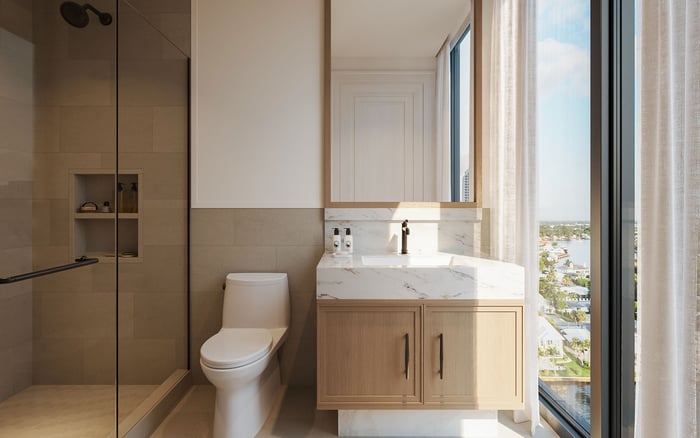
A buyer-focused framework for evaluating possible design-package choices at The Ritz-Carlton Residences® Fort Lauderdale, with emphasis on written confirmation, timing exposure, approval requirements and future marketability.

Buyers considering The Ritz-Carlton Residences® Fort Lauderdale should first establish whether design packages, finish selections or custom changes are available for the residence under consideration. Availability should not be inferred from renderings, model residences or discussions about another unit.
Request the current specification sheet, available selection materials and governing contract documents. These materials should distinguish included features from optional upgrades and buyer-requested changes. If the documents do not address a desired modification, obtain written clarification before treating it as available.
A practical review divides every desired choice into three categories: the documented standard, a developer-approved option or work to be considered after closing. This prevents an attractive concept from being mistaken for a contractual inclusion.
For any option or requested change, ask who has authority to approve it, how pricing is established, when payment is due and whether the decision can be reversed. For post-closing work, buyers should review the applicable building rules and approval process before retaining a designer or contractor.
Comparisons with Four Seasons Hotel & Private Residences Fort Lauderdale should follow the same document-based approach. Each South Florida development may define selections, approvals and delivery obligations differently, so terms from one project should not be transferred to another.
A requested change may create timing exposure if it intersects with design review, procurement, fabrication, installation or inspection. The existence or extent of any effect must be confirmed for the specific residence rather than assumed.
Before approving a change, request the selection deadline, written scope, price, approval status and stated schedule consequence. Buyers should also ask what happens if a material becomes unavailable, an approval is withheld or the request cannot be completed as proposed.
Verbal assurances should be reflected in the controlling documents when the decision affects cost, delivery or the finished residence. A written record also helps the buyer track approved substitutions, warranties and responsibilities.
No design choice guarantees a particular resale result. The more useful question is whether a modification supports daily use while remaining coherent, durable and understandable to a future buyer.
Highly personal colors, specialized built-ins or difficult-to-reverse layouts may appeal to a narrower audience. More restrained selections can support broader marketability, but they do not ensure a faster sale or higher price. Buyers should weigh the personal benefit of each decision against its cost, reversibility and likely effect on presentation.
A future purchaser will assess the residence as a whole, not merely a list of upgrades. Documentation can therefore matter alongside design: organized records of approved work, product information and warranty treatment may make the residence easier to evaluate.
A buyer considering St. Regis® Residences Bahia Mar Fort Lauderdale alongside The Ritz-Carlton Residences® Fort Lauderdale should compare current written materials on their own terms. Brand affiliation alone does not establish identical finish programs, customization rights, approval procedures or timing consequences.
The most disciplined comparison uses the same checklist for every Fort Lauderdale residence: inclusions, available choices, deadlines, costs, approval authority, schedule effects, warranty treatment and rules for later work. This keeps the analysis focused on verifiable obligations rather than assumptions.
Begin by identifying the choices that materially improve how the residence will be used. Then determine which choices are documented, which require approval and which may need to wait until after closing. For every approved change, retain the written scope and related records.
Finally, review all selections as one composition rather than isolated upgrades. The strongest decision is one that balances personal enjoyment, execution certainty, timing awareness and future marketability without relying on an undocumented promise.
Are design packages confirmed for every residence? Buyers should verify current availability for the specific residence in writing rather than assume that a package applies to every home.
What documents should a buyer request first? Request the current specifications, selection materials, purchase documents and any written terms governing options or changes.
Can a custom request affect timing? It may create timing exposure, but any consequence should be confirmed in writing for the requested change and residence.
What should be documented before approving an option? Record the scope, price, deadline, approval status, payment terms and stated schedule effect.
Should verbal assurances be relied upon? Material commitments affecting cost, delivery or the finished residence should be reflected in the controlling written documents.
How should post-closing work be handled? Review applicable building rules and approval requirements before engaging designers, contractors or vendors.
Do neutral selections guarantee stronger resale? No. They may support broader appeal, but no design choice guarantees a resale price or marketing period.
Can highly personal choices limit marketability? They may appeal to fewer future buyers, particularly when they are expensive or difficult to reverse.
How should competing branded residences be compared? Apply the same document-based checklist to each project and avoid assuming that brand affiliation creates identical terms.
What records should an owner retain? Keep approved scopes, substitutions, product information, payment records and available warranty documentation.
When you're ready to tour or underwrite the options, connect with MILLION.
If branded residences are on your mind — as a home or as an allocation — we would be glad to share what we are seeing, privately.
Begin a quiet conversation