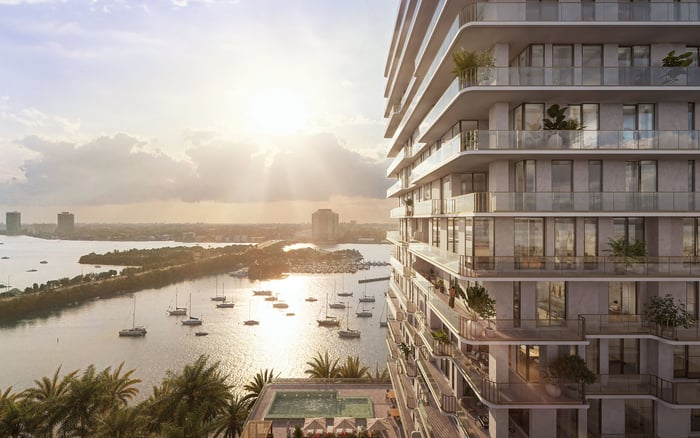
One Park Tower advertises a substantial physical-security offering. For buyers, the next step is to establish how access permissions, surveillance evidence, resident information, and vendor privileges are governed through written policies and operational documentation.

At One Park Tower by Turnberry North Miami, the advertised security offering includes 24-hour professional security, video surveillance, gated entry, and secured garage parking. The address is 2411 Laguna Circle, North Miami, Florida 33181. A private residential porte cochère and lobby complete the arrival experience.
For a discerning purchaser, those features begin the diligence process; they do not conclude it. The more consequential questions are who can authorize entry, who can reconstruct an incident, and how long the resulting information remains accessible. Privacy depends not simply on a controlled threshold, but on the governance behind it.
The distinction is essential: an undisclosed control is not necessarily an absent one. Marketing descriptions are not security audits. Buyers should seek written operational answers without treating silence as evidence of a vulnerability.
High-speed elevator access to residences and direct elevator access to corner residences are advertised. Neither description establishes credential technology, floor permissions, or audit-log capabilities. The advertised features also do not specify whether entry relies on cards, mobile devices, biometrics, license-plate recognition, intercoms, or a combination.
Request an access-control matrix defining permissions for residents, household staff, guests, contractors, delivery personnel, and building employees. Ask whether permissions can be limited by floor, route, amenity, or time-and who may change them. The objective is to understand the scope of each authorization, not merely its convenience.
Then test the access lifecycle through practical scenarios: a lost credential, a departing employee, a terminated contractor, and a former resident. Seek written revocation timelines, designated responsible personnel, and emergency-override procedures. Ask whether guest passes expire automatically and how after-hours arrivals are handled. These practices have not been established.
A functioning entry system and a useful audit trail are distinct capabilities. It has not been established whether resident, guest, garage, elevator, and amenity-entry events are centrally logged or available to residents on request.
Request a description of the events recorded, the identifiers attached to them, and the retrieval process. Ask whether management can correlate a credential event with a relevant camera recording and whether timestamps are sufficiently coordinated to do so. These are diligence questions, not verified building capabilities.
Oversight of the search itself is equally important. Who may examine a resident’s movements? Are administrative searches and exports logged? What approval is required, and what prevents unrelated browsing? Request a redacted sample or demonstration rather than another resident’s identifiable records. Discuss resident access as a policy question, not an assumed unconditional entitlement.
The advertised combination of professional security and video surveillance does not establish camera coverage, continuous recording, image quality, monitoring hours, storage location, or export procedures. In particular, 24-hour professional security does not confirm that every camera receives continuous live monitoring.
Ask for a buyer-appropriate explanation of coverage and recording arrangements without demanding sensitive technical details. Confirm who can search footage, who authorizes an export, how it is delivered, and whether chain-of-custody records are maintained. Request the procedure for preserving relevant material after an incident, before routine deletion occurs.
Entry-and-exit cameras with retrievable footage retained for at least 30 days are among the measures supporting a Florida statutory presumption against liability for certain third-party criminal acts. That period is a qualifying security benchmark-not proof of One Park Tower’s actual retention period or a blanket requirement for every condominium. Ask counsel to assess applicability and request the building’s actual schedule separately.
Website users’ personal information is covered by provisions for access, editing, export, and deletion, with exceptions for information retained for administrative, legal, or security purposes. Those provisions focus on online accounts, profiles, and comments; they do not clearly establish how condominium resident records are treated.
Request a building-data policy covering access credentials, visitor registrations, package records, amenity bookings, resident communications, and surveillance footage. For each category, seek the purpose of collection, authorized users, storage arrangements, retention period, and deletion procedure. These schedules have not been disclosed.
Ask how legal holds affect deletion and how police requests and subpoenas are handled. Confirm any resident access or correction process independently of the website provisions. A meaningful retention policy should explain both routine disposal and documented exceptions. Neither indefinite storage nor immediate deletion should be assumed to govern every record.
Access-control, visitor-management, surveillance, smart-home, and resident-portal vendors have not been identified. It is also undisclosed whether security networks are isolated from resident Wi-Fi, building automation, smart-home systems, or administrative systems.
Request a vendor list and a high-level explanation of network separation. Ask whether remote administration uses multifactor authentication, whether vendor accounts are individually assigned, and how temporary access is approved and revoked. Seek contractual security responsibilities, including who maintains systems and who must respond when a problem is discovered.
The same questions belong in a Sunny Isles Beach comparison involving Turnberry Ocean Club Sunny Isles. A shared developer name should neither substitute for property-specific documentation nor imply identical technology. Evaluate each candidate through its own policies and operating responsibilities.
Cybersecurity assessments, penetration testing, vendor security reviews, incident-response exercises, and resident-system breach-notification planning have not been disclosed for One Park Tower. Ask whether these exist, what management can appropriately share, and who coordinates the response. Nondisclosure is not proof that testing or planning has never occurred.
If the search extends to Bal Harbour and Rivage Bal Harbour, apply the same written questionnaire rather than ranking buildings by the language of their security amenities. This is a recommended comparison framework, not a claim about either property’s controls.
Classify each answer as an advertised feature, a documented policy, or an operational demonstration. Ask which party is responsible for implementation and which provisions remain subject to change. This approach keeps the purchase discussion focused on evidence while allowing legitimately sensitive details to remain restricted.
Before closing, request the condominium declaration, rules, management agreement, security specifications, building-data policy, retention schedules, access-control matrix, vendor list, and relevant incident disclosures. Have counsel assess what can be supplied and which answers require contractual clarification.
The decision standard is straightforward: understand who controls entry, who can inspect the resulting records, when those records disappear, and who responds when systems fail. An elegant arrival is valuable; documented accountability makes the security discussion decision-grade.
For a discreet perspective on South Florida residential choices, explore MILLION.
If branded residences are on your mind — as a home or as an allocation — we would be glad to share what we are seeing, privately.
Begin a quiet conversationThe project is located at 2411 Laguna Circle, North Miami, Florida 33181.
Advertised features include 24-hour professional security, video surveillance, gated entry, and secured garage parking. These descriptions do not establish the underlying data-governance or cybersecurity controls.
No. Direct elevator access to corner residences is advertised, but credential technology, elevator permissions, and audit-log capabilities are not specified in the reviewed materials.
The reviewed materials do not establish whether resident, guest, garage, elevator, or amenity-entry events are centrally logged. Buyers should request written details about recording and retrieval.
The disclosed materials do not establish resident access to these records. Ask about the applicable request process, approvals, and restrictions rather than assuming a universal entitlement.
No. Florida Statute §768.0706 includes at least 30 days of retrievable entry-and-exit footage among qualifying security measures, but this does not establish One Park Tower’s actual schedule.
It does not clearly establish rules for resident credentials, visitor records, package records, or surveillance footage. Request a separate building-data policy and retention schedules.
The reviewed brochure does not identify access-control, visitor-management, surveillance, smart-home, or resident-portal vendors. Buyers should request a vendor list and clarification of security responsibilities.
Ask about network separation, multifactor authentication for remote administration, vendor permissions, security assessments, and incident response. These are recommended diligence requests, not verified building practices.
Request the declaration, rules, management agreement, security specifications, building-data policy, retention schedules, access-control matrix, vendor list, and relevant incident disclosures. Counsel should assess availability and any needed contractual clarification.