For finance executives weighing South Florida real estate, the central choice is not simply access versus seclusion. It is how a residence protects time, discretion and optionality while still supporting a highly networked life.
.jpg)
For finance executives buying in South Florida, the choice between club adjacency and true residential privacy is rarely binary. The more useful question is which environment makes daily life more efficient, more discreet and more resilient under pressure. A residence may sit near a private club, a favored dining room or a professional corridor and still feel exposed. Another may offer quiet arrivals, controlled circulation and a deeply residential setting, yet require more planning around meetings, dinners and family logistics.
The strongest purchase usually begins with an honest calendar audit. If a buyer’s week is built around in-person breakfasts, board dinners, investor meetings and spontaneous social overlap, adjacency has real utility. If the week is dominated by confidential calls, concentrated work, family time and recovery between flights, privacy becomes the more durable luxury.
Club adjacency is about compression. It reduces friction between work, fitness, dining and social capital. For an executive whose professional network exists partly in rooms that are not called offices, proximity can be strategic. The ability to move from residence to dinner, from a morning workout to a meeting, or from a guest arrival to a familiar table can make a property feel operationally intelligent.
In Brickell, that logic is especially clear. Residences such as St. Regis® Residences Brickell and 2200 Brickell appeal to buyers who want immediate access to the city’s financial and hospitality core without turning every outing into a production. For the right buyer, this is not convenience alone. It is the ability to keep momentum through a long day without sacrificing polish.
Yet adjacency has limits. A club-adjacent address can increase casual visibility. It can also blur the boundary between professional presence and private life. For some finance leaders, being recognized in the lobby, at the valet or beside the pool is a cost, not a benefit. The higher the public profile, the more carefully that cost must be weighed.
True residential privacy is not simply distance from activity. It is the architecture of separation. It shows up in arrival sequence, elevator behavior, staff circulation, guest management, acoustic comfort and the degree to which a home can absorb a demanding life without broadcasting it.
For executives who host selectively, travel frequently or manage sensitive conversations, privacy protects attention. It allows a residence to function as a controlled environment rather than an extension of the social circuit. In this sense, privacy is not anti-social. It is curated access.
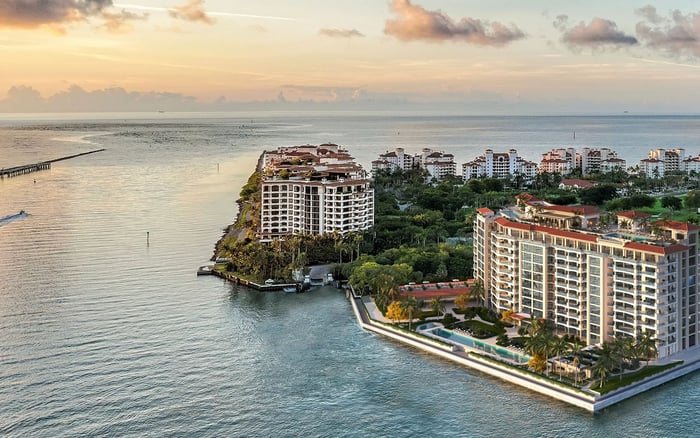
Island and enclave settings often speak to this preference. The Residences at Six Fisher Island represents the kind of address considered by buyers who prioritize separation, arrival control and a more insulated residential rhythm. The point is not withdrawal. The point is sovereignty over when and how one is seen.
South Florida offers several versions of luxury, and each carries a different psychology. Brickell is for speed, immediacy and proximity to capital. Miami Beach is for cultural access, design, dining and a more visible social cadence. Coconut Grove softens the day with canopy, village texture and a residential pace that can feel especially valuable to buyers who want Miami without constant performance.
That is why Four Seasons Residences Coconut Grove belongs in the conversation for executives who want service and refinement in a quieter setting. The Grove can support a sophisticated public life while keeping the home environment more relaxed and grounded.
Further north, club-oriented living can take a different form. Shell Bay by Auberge Hallandale will naturally interest buyers who see golf, hospitality and controlled leisure as part of a complete residential formula. For some, the club becomes an extension of the home. For others, even that extension is too communal.
The right answer depends on four variables: exposure, frequency, family and flexibility.
Exposure asks how visible the buyer is, and whether recognition enhances or diminishes quality of life. Frequency asks how often club access will actually be used. Many buyers overestimate amenity usage and underestimate the value of a quiet arrival at the end of a volatile week. Family asks whether spouses, children, guests and staff benefit more from adjacency or from a protected setting. Flexibility asks how the property will read to the next buyer, especially if the future purchaser has a different appetite for visibility.
A club-adjacent residence can be ideal when the home is a platform for connection. A privacy-led residence can be superior when the home is a refuge and command center. The mistake is assuming one is inherently more luxurious. At the highest level, luxury is not more access or more isolation. It is precision.
When touring, finance executives should look beyond finishes. Ask how a guest is announced, where staff enter, how deliveries are handled and whether private circulation feels intuitive. Study the arrival after dark, not only at noon. Consider whether amenity spaces feel serene or performative. Notice whether the residence supports simultaneous lives: a confidential call, a family dinner, a visiting colleague and a quiet morning can all require different zones.
For club-adjacent properties, test the walking or driving pattern during peak times. For privacy-led properties, test the time cost of reaching the places you actually use. A beautiful home that complicates every meeting may fail the executive test. A connected home that leaves no room for decompression may fail it as well.
For finance executives, club adjacency matters most when professional life depends on frequent, high-quality proximity. True residential privacy matters most when the home must protect concentration, family rhythm and personal discretion. The best South Florida residence is not the most secluded or the most connected. It is the one that matches the buyer’s real operating system.
Is club adjacency better for finance executives in Brickell? It can be, especially for buyers whose weeks revolve around meetings, dining and professional proximity. Brickell rewards speed and access.
Does true privacy mean living far from Miami’s center? Not necessarily. Privacy can come from building design, arrival control and residential setting rather than distance alone.
Should Miami Beach buyers prioritize social access or discretion? It depends on how often the buyer uses the social circuit. Frequent hosts may value access, while high-profile buyers may prefer more controlled visibility.
Why does Fisher Island appeal to privacy-led buyers? Fisher Island is often considered by buyers seeking a more insulated residential rhythm. The appeal is the sense of separation from everyday exposure.
Is Coconut Grove a good fit for executives who want quiet? Coconut Grove can suit buyers who want refined living with a softer pace. It is often attractive to those who value greenery and residential calm.
How should a buyer evaluate golf-oriented communities? Golf should be judged as part of the weekly lifestyle, not as a decorative amenity. If it supports relationships and routine, it can add real value.
What is the risk of choosing too much club adjacency? The main risk is overexposure. A residence that keeps the buyer constantly visible can feel less restorative over time.
What is the risk of choosing too much privacy? The main risk is friction. If every dinner, meeting or airport run becomes inconvenient, privacy may start to feel inefficient.
Which matters more for resale, access or privacy? Both can matter, but the strongest properties usually offer a balanced version of each. Buyers respond to convenience when it does not compromise discretion.
What should executives prioritize during a private showing? Focus on arrival, circulation, sound, guest control and daily logistics. These details reveal whether the residence truly supports an executive life.
For a confidential assessment and a building-by-building shortlist, connect with MILLION.
If branded residences are on your mind — as a home or as an allocation — we would be glad to share what we are seeing, privately.
Begin a quiet conversation