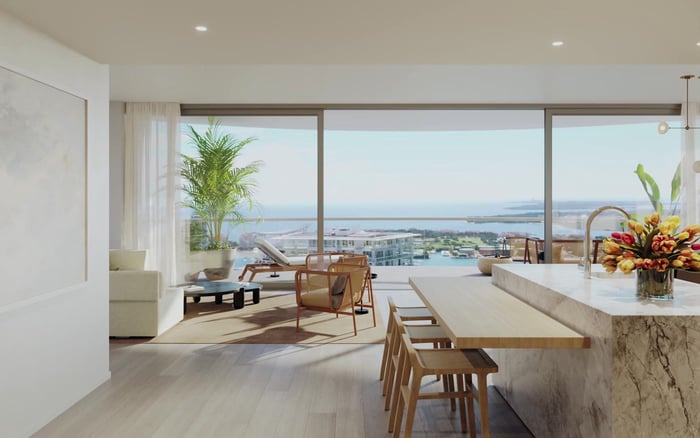
At Apogee South Beach, ownership flexibility is shaped by long lease minimums, limited annual rental turns, and guest-use rules that require careful document review before closing.

At Apogee South Beach, the ownership proposition is deliberately residential. The 22-story condominium comprises 67 residences at 800 S Pointe Drive in Miami Beach’s South of Fifth neighborhood-a scale and setting defined by privacy rather than transient occupancy. For buyers, that distinction is more than atmospheric. It shapes how a residence may be leased, occupied by guests, and ultimately positioned for resale.
Published descriptions agree on the central point: short-term vacation rentals are prohibited, and ownership is structured around longer tenancies. They diverge, however, on key operating details. Some describe a six-month minimum with no more than two leases annually. Others cite a one-year minimum and one lease per year. Unit-level information has also indicated a 365-day minimum and a once-yearly cap.
At Apogee, exit flexibility depends less on rental demand than on the tenancy the rules permit.
This discrepancy makes the condominium documents, amendments, and current association rules decisive. Marketing language and listing fields can frame the right questions, but they cannot replace written confirmation from the documents governing ownership after closing.
A six-month minimum with two annual leases provides materially more flexibility than an annual-only structure. It could allow an owner to divide a year between two qualifying tenants, subject to association procedures and the rules’ precise wording. A 12-month minimum with one annual lease creates a narrower model centered on a single long-term occupant.
Neither structure accommodates nightly, weekly, or conventional 30-to-90-day vacation stays. This eliminates the frequent turnover on which short-term-rental and hybrid hospitality strategies depend. The remaining rental opportunity is long-term in character, suited to an owner seeking a stable tenant rather than recurring seasonal income.
Leasing after purchase appears to be permitted, rather than subject to a blanket post-closing waiting period. Even so, an owner seeking an immediate tenant would need to comply with the applicable minimum term, annual frequency limit, screening process, approvals, deposits, move procedures, and other association requirements.
Before the inspection period or document-review window expires, counsel should reconcile the declaration, bylaws, amendments, rules, application materials, and any written association guidance. The objective is not merely to establish whether leasing is allowed, but to understand precisely how that right may be exercised.
The closing file should confirm the minimum lease duration, the number of permitted leases in a calendar or rolling year, and whether renewals count as new leases. Buyers should also verify tenant-screening procedures, approval timing, security deposits, move-in charges, advertising restrictions, pet provisions, and any occupancy requirements affecting family members or guests.
Condominium associations can impose lease restrictions and short-stay prohibitions through their governing documents, even when broader local rules might otherwise permit rental use. The association standard is therefore a distinct layer of diligence. A buyer’s attorney should also determine whether any amendment has been adopted but is not yet reflected in commonly circulated summaries.
For context, purchasers touring South of Fifth may also review ownership documents at Continuum on South Beach and Five Park Miami Beach. These are not substitutes for an Apogee review; they simply reinforce why building-specific governance belongs beside architecture, views, and amenities in any luxury comparison.
Apogee’s restrictions do not eliminate investment utility; they define it. The strongest fit is an owner comfortable with six-to-12-month tenancies and only one or two potential rental turns per year, depending on the verified rule. That structure can reduce turnover, but it also limits an owner’s ability to respond quickly to seasonal demand or changing personal schedules.
The practical resale audience is consequently concentrated among end-users, second-home purchasers, and investors seeking stable, long-term occupancy. Buyers whose underwriting depends on vacation-rental revenue are a weaker fit because the permitted use does not support their operating model.
That narrower use case can shape exit strategy. A future seller should present verified leasing terms early, enabling qualified purchasers to model the asset accurately. Ambiguity discovered late in negotiations can disrupt income assumptions, financing discussions, or plans for immediate occupancy.
Waterfront luxury buyers may also weigh governance alongside location when considering The Ritz-Carlton Residences® South Beach. The lesson is universal: two residences can serve markedly different ownership plans even within the same broader market.
Rental restrictions and guest privileges should not be treated as interchangeable. Information associated with one Apogee residence states “Guest Accommodations: No.” This suggests that a purchaser should not assume access to a building-operated guest-suite program, but it does not establish the full policy for private guests staying in an owner’s residence.
Buyers should obtain written clarification on unaccompanied guests, permitted lengths of stay, registration procedures, access credentials, parking, service personnel, and whether repeated guest occupancy could be treated as an unauthorized lease. If an owner expects family, staff, or friends to use the residence in the owner’s absence, those scenarios should be addressed directly rather than tested after closing.
Pet provisions warrant similar care. Apogee is described as pet-friendly for owners and renters, with one published policy indicating one pet per tenant, no weight restriction, and service-elevator use for pets over 25 pounds. Current rules should still be confirmed, particularly when a tenant will occupy the residence.
Publicly displayed asking data has placed Apogee near the upper end of the South of Fifth condominium market, including an approximate average asking level of $3,299 per square foot and advertised residences ranging from roughly $8.45 million to $15 million. Asking figures are not closed-sale evidence, but they underscore the importance of aligning a substantial acquisition with the correct ownership plan.
At this level, flexibility should be defined before contract execution. For one buyer, it means installing a qualified annual tenant immediately after closing. For another, it means accommodating family visits while preserving a serene building environment. For a vacation-rental investor, the same rules may render the property unsuitable.
The prudent course is not to select the most favorable published version of Apogee’s rules. It is to secure the current, controlling version in writing and test it against the buyer’s intended calendar, income model, and eventual exit audience. Sellers can strengthen execution by providing the same verified package before a serious prospect begins underwriting.
Apogee South Beach offers rental flexibility within a long-term residential framework, not a hospitality model. Once that boundary is clear, buyers can assess the residence on its intended merits: privacy, limited turnover, and a highly selective South of Fifth address.
For discreet guidance on Miami Beach ownership and closing strategy, connect with MILLION.
If branded residences are on your mind — as a home or as an allocation — we would be glad to share what we are seeing, privately.
Begin a quiet conversationNo. The available building information excludes vacation and short-term rental strategies.
Published terms conflict between a six-month minimum and a one-year minimum. Buyers should verify the current controlling documents before closing.
Published descriptions indicate either one or two leases annually. The declaration, amendments, and current association rules should control the answer.
Leasing after purchase appears to be permitted, with no blanket waiting period identified. Any lease remains subject to term limits, frequency caps, and association procedures.
No conventional seasonal strategy should be assumed. Reported minimums of six to 12 months rule out typical 30-to-90-day stays.
One unit listing states that guest accommodations are not available. Buyers should not assume a building-operated guest suite and should verify private guest rules separately.
The available facts do not establish the complete policy for unaccompanied private guests. Registration, duration, access, and occupancy rules should be confirmed in writing.
The practical audience includes end-users, second-home purchasers, and investors comfortable with stable long-term tenancies and limited annual turnover.
Apogee is described as pet-friendly for owners and renters. One published policy allows one pet per tenant, but current association rules should be verified.
Confirm the minimum term, annual cap, screening and approval process, deposits, move charges, advertising limits, renewal treatment, and guest-use restrictions.