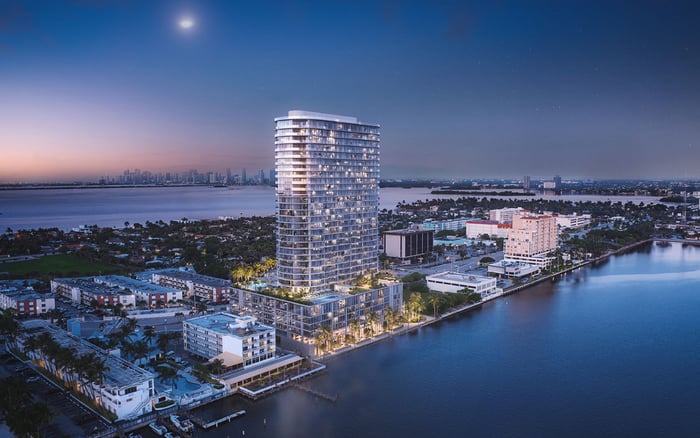
For Austin buyers entering North Bay Village, the choice between cash and portfolio financing is less about purchasing power than the strategic value of certainty, liquidity, and capital efficiency.

For an Austin buyer considering North Bay Village, the cash-versus-financing decision should begin well before an offer is drafted. At the luxury level, the central question is rarely whether the buyer can pay cash. It is whether certainty at closing justifies concentrating substantial capital in an illiquid asset.
A North Bay Village acquisition is best evaluated through three priorities: control of the transaction, liquidity after closing, and the intended life of the asset. A primary residence, second-home purchase, and longer-term investment may warrant different capital structures, even at the same purchase price.
Cash offers the cleanest execution. It removes mortgage underwriting, can accelerate closing, may reduce transaction costs, and gives the buyer greater control over timing. Portfolio financing introduces more steps, but it can preserve meaningful capital for taxes, carrying costs, improvements, reserves, and investments beyond the property.
A cash offer minimizes contingencies tied to lender approval. That can strengthen the bid and reduce the risk that documentation, appraisal, or underwriting delays disrupt the closing schedule. For an Austin-based buyer coordinating advisers, inspections, and signatures from another state, fewer financing conditions can also streamline execution.
This advantage matters most when certainty and speed take precedence over capital efficiency. A buyer evaluating Continuum Club & Residences North Bay Village, for example, can determine in advance whether the desired negotiating posture calls for readily verifiable funds and a closing schedule independent of a lender.
The tradeoff emerges after closing. Cash moves a substantial allocation from a liquid portfolio into a single property. Buyers should therefore model not only the acquisition price, but also the liquidity they want available for near-term obligations, unforeseen costs, and opportunities elsewhere.
A portfolio mortgage is originated and retained by the lender rather than sold into the secondary mortgage market. Because the lender keeps the loan, it can set underwriting standards outside conventional conforming rules. This flexibility may benefit buyers with nontraditional income, elevated debt-to-income ratios, complex financial statements, or a property that falls outside conventional guidelines.
Flexibility should not be mistaken for informality. Portfolio products are not standardized. Rates, documentation, eligibility, down payment, reserve requirements, appraisal standards, and collateral expectations may differ materially by lender and borrower profile. A meaningful down payment and substantial post-closing reserves may still be required.
Property-specific preparation is essential. Before pursuing Shoma Bay North Bay Village, an Austin buyer should request terms for the residence under consideration rather than rely on a broad prequalification. The financing calendar should account for underwriting, appraisal, approval conditions, and closing documentation.
The phrase portfolio financing can describe two distinct structures. The first is the lender-held mortgage discussed above. The second is borrowing against an investment portfolio, often through securities-backed lending or a portfolio line of credit.
Securities-backed borrowing may give a buyer access to purchase capital without first liquidating holdings, preserving market exposure. Yet it introduces collateral risk distinct from mortgage risk. The comparison should weigh borrowing costs against expected portfolio returns, liquidity needs, and the value of remaining invested. Terms and risks should be reviewed with the buyer's lending, tax, and investment advisers.
For a waterfront residence, the analysis should also preserve capital for ownership beyond closing. A buyer considering Tula Residences North Bay Village may prefer a structure that retains room for carrying costs and reserves, provided the additional lender oversight does not compromise the transaction.
Cash is generally stronger when maximum certainty, minimal friction, and control over timing are the priorities. Portfolio financing becomes more compelling when preserving investable capital outweighs the burden of lender conditions. Neither conclusion should rest on purchase price alone.
The intended holding period and exit plan matter. A buyer planning a long hold may value liquidity and capital diversification differently from someone anticipating a shorter ownership window. The same analysis applies to renovation plans, future refinancing, and the amount of cash the buyer expects to retain after closing.
Before making an offer, establish two executable paths. The cash path should include current proof of funds and a defined post-closing reserve target. The financing path should include property-specific terms, documentation readiness, appraisal timing, reserve requirements, and a realistic approval schedule. Comparing the two side by side reveals whether financing creates genuine flexibility or merely adds complexity.
Does cash always produce the strongest offer? Cash generally improves certainty and reduces closing friction, but price, terms, and the seller's priorities still shape an offer's appeal.
What is a portfolio mortgage? It is a mortgage originated and retained by the lender, allowing underwriting outside conventional conforming-loan rules.
Is portfolio underwriting easier than conventional underwriting? It may be more flexible, but it still requires documentation, appraisal, approval, and satisfaction of lender conditions.
Can portfolio financing accommodate nontraditional income? It may accommodate nontraditional income or complex borrower profiles, subject to the individual lender's standards.
Will a portfolio lender require a large down payment? A meaningful down payment is common, while the precise requirement depends on the lender, borrower, and property.
Why might a cash-capable buyer still finance? Financing can preserve liquidity for reserves, carrying costs, improvements, taxes, and investments outside the residence.
Is securities-backed borrowing the same as a portfolio mortgage? No. One is secured as a mortgage, while the other draws against investment assets and carries distinct collateral risks.
What should an Austin buyer arrange before offering? Prepare current proof of funds or property-specific financing terms, along with a realistic remote closing schedule.
How does the holding period affect the decision? The expected hold and exit plan influence how much liquidity, leverage, and capital diversification may be appropriate.
What is the simplest decision rule? Choose cash for maximum certainty and financing when preserving capital clearly outweighs added lender oversight.
When you're ready to tour or underwrite the options, connect with MILLION.
If branded residences are on your mind — as a home or as an allocation — we would be glad to share what we are seeing, privately.
Begin a quiet conversation