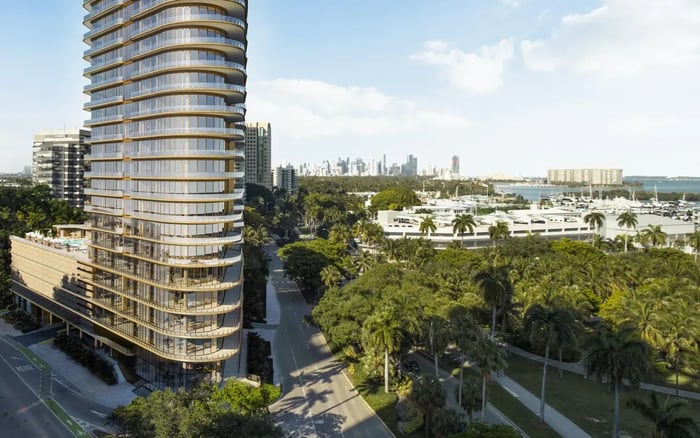
A lower condominium fee can support a higher purchase price, but only when the savings survive a close review of operating costs, reserves, structural obligations and assessment exposure. This Miami buyer’s framework separates illustrative financial value from a premium the resale market will actually support.

A condominium with a lower monthly association fee can justify a higher purchase price-but only if the savings are durable, the residences genuinely comparable, and the association’s financial obligations understood. A modest monthly bill is not, by itself, evidence of efficient management. It may also reflect expenses excluded from the budget or repairs deferred into the future.
For a Miami buyer, the distinction is between paying for lower operating costs and taking on an obligation that has not yet come due. The question is not simply how much less the building charges today, but how much less ownership should cost after accounting for services, insurance, reserves and foreseeable capital work.
Start by comparing both residences on an annual basis. Include association dues, owner-paid insurance, excluded utilities, recurring parking or amenity charges, and expected assessments. Separate recurring expenses from one-time obligations to avoid counting any expense twice.
Then compare the residences themselves. Unit size, service levels, building condition and insurance obligations all determine whether a fee difference represents an economic advantage. A lower bill for fewer services is not necessarily a discount on the same ownership experience.
For a buyer considering Una Residences Brickell alongside other Brickell options, the useful exercise is a residence-by-residence comparison of inclusions and obligations-not an assumption that the smallest monthly figure wins. No fee advantage should be assigned to a particular project without reviewing its documents.
This comparison yields the number worth valuing: the annual savings that remain after accounting for comparable ownership costs.
One illustrative approach divides durable annual savings by the buyer’s required yield:
Illustrative premium = durable annual savings ÷ required yield
Suppose two otherwise comparable residences have monthly fees of $2,500 and $1,800. The apparent difference is $700 a month, or $8,400 annually. If that entire difference survives the ownership-cost review, the calculation produces these hypothetical values:
At a 5% required yield: $168,000.
At a 6% required yield: $140,000.
At a 7% required yield: $120,000.
These are scenarios, not observed Miami transaction premiums or established market capitalization rates. The chosen yield expresses the buyer’s required return on the additional capital committed. A higher required yield produces a smaller justified premium.
The formula also assumes the savings persist. If evidence suggests the gap will narrow, capitalizing today’s full difference overstates the advantage. For a defined holding period, analyzing savings during ownership and the eventual resale outcome separately is more useful than assuming an indefinite benefit.
Miami-Dade condominium association fees rose substantially between 2022 and 2025, with particularly sharp increases in buildings of three stories or more. Association insurance costs also increased: average premiums rose from approximately $175,000 in early 2021 to $462,000 by late 2024. Those figures describe association-level premiums, not individual owners’ bills.
That context makes the explanation behind a low fee essential. Ask whether the current budget incorporates insurance costs and reserve contributions, and whether apparent savings depend on postponing expenditure. A fee is a funding decision, not a complete account of a building’s financial condition.
The same discipline applies when evaluating a residence at The Perigon Miami Beach or another Miami Beach address. The project name does not answer the financial question. What matters is what the applicable budget includes, what remains outside it and how future obligations will be funded.
Florida generally requires milestone structural inspections for condominium and cooperative buildings of three stories or more, subject to applicable age thresholds and exceptions. These inspections evaluate structural components, including load-bearing elements. They are not simply routine property-condition checks.
Qualifying buildings must also undergo a Structural Integrity Reserve Study, or SIRS, at least every 10 years. The study identifies major common elements requiring reserve funding and helps establish future structural repair needs. Buyers should verify the requirements for the particular building rather than rely on blanket assumptions about age or coastal proximity.
Read the budget and reserve schedule alongside the SIRS, milestone inspection findings, engineering documents, insurance declarations, board minutes and assessment notices. Look for consistency between identified work, available funds and planned contributions. The objective is to understand whether today’s dues reflect tomorrow’s obligations-not merely whether the documents exist.
A special assessment is an additional owner charge beyond regular association fees, typically imposed when existing funds cannot cover an expense. Structural repairs, insurance shortfalls, storm damage and reserve deficiencies can all create exposure despite a low advertised fee. Phase-two milestone findings may identify required repairs that lead to substantial assessments.
Consider the earlier $140,000 theoretical premium. If the buyer assigns $60,000 of per-unit assessment exposure to the lower-fee option, a simplified subtraction leaves $80,000 before further uncertainty, taxes, financing costs or resale effects. This is an illustration, not a prediction for any building.
Do not deduct that $60,000 again if it is already included in the cost comparison. Examine the estoppel certificate for assessment charges and unpaid balances, while separately investigating potential future assessments. A closing balance and a forward-looking repair obligation answer different questions.
Resale evidence must remain independent of the savings calculation. Compare recent sales of genuinely comparable residences and check lender acceptance before treating a theoretical premium as supportable pricing. The calculation does not establish that another buyer will pay the same amount later.
For a search that includes Park Grove Coconut Grove and other Coconut Grove residences, distinguish the value of the home itself from the value attributed to its recurring costs. Otherwise, differences in the residence or services may be mistaken for a fee-driven premium.
The decision rule is straightforward: normalize costs, establish the durability of savings, account for unfunded obligations, then test the resulting price against the market. A low fee deserves a premium only to the extent that it represents a genuine ownership advantage rather than an expense waiting to surface.
For a considered approach to your next South Florida residence, explore MILLION.
If branded residences are on your mind — as a home or as an allocation — we would be glad to share what we are seeing, privately.
Begin a quiet conversationYes, if the savings are durable and remain after comparing equivalent services, insurance obligations, reserves and assessment exposure. The resulting premium still needs an independent market check.
Divide durable annual savings by the buyer’s required yield. This is a financial scenario, not proof of the premium buyers actually pay.
It equals $8,400 a year before adjusting for differences in other ownership costs. At a hypothetical 6% required yield, that amount produces a theoretical $140,000 premium.
No. They are illustrative required yields used to show how the calculation changes, not established market rates.
Compare owner-paid insurance, excluded utilities, recurring parking or amenity charges, and expected assessments. Match unit size, services and building condition as well.
A SIRS identifies major common elements requiring reserve funding and helps establish future structural repair funding needs. Qualifying associations must complete one at least every 10 years.
They evaluate structural components, including load-bearing elements. Florida generally requires them for condominium and cooperative buildings of three stories or more, subject to applicable age thresholds and exceptions.
Yes. Structural repairs, insurance shortfalls, storm damage or inadequate reserves can create additional charges beyond regular association fees.
No. Buyers should examine it for assessment charges and unpaid balances, then separately investigate potential future assessments through association and engineering documents.
Account for it separately or incorporate it into the ownership-cost comparison, but do not count the same obligation twice. In a simplified example, $60,000 of exposure reduces a $140,000 theoretical premium to $80,000 before other adjustments.