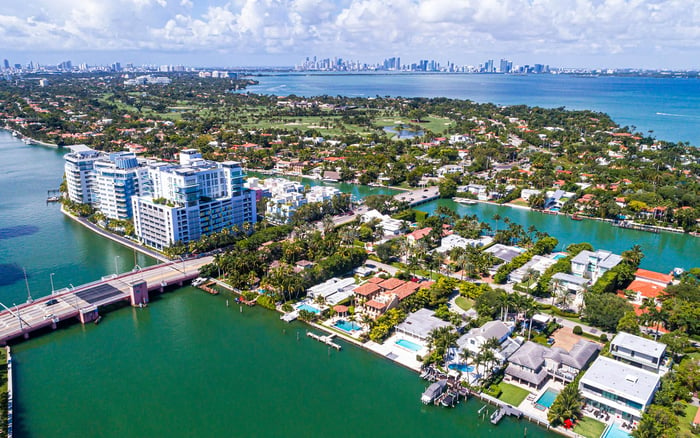
For California buyers, Miami, Boca Raton, and Palm Beach share Florida’s income-tax framework but offer distinct ways of living. Compare their residential character and ownership considerations before choosing an address.

For a California buyer considering South Florida, the first distinction is not tax treatment. Miami, Boca Raton, and Palm Beach share Florida’s absence of individual state income tax. What changes is the residential experience: the intensity of the surroundings, the relationship to the water, and the choice between condominium living and an estate.
Miami is the urban, internationally connected option. Boca Raton offers a quieter coastal setting with waterfront houses and luxury condominiums. Palm Beach places greater emphasis on estates, historic architecture, and exclusivity. These are starting points, not rankings. The right choice depends on how a buyer wants an ordinary week to feel-not which destination makes the strongest first impression.
Miami makes the clearest case for buyers who want business, hospitality, nightlife, and an international atmosphere to remain part of daily life. Its luxury housing choices are correspondingly broad, from Brickell condominiums to Miami Beach oceanfront buildings and waterfront estates in Coconut Grove, Coral Gables, and Miami Beach.
Geography requires precision. In a relocation conversation, “Miami” often encompasses several distinct municipalities and neighborhoods. A Brickell condominium and a Miami Beach house are not interchangeable expressions of the same market. Choose the setting first, then compare properties within it.
For buyers exploring Brickell, The Residences at 1428 Brickell can be a starting point for a property-specific inquiry. On the beach side, The Perigon Miami Beach warrants a separate search. Neither should be evaluated through neighborhood pricing alone; the residence itself and its ownership obligations matter more.
Build a budget around the actual property category and available residences rather than treating a broad luxury-market range as a price assurance for a particular home.
Boca Raton is the alternative for buyers who want a coastal address without metropolitan intensity defining daily life. Its luxury choices include Intracoastal estates, oceanfront homes, and newer condominiums. That variety makes the house-versus-condominium decision particularly important.
A buyer leaving a California house may assume another house is the natural replacement. That assumption deserves testing. Weigh the desired privacy, outdoor space, and maintenance responsibilities against the appeal of condominium ownership. Neither format is inherently simpler or better; the answer depends on the property and the owner’s expectations.
Alina Residences Boca Raton provides a starting point for the condominium side of that search. Evaluate it against specific alternatives rather than assuming every Boca residence delivers the same experience.
Choosing Boca is not simply choosing a lower price. It is choosing a different residential setting, then finding the home that best suits it. Compare specific condominiums and houses before deciding which ownership format fits the budget.
Palm Beach speaks most directly to buyers drawn to oceanfront estates, historic architecture, Worth Avenue, and a private-club-oriented social setting. Its appeal is less about a broad high-rise market and more about the relationship between a distinctive property and limited inventory.
That calls for a patient, property-led search. Architecture, location, and the character of the surroundings deserve more attention than a generalized comparison with Miami or Boca Raton. Private clubs may be part of the destination’s identity, but buyers should investigate access independently rather than treating it as a benefit conveyed with a home.
Buyers considering Palm Beach Residences should apply the same address-specific discipline. Palm Beach, West Palm Beach, and Palm Beach County are not interchangeable geographies, regardless of how broadly a search is framed.
Build price expectations around the actual property category and available choices, not a generalized entry price for Palm Beach luxury real estate.
Florida has no individual state income tax. That distinction can be consequential, but it does not favor one of these three Florida destinations over another. Nor does it establish an individual buyer’s tax savings. Have qualified advisers evaluate the circumstances of a move before assigning a financial benefit to it.
Property-tax assessment rules also deserve separate review. Assessment-growth limits are not property-tax rates, and eligibility for homestead treatment should not be assumed for every purchase. Ask advisers to evaluate the prospective purchase rather than relying on the seller’s tax bill as a future budget.
Separate the location preference from the ownership calculation. First establish which setting fits. Then assess the individual home’s projected expenses and the tax treatment applicable to the buyer. An attractive statewide tax framework cannot resolve a mismatch between the home and the life intended for it.
Waterfront appeal demands property-specific scrutiny. Insurance, flood exposure, association reserves, potential assessments, and total carrying costs each need review. None can be established reliably from a city’s reputation or an asking price.
Broad homeowners-insurance estimates are not a suitable budget for an ultra-premium residence. Location, property characteristics, and coverage affect the outcome. Obtain quotes for the actual property and review coverage terms before relying on an ownership-cost projection.
For condominiums, request the documents needed to understand recurring charges, reserves, and potential assessments. For houses, develop an equally explicit view of insurance and maintenance responsibilities. The objective is not to identify a universally cheapest destination, but to understand what a particular choice requires.
Choose Miami if urban energy and residential variety lead the brief. Put Boca Raton first if a quieter coastal rhythm is the priority. Focus on Palm Beach if estate character, historic surroundings, and exclusivity matter most. Then compare like with like: similar property types, clearly defined geographies, and individually assessed ownership costs.
Refine your South Florida shortlist with MILLION.
If branded residences are on your mind — as a home or as an allocation — we would be glad to share what we are seeing, privately.
Begin a quiet conversationMiami is the strongest starting point for buyers prioritizing business, nightlife, hospitality, and an internationally connected setting. Its residential choices range from condominiums to waterfront estates.
Boca Raton offers a quieter coastal alternative, with Intracoastal estates, oceanfront homes, and newer luxury condominiums. The distinction is primarily about lifestyle rather than an automatic price advantage.
Palm Beach emphasizes estates, historic architecture, Worth Avenue, and limited inventory rather than a broad high-rise market. Its private-club character does not imply that buying property includes club access.
Florida has no individual state income tax, whether the home is in Miami, Boca Raton, or Palm Beach. A buyer’s actual tax outcome still requires individualized advice.
No, assessment-growth limits and property-tax rates are different. Buyers should review eligibility for homestead treatment and the prospective purchase’s tax implications with qualified advisers.
Compare specific residences and their ownership obligations rather than relying on broad market ranges. Include recurring association charges, reserves, and potential assessments in the review.
Consider privacy, outdoor space, maintenance responsibilities, and the preferred daily routine. Neither ownership format is inherently simpler or better for every buyer.
A broad price assumption is not a dependable guide to every Palm Beach property category. Build expectations around specific homes, their locations, and available alternatives.
No, broad estimates are not property-specific quotes and should not be used to budget an ultra-premium residence. Obtain quotes and review coverage terms for the actual property.
Review property-specific insurance, flood exposure, maintenance responsibilities, and total carrying costs. For condominiums, also examine association charges, reserves, and potential assessments.