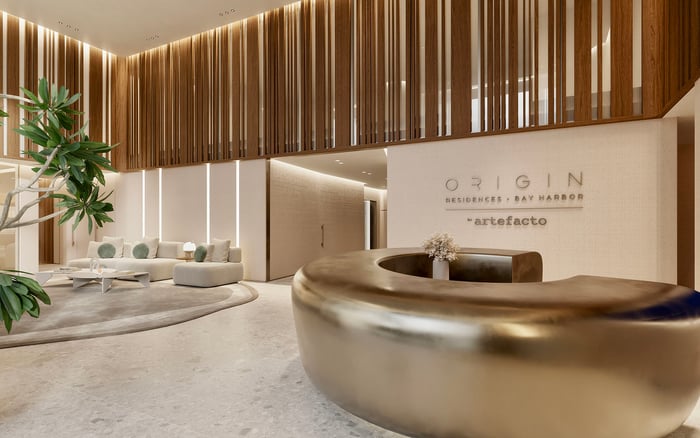
At Onda Bay Harbor, selected residences advertise private elevator access and separate service entrances. For buyers considering a trust or LLC, the essential work is connecting ownership authority, the exact floor plan, and management-approved household access without assuming that one establishes the others.

For a household that values discretion, a private arrival is only part of the equation. The more revealing question is how the residence functions when a housekeeper arrives, a delivery needs attention, or a technician requires entry while the owner is away. At Onda Bay Harbor, these practical details deserve the same scrutiny as the interiors.
Onda is an eight-story, 41-residence condominium at 1135 103rd Street, Bay Harbor Islands, Florida 33154. Selected residences advertise private elevator access and service entrances-an appealing starting point for buyers seeking separation between personal arrival and household activity.
Three questions remain distinct: who holds title, how people physically reach the residence, and who may authorize entry. A trust or LLC is not a substitute for an access policy, and a separate door should not be mistaken for a dedicated service corridor.
Buyers considering a trust, trustee-held title, or an LLC should have counsel review the proposed structure against the condominium's governing documents and purchase requirements. Onda-specific approval requirements for these arrangements remain unconfirmed. Neither approval nor anonymity should be assumed.
Ask management and counsel what documentation is required to identify the purchaser, establish signing authority, and designate permitted occupants. Separately, determine who may issue instructions to reception, authorize visitors, and change household access permissions. These are questions to resolve, not established Onda procedures.
For a household with several decision-makers, request a clear authorization hierarchy. Would instructions come from the trustee, an LLC representative, a resident, or an approved household manager? How would conflicting instructions be resolved? The objective is to prevent ambiguity when an owner is unavailable.
Have counsel address any proposed later change in ownership or authorized representatives as well. A plan that depends on future transfers or substitutions warrants review before purchase, rather than being left as an operational assumption.
Units 304 and 602 have been advertised with private elevator access and a service entrance. Unit 402 has been marketed with direct private-elevator entry into the residence and a separate service entrance. These descriptions are unit-specific; they do not establish that every Onda floor plan has identical circulation.
For the residence under consideration, request the floor plan and walk both arrival routes with an authorized building representative. Establish where the service entrance leads: a dedicated corridor, a service elevator connection, or circulation shared with other users. Dedicated service corridors and service elevators remain unverified.
Inside the residence, consider whether the service door reaches the rooms your household needs without interrupting private living areas. Outside, ask where staff wait, how elevator access is granted, and whether the route changes during deliveries or maintenance. Confirm each answer against current rules.
The meaningful distinction is between a second entrance and a complete, permitted service route. Only the latter can demonstrate how the household would function in practice.
An advertised service entrance does not establish a mandatory staff-entry route. Before relying on it, ask management whether household employees must use that entrance, may use it, or follow different procedures depending on the visit.
Describe the intended routine precisely. A regularly scheduled housekeeper, a visiting chef, and an occasional repair technician may raise different operational questions. Do not assume the building assigns them the same access category or permits the same credentials.
Request confirmation of any registration, identification, screening, credential, escort, or advance-notice requirements. Ask how authorization is withdrawn when employment ends, whether temporary permissions are available, and who can approve substitutions. Credential controls and access logs are not established features here.
Parking deserves a separate inquiry. Advertised valet service does not resolve staff parking eligibility, vehicle waiting arrangements, or vendor loading. Likewise, ask about permitted entry hours and emergency exceptions rather than inferring unrestricted access from the building's service offering.
Onda's advertised services include 24-hour valet, lobby reception with an administrator stationed at a counter, and integrated digital-concierge functions. These offerings provide context for daily life, but they do not establish a complete vendor-access protocol.
Building-assisted delivery handling is also described. The precise handoff remains unresolved: parcels might be held for collection, brought to a residence, or handled through another route. Confirm the arrangement rather than treating any of these possibilities as a promised service.
Ask management to distinguish ordinary parcels from groceries, furnishings, and deliveries requiring installation. For each, establish where the handoff occurs, whether the owner must be present, and what advance coordination is required. Do not assume reception accepts responsibility for bringing goods inside the home.
For digital-concierge functions, request a demonstration of the capabilities relevant to your household. Verify whether visitor authorization is supported at all before relying on an application to manage access remotely.
A useful pre-purchase exercise is to walk through a day when nobody from the household is in residence. A scheduled employee arrives, a delivery follows, and an unexpected repair becomes necessary. Ask management to explain the permitted response at each stage.
Clarify whether anyone may hold keys or credentials, who can authorize entry in the owner's absence, and how instructions are documented. Ask whether after-hours requests follow a different procedure. None of these arrangements should be assumed from a private elevator or a service entrance.
The household's own instructions should then align with the confirmed building rules. Consider maintaining an authorized contact list, defining the household manager's scope, and setting a process for withdrawing permissions. These are planning recommendations, not descriptions of Onda's existing systems.
If Bay Harbor Towers is also on your shortlist, carry the same ownership and access questions into that review. Compare documented answers rather than assuming that comparable locations imply similar operating rules.
The same discipline applies when considering Alana Bay Harbor Islands. A useful comparison separates the physical route, the permission to use it, and the person empowered to grant access. Including either project in a search implies no equivalent service layout or ownership policy.
Before committing at Onda, seek alignment among three items: counsel's review of the proposed ownership structure, the exact residence's verified circulation, and written management guidance for the intended household routine. Where an operational detail is essential to the purchase, ask counsel how it should be addressed before proceeding. Discretion is most dependable when expectations are explicit.
For a discreet conversation about finding a residence that fits your household, connect with MILLION.
If branded residences are on your mind — as a home or as an allocation — we would be glad to share what we are seeing, privately.
Begin a quiet conversationOnda is at 1135 103rd Street, Bay Harbor Islands, Florida 33154.
Onda is an eight-story boutique condominium with 41 residences.
Onda-specific approval requirements for these structures remain unconfirmed. Have counsel and management establish the applicable requirements before proceeding.
No guarantee of anonymity is established. Counsel should review the proposed structure and any required disclosures rather than treating privacy as assured.
Units 304, 402, and 602 have been advertised with private elevator access and service entrances. Those descriptions do not establish identical features across all residences.
No. Verify whether the exact residence's entrance connects to a dedicated corridor, a service elevator, or shared circulation.
A mandatory staff-entry route is not established. Ask management to confirm the permitted route and any applicable staff-access rules.
Advertised offerings include 24-hour valet, lobby reception with an administrator, and integrated digital-concierge functions. These do not establish unrestricted vendor access.
Building-assisted delivery handling is described, but the precise handoff and route are not established. Confirm whether deliveries are held for collection or handled another way.
Confirm who may authorize entry, whether key or credential arrangements are permitted, and how after-hours requests are handled. These procedures should not be inferred from the residence's layout.