A collector-first guide to evaluating Miami Beach branded residences through the practical lenses of privacy, controllable daylight, physical security, environmental stability, and discreet art handling.

For an art collector, the most persuasive residence in Miami Beach is not necessarily the one with the broadest walls of glass or the most theatrical lobby. It is the home that supports private daily life while providing important works with a stable, secure and visually disciplined setting.
That reframes the buying brief. Privacy must be assessed from curb to residence; daylight must be controllable, not merely abundant; and security must extend beyond the front door. The best branded residences should be evaluated as complete operating environments for living with art, receiving specialists and moving valuable objects without spectacle.
Brand identity can establish an aesthetic tone, but collectors should separate presentation from performance. Design and architecture matter most when circulation, wall dimensions, glazing, lighting, mechanical systems and service access work in concert.
A focused viewing schedule can begin with Setai Residences Miami Beach and Shore Club Private Collections Miami Beach. Tour each with the same collector-specific checklist so the residences, arrival sequences and service paths can be compared on equal terms rather than by atmosphere alone.
The schedule can then extend to The Ritz-Carlton Residences® Miami Beach and The Perigon Miami Beach. A recognized name should not be assumed to resolve every concern. The objective is to determine which individual residence can be adapted to the collection without compromising either the artwork or the owner’s way of life.
In every building, buyers should evaluate the specific home under consideration. Orientation, floor plan, interior construction and access conditions can matter more than the project-level impression.
Collectors should trace every likely journey through a property: resident arrival, guest arrival, staff entry, art delivery and emergency removal. The strongest plan minimizes unnecessary crossings and limits the number of people who can observe a work entering or leaving.
Ask how visitors are announced, how vendors are authenticated and where an art handler waits before entering the residence. Review elevator transitions, loading access, parking circulation and camera coverage with qualified advisers. Before a purchase decision, measure a discreet installation route for width, height, turning radius and weight constraints.
Privacy within the home deserves equal scrutiny. A penthouse may provide separation, but its suitability still depends on sightlines, elevator exposure and the relationship between entertaining and private rooms. A terrace can enhance daily life while creating direct views into display areas, making nighttime visibility as important to test as daytime exposure.
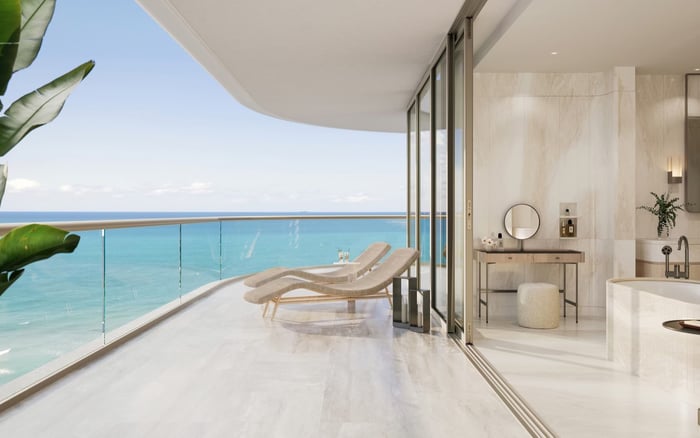
Miami Beach light can be a design asset, but control is the collector’s priority. During each tour, observe direct sun, reflected light and glare at different times where possible. Oceanfront exposure may create a compelling atmosphere, but the display plan must respond to the actual glazing and orientation of the selected residence.
Request a room-by-room lighting concept before committing major works to the walls. It should distinguish among ambient, accent and conservation-sensitive requirements while accounting for heat, ultraviolet exposure and reflections. Evaluate window treatments, shades and blackout strategies for coverage, edge leakage, automation and manual override.
Wall placement matters just as much. Confirm that proposed display surfaces can accommodate the necessary anchors and loads. Freestanding sculpture requires sufficient circulation, stable support and protection from doors, moving furniture and crowded entertaining routes.
A serious security review extends beyond visible personnel. It considers access credentials, visitor protocols, elevator control, alarms, camera placement, communications resilience and the separation of residential and service movement. Buyers should commission an independent assessment rather than infer capability from branding or finishes.
Within the residence, the security plan should balance detection with discretion. Consider zoned alarms, object-level protection where appropriate, secure storage for works not on display and controlled access to records. Digital files containing valuations, condition reports and installation plans should receive the same protection as physical keys.
Insurance and emergency planning belong in the conversation early. Confirm the documentation an insurer requires, who is authorized to respond and how works would be stabilized or removed after a building incident. The final plan should coordinate the owner, household staff, conservator, installer, security consultant and insurer without distributing unnecessary information.
Before contract, revisit the residence with advisers who understand the collection. Prepare a scaled art plan, test critical sightlines and document possible delivery routes. Through the appropriate legal and technical professionals, review alteration rules, contractor access, work hours and approval procedures.
The result should be a residence-specific risk register covering light, climate, mounting, movement, storage, privacy and emergency response. A beautiful home becomes collector-ready only when these systems are coordinated, documented and practical to maintain.
What should an art collector inspect first in a Miami Beach residence? Begin with glazing, wall capacity, circulation and the complete art-delivery route.
Is abundant natural light always desirable for displaying art? No. Controllable daylight is generally more useful than uninterrupted exposure.
Should a buyer rely on the residence brand for security? No. Commission an independent, residence-specific security assessment.
Why does the loading route matter? It affects privacy and determines whether large works can be moved safely into the home.
When should an art conservator join the purchase process? Ideally before contract, while layout and environmental concerns can still inform the decision.
What should be measured during a second viewing? Measure walls, doors, elevators, turns, ceiling heights and proposed sculpture zones.
Can window treatments solve every light-control issue? Not automatically. Coverage, automation, edge leakage and glazing conditions all matter.
How should collection records be handled? Limit access and securely protect digital inventories, valuations and condition reports.
Does a higher floor guarantee greater privacy? No. Arrival paths, sightlines, neighboring views and service access remain relevant.
What is the most useful final buying test? Confirm that the specific residence supports the collection without disrupting daily life.
For a confidential assessment and a building-by-building shortlist, connect with MILLION.
If branded residences are on your mind — as a home or as an allocation — we would be glad to share what we are seeing, privately.
Begin a quiet conversation